

Standing above the bustling Piazza del Popolo and framed by the quiet elegance of Villa Borghese Gardens, Pincian Hill (Colle Pinciano) is one of those places that makes time stand still. While the ancient hills of Rome are tied to emperors and battles, the Pincio belongs to beauty, peace, and light. It is not a hill of conquest, but of contemplation — a place where you can breathe, watch, and let Rome unfold beneath you.
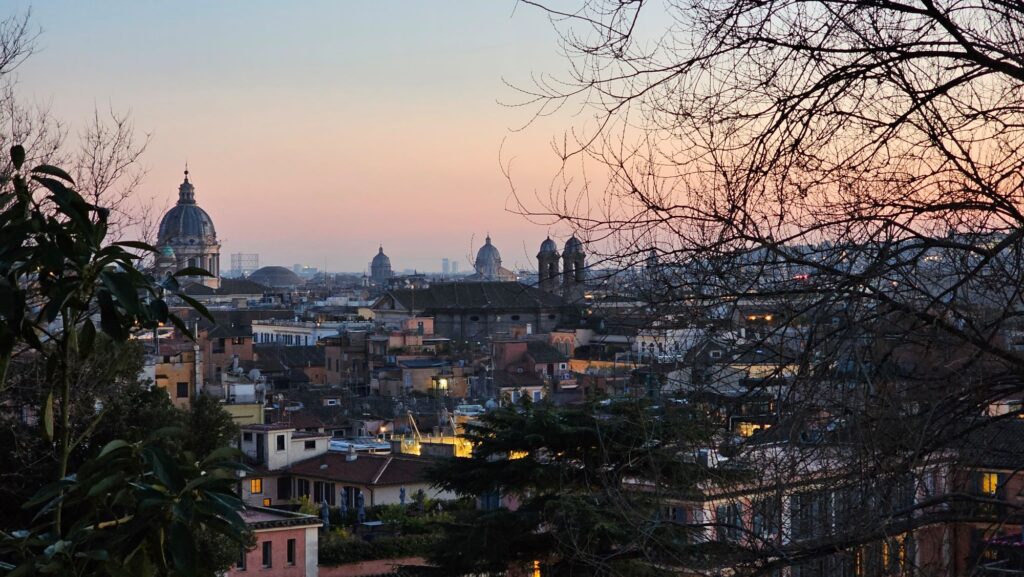
I visited the Pincio at sunset, the moment when the Eternal City glows with its most tender light. What I experienced that evening was more than just a panoramic view — it was a moment of stillness and wonder that captured the very soul of Rome.

A Hill with Ancient Roots and Romantic Spirit
In ancient times, the area we now call Pincian Hill was known as the Collis Hortorum, or “Hill of Gardens.” It was the retreat of Rome’s elite families — the Luculli, Domitii, and Sallustii — who built lavish villas surrounded by fountains, cypress trees, and sculptures. The name “Pincio” later came from the Pincii family, who lived here in the 4th century.
This hill wasn’t part of the original seven hills of Rome, yet it became central to Roman life when Emperor Aurelian enclosed it within the Aurelian Walls in the 3rd century AD. For centuries afterward, it remained a place of quiet refinement, a refuge for nobles who preferred the fresh air and views to the chaos of the city below.
But the modern Pincio — the one we know and love today — was shaped in the early 19th century. Under Napoleonic rule, the architect Giuseppe Valadier redesigned the hill between 1809 and 1814, linking it to Piazza del Popolo with sweeping stairways, terraces, and curving paths. His design was a masterpiece of harmony: nature and architecture blending seamlessly to frame the city’s skyline.
At the top of the hill stands the Terrazza del Pincio, a broad viewpoint lined with elegant balustrades and lampposts. From here, Pope Pius VII ordered the erection of an obelisk in 1822, completing the neoclassical composition that still defines the Pincio today.
A Timeless Promenade in the Heart of Rome
By the 19th century, the Pincio had become one of the most fashionable places for Romans to stroll — the famous passeggiata. Artists, poets, and lovers all came here in the evening to watch the light soften over the rooftops. Writers like Henry James, Goethe, and Stendhal described its view as one of the most poetic in Europe.
Today, that same spirit endures. As you walk beneath the stone pines and chestnut trees, the air smells faintly of sap and flowers. Marble busts of Italian patriots and philosophers line the pathways, each one silently observing the city’s changing story. The voices of people blend softly — tourists whispering, locals laughing, street musicians playing gentle tunes that drift into the golden air.
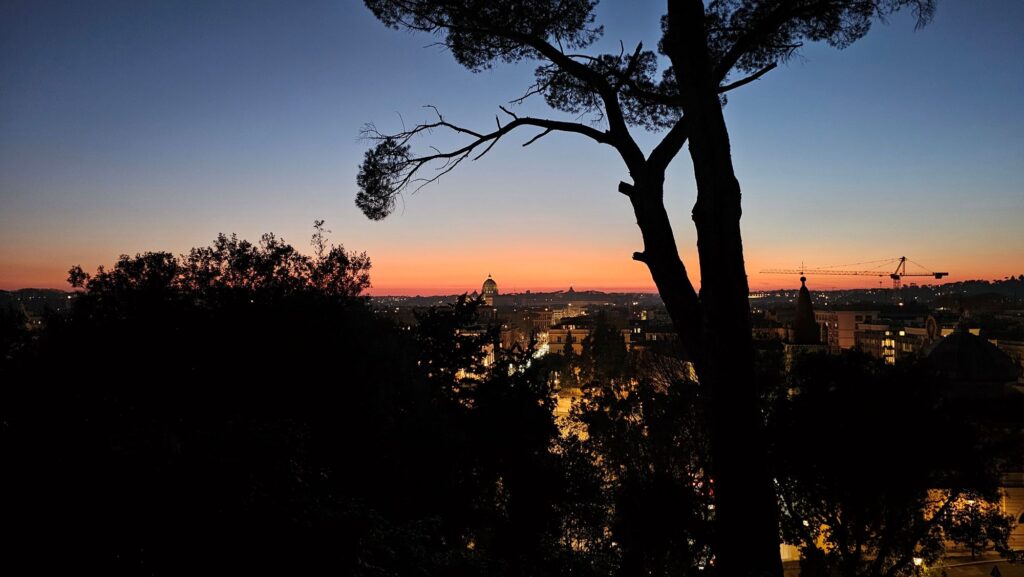
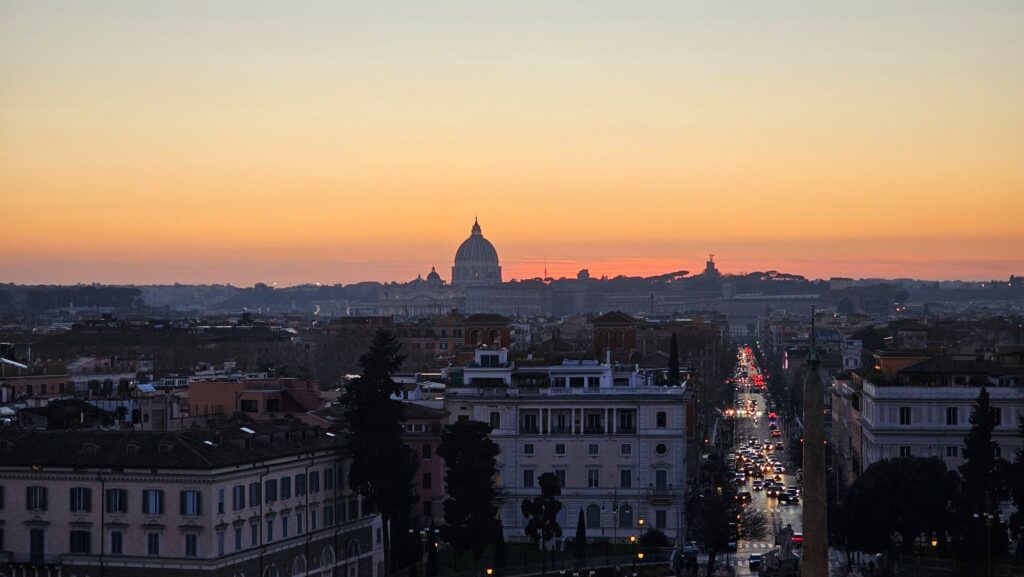
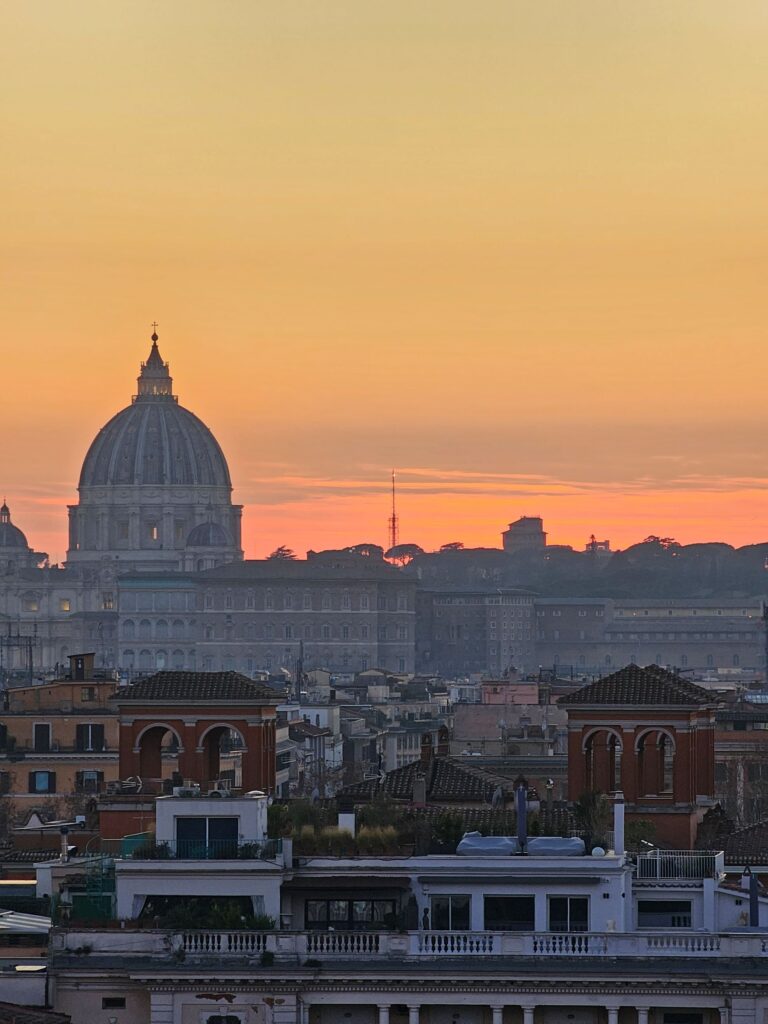
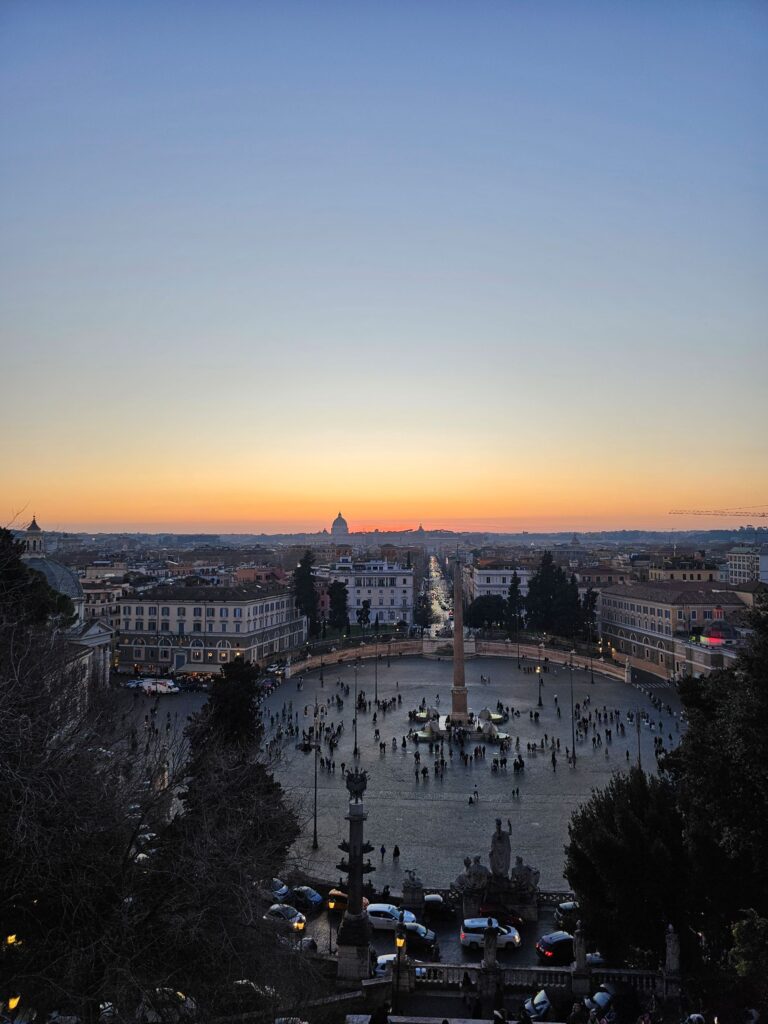
The Terrazza del Pincio opens suddenly, and the view takes your breath away. Below lies Piazza del Popolo, perfectly symmetrical, with its Egyptian obelisk and twin churches glowing in the fading light. Beyond the rooftops, the dome of St. Peter’s Basilica rises proudly on the horizon, catching the last warm rays of the sun.
The Magic of Sunset
Sunset at Pincian Hill is an experience that feels almost cinematic. As I stood at the terrace railing, the sky began to shift — from blue to rose, then to amber and violet. The marble statues glowed softly, their edges gilded by the sun’s last touch. The sound of the city below faded into a gentle hum as the evening breeze swept through the trees.
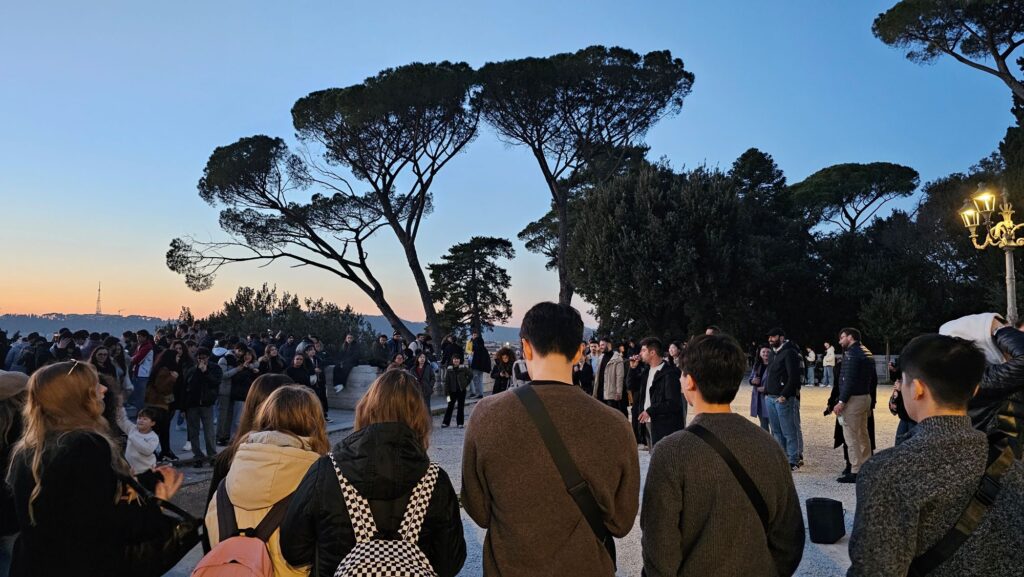
Musicians set up nearby, their violin melodies echoing softly. A group of young travelers opened a bottle of wine. A couple leaned quietly against the balustrade, their hands intertwined. It was a shared silence, the kind that doesn’t need words.
The sun dipped lower, painting Rome in gold. From the terrace, I could see domes and towers catching the light like embers. St. Peter’s shone brightest, its dome reflecting the sunset like a mirror. The city looked eternal — not frozen in time, but alive in every hue.
When the first streetlights flickered on below in Piazza del Popolo, Rome transformed again. The glowing lamps and shadows on the cobblestones made the city look like a living painting. A violinist played O Sole Mio, and the crowd clapped softly, smiling at one another as if to acknowledge the beauty they had just shared.

From the Pincio to Villa Borghese
Behind the terrace lies Villa Borghese, Rome’s great urban garden — an oasis of art, culture, and greenery. Once the private estate of the Borghese family, it now belongs to the people. From the Pincio, you can stroll directly into the park’s shady avenues, where ancient statues and fountains appear between trees.
Inside Villa Borghese you’ll find treasures like the Galleria Borghese, which houses masterpieces by Bernini, Caravaggio, and Raphael. Nearby, the Temple of Aesculapius reflects perfectly in a tranquil pond, where rowboats drift lazily across the water. If you prefer a more modern pleasure, stop by Casina Valadier, a neoclassical villa-turned-café where you can enjoy coffee or prosecco while watching the sunset fade into the night.
The transition from the Pincio’s terrace to Villa Borghese’s gardens feels natural — as though the city itself is inviting you to slow down, breathe, and wander a little longer.
My Visit and Reflections
As the sun disappeared behind St. Peter’s dome, I stayed for a while, reluctant to leave. The crowd thinned, and the terrace grew quieter. A warm afterglow lingered over the rooftops, and the sky deepened into shades of blue and lavender. I could still hear faint music from the violinist and the distant bells ringing the evening hour.
It was one of those perfect Roman moments — fleeting but eternal. The kind that makes you realize why so many writers, painters, and dreamers have fallen in love with this city. The Pincio isn’t grand or overwhelming; its beauty lies in its balance — between architecture and nature, history and silence, light and shadow.
When I finally turned to leave, the lamps along the path flickered on one by one, guiding me gently toward the entrance of Villa Borghese. I looked back once more, and the terrace glowed softly under the evening sky. Rome shimmered in the distance — endless, timeless, and utterly unforgettable.

Tips for Visiting Pincian Hill
Best Time to Visit: Sunset is the most magical hour, when the city glows and the air cools. Mornings are peaceful too, ideal for quiet walks before the crowds arrive.
How to Get There: From Piazza del Popolo, take the stairs or ramp up the hill. The nearest metro station is Flaminio (Line A). You can also approach from Villa Borghese if you’re exploring the park.
What to Bring: Comfortable shoes, water, and a camera. If you visit at sunset, bring a light jacket — the hill gets breezy after dark.
Ideal For: Photographers, couples, solo travelers, and anyone seeking a serene moment above the city.
Nearby Attractions: Piazza del Popolo, Via del Corso, Villa Borghese, Galleria Borghese, and Temple of Aesculapius.
Practical Information
Name: Pincian Hill (Italian: Colle Pinciano / Terrace: Terrazza del Pincio)
Address: Viale Gabriele D’Annunzio, 00187 Roma RM, Italy
Nearest Metro: Flaminio – Piazza del Popolo (Line A)
Admission: Free
Opening Hours: Open 24 hours (recommended at daylight or sunset)
Facilities: Benches, rest areas, nearby cafés, and vendors at the Villa Borghese entrance
Recommended Duration: 30–60 minutes for the terrace; 2–3 hours including Villa Borghese walk
Trevi Fountain, Rome: A Timeless Masterpiece of Baroque Art
Discover the Charm of Piazza di Spagna, Spanish Steps and Trinità dei Monti in Rome