

At the northern gateway of Rome, where ancient travelers once entered the Eternal City, lies Piazza del Popolo — a magnificent square that captures the essence of Rome’s spirit: majestic yet inviting, historical yet alive. Its name means “Square of the People,” and few places in the city deserve it more. With its sweeping symmetry, towering obelisk, and twin domed churches, Piazza del Popolo feels like a living stage — one that has seen processions, festivals, executions, and quiet sunsets over the centuries.
When I first stepped into the square, I immediately understood why it has enchanted visitors for hundreds of years. It is both monumental and human-scaled — a place where history breathes, pigeons circle the sky, and Romans stop to chat, laugh, and watch the world unfold.
A Grand Entrance to the Eternal City
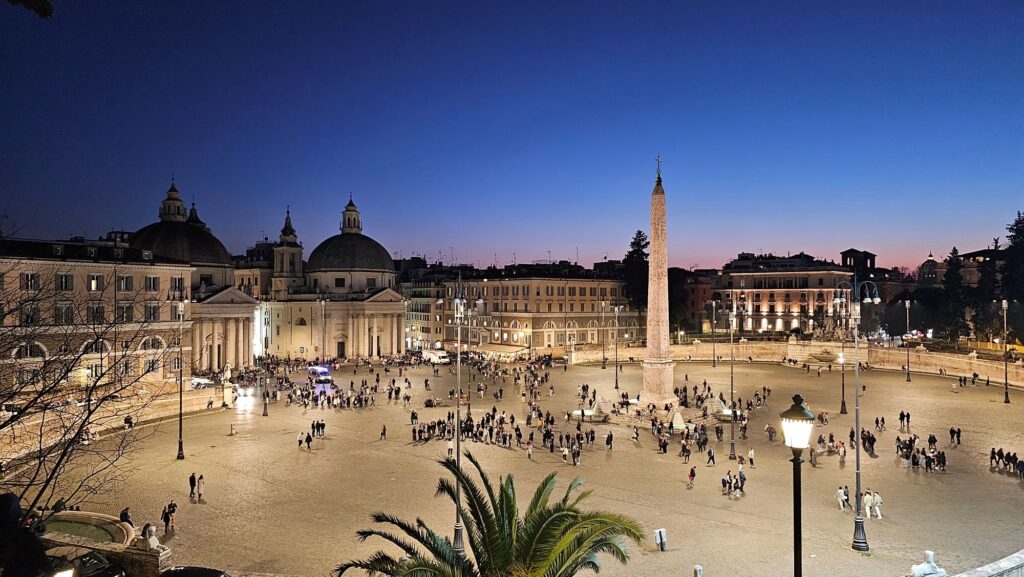
Piazza del Popolo has always been a gateway — literally and symbolically. In antiquity, travelers arriving from the north entered Rome through the Porta Flaminia, today called Porta del Popolo. This ancient gate marked the beginning of the Via Flaminia, one of the major roads that connected Rome to the rest of Italy. In the Middle Ages, pilgrims arriving from distant lands would have crossed this threshold on their way to St. Peter’s Basilica, often making this square their first encounter with the city’s grandeur.
The current design of the square dates to the early 19th century, when the architect Giuseppe Valadier — the same visionary who shaped the Pincian Hill above — redesigned it into the elegant, elliptical piazza we see today. His neoclassical layout balanced monumental geometry with graceful lines, framing the square between three major roads that radiate southward: Via del Corso, Via del Babuino, and Via di Ripetta. Together, these form the so-called “Tridente,” or trident, symbolizing the city’s urban harmony and the convergence of art, faith, and everyday life.
The Egyptian Obelisk: A Bridge Between Eras
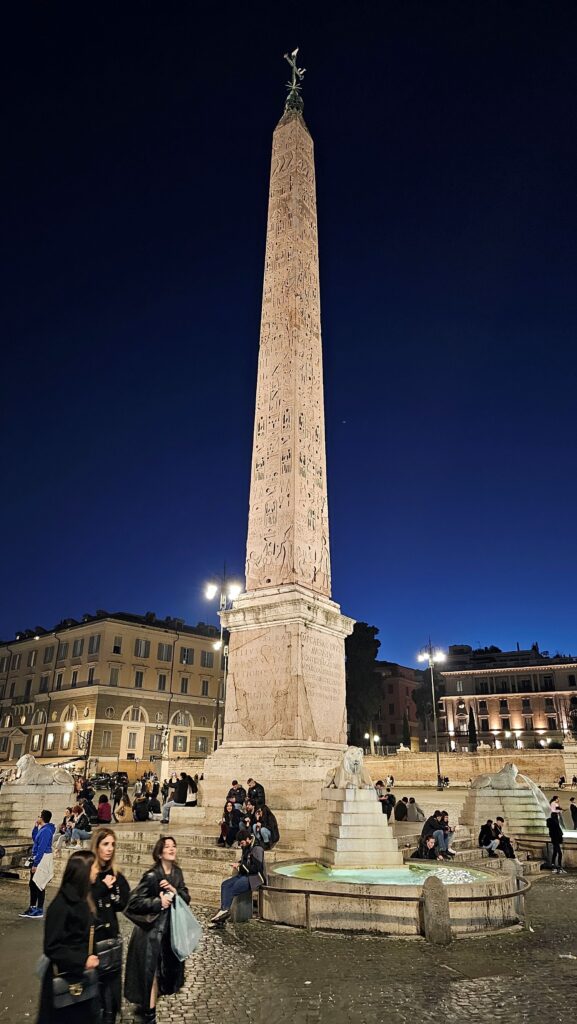
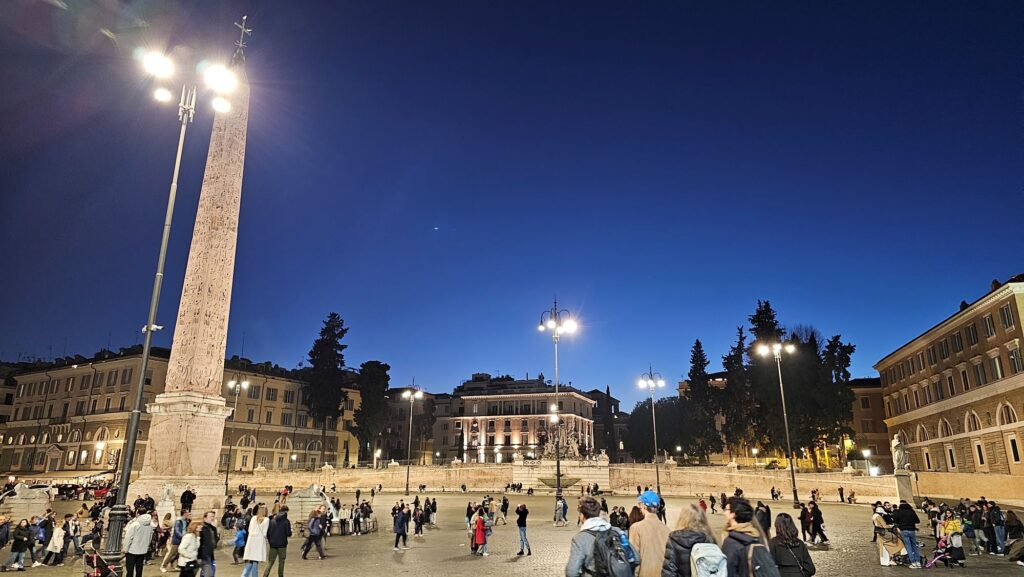
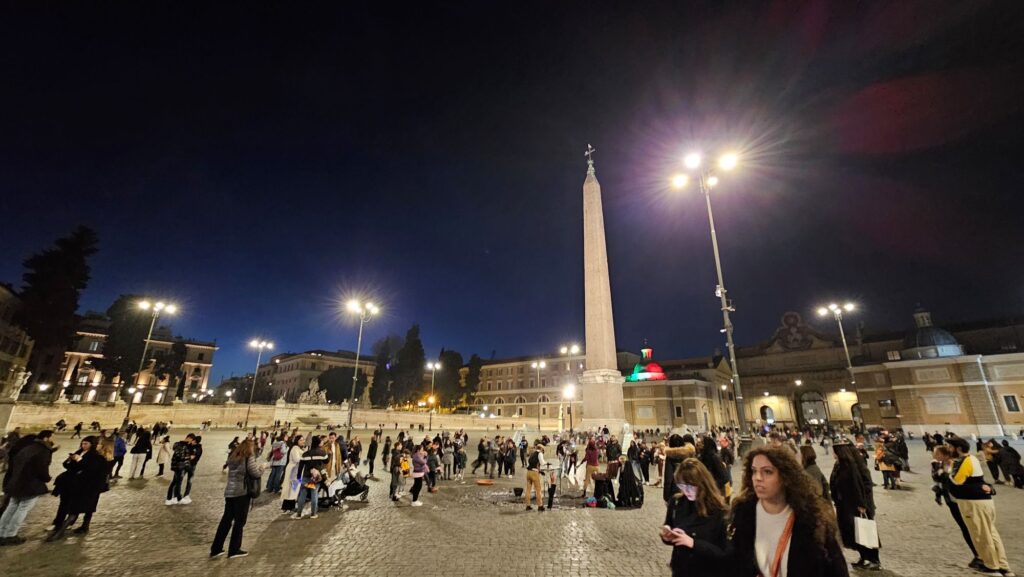
At the heart of Piazza del Popolo stands the Obelisco Flaminio, one of Rome’s oldest and most striking obelisks. Originally erected by Pharaoh Ramses II at Heliopolis around 1300 BC, it was brought to Rome by Emperor Augustus in 10 BC to adorn the Circus Maximus. It wasn’t until 1589, under Pope Sixtus V, that the obelisk was moved to its present location as part of a broader plan to Christianize Rome’s ancient monuments.
The obelisk stands 36 meters high (including its base and cross) and is surrounded by four lion fountains whose cascading water softens the monument’s ancient power with an almost musical rhythm. The contrast between Egyptian stone, Roman ambition, and Valadier’s neoclassical symmetry makes this obelisk more than decoration — it’s a visual metaphor for Rome itself, a city built on layers of civilizations.
The Twin Churches and Urban Harmony
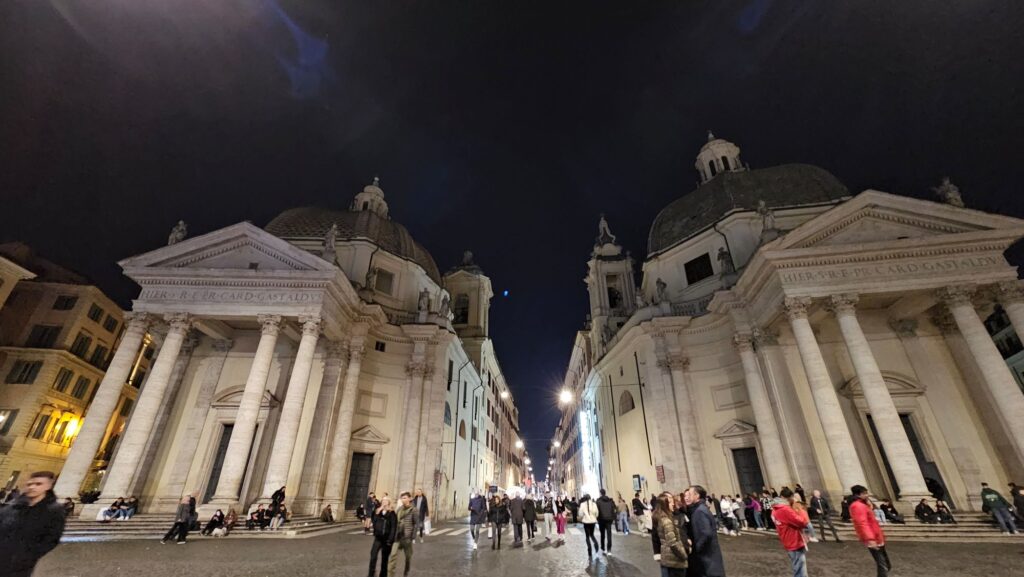
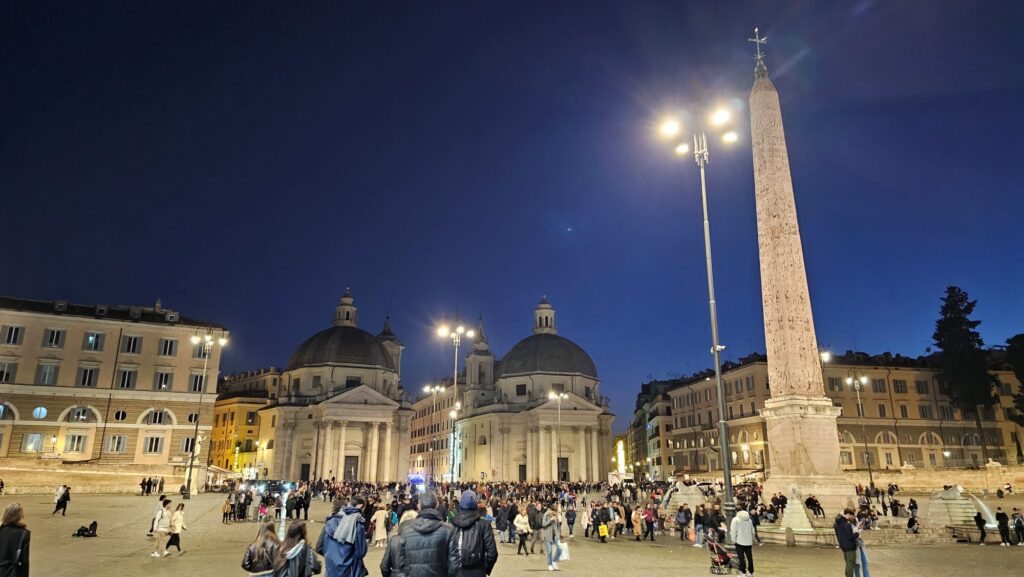
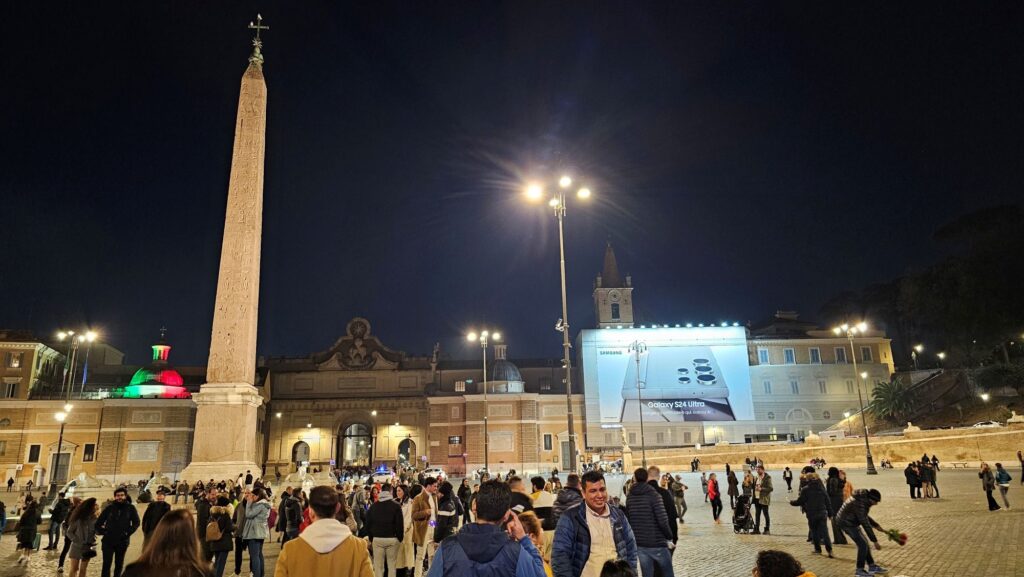
Facing south, the most iconic view of Piazza del Popolo reveals two near-identical domed churches — Santa Maria dei Miracoli and Santa Maria in Montesanto — framing the entrance to Via del Corso. Their symmetry is deceptive; while they appear identical from the square, subtle differences in shape and proportion reflect the irregular geometry of the surrounding streets.
The twin churches were commissioned by Pope Alexander VII in the 17th century and designed by Carlo Rainaldi and Gian Lorenzo Bernini, whose genius in balancing illusion and proportion created one of the most recognizable vistas in Rome. Between them lies Via del Corso, Rome’s great historic boulevard, once used for horse races and papal parades, and now filled with cafés, shops, and strolling locals.
The Basilica of Santa Maria del Popolo
On the northern side of the square, just inside the gate, stands the Basilica di Santa Maria del Popolo, one of Rome’s true artistic treasures. Built in the 15th century on the site of a medieval chapel, the church is a showcase of Renaissance and Baroque brilliance. Its chapels contain works by Caravaggio, Bernini, Raphael, and Pinturicchio — an astonishing collection under one roof.
Inside, the Cerasi Chapel holds two of Caravaggio’s masterpieces: The Crucifixion of Saint Peter and The Conversion of Saint Paul. The dramatic lighting and emotional realism of these paintings embody the essence of the Baroque spirit. Bernini’s sculptures, meanwhile, add a sense of divine movement that contrasts beautifully with Raphael’s calm frescoes in the Chigi Chapel.
To step into Santa Maria del Popolo is to walk into a microcosm of Roman art history — intimate, powerful, and unforgettable.
My Visit: The Square at Dusk
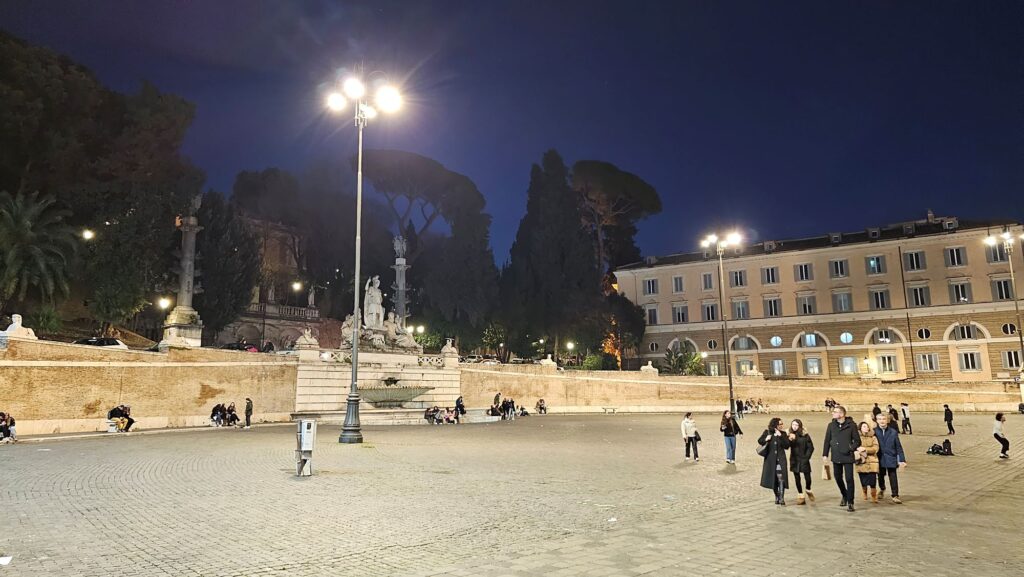
I visited Piazza del Popolo in the late afternoon, just as the golden light began to soften across the buildings. Musicians played on the steps of the obelisk, and children chased pigeons around the fountains. Locals leaned against the marble balustrades, chatting and watching as the sky began to shift from bright blue to shades of amber and rose.
The atmosphere was both lively and serene. Street performers drew applause near the center, while couples sat on the steps of the twin churches, sharing gelato. From above, on Pincian Hill, I could see the square spread out like a painting — the obelisk casting a long shadow across the cobblestones, the streets radiating outward like the points of a compass.
As the sun dipped lower, the lamps flickered on, bathing the square in a soft glow. The fountains shimmered, and the air was filled with the hum of conversations and distant church bells. It felt as though the entire city exhaled — a collective sigh at the close of another Roman day.
Walking toward Via del Corso, I glanced back at the square one more time. The obelisk glowed gently against the twilight, and the twin domes framed the last light in the sky. In that moment, I understood why so many people fall in love with Rome — not for its grandeur alone, but for how seamlessly it weaves beauty into everyday life.
Why Piazza del Popolo Matters
What makes Piazza del Popolo special isn’t just its architecture or history — it’s the way it brings together the past and the present. It is both a monument and a meeting place, a crossroads where the grandeur of empires meets the rhythm of daily life. It represents Rome’s timeless ability to evolve without losing its soul.
Standing there, surrounded by marble, fountains, and laughter, you feel connected to centuries of travelers who arrived here before you — pilgrims, artists, emperors, and wanderers — all drawn to the same light, the same beauty, the same sense of belonging.
Tips for Visiting Piazza del Popolo
Best Time to Visit: Late afternoon through sunset, when the light enhances the colors of the buildings and the view from Pincian Hill above is at its most beautiful.
How to Get There: Take Metro Line A to Flaminio Station, then exit directly onto the square. It’s also easily reachable on foot from Via del Corso or Piazza di Spagna.
What to See: The Obelisco Flaminio, the twin churches, Basilica di Santa Maria del Popolo, and the view from Terrazza del Pincio just above the square.
What to Bring: Comfortable shoes, a camera, and perhaps a snack to enjoy while people-watching by the fountains.
Nearby Attractions: Pincian Hill, Villa Borghese Gardens, Via del Corso, Piazza di Spagna, and Galleria Borghese.
Practical Information
Name: Piazza del Popolo (People’s Square)
Address: Piazza del Popolo, 00187 Roma RM, Italy
Nearest Metro: Flaminio – Piazza del Popolo (Line A)
Admission: Free
Opening Hours: Open 24 hours, best visited during daylight or sunset
Facilities: Benches, fountains, cafés nearby, and direct access to Pincian Hill
Recommended Duration: 30–60 minutes for the square; 2–3 hours including Santa Maria del Popolo and Pincio Terrace
Campo de’ Fiori, A Lively Roman Market Steeped in Local Life and History
Foro Romano, The Heart of Ancient Rome in Ruins