
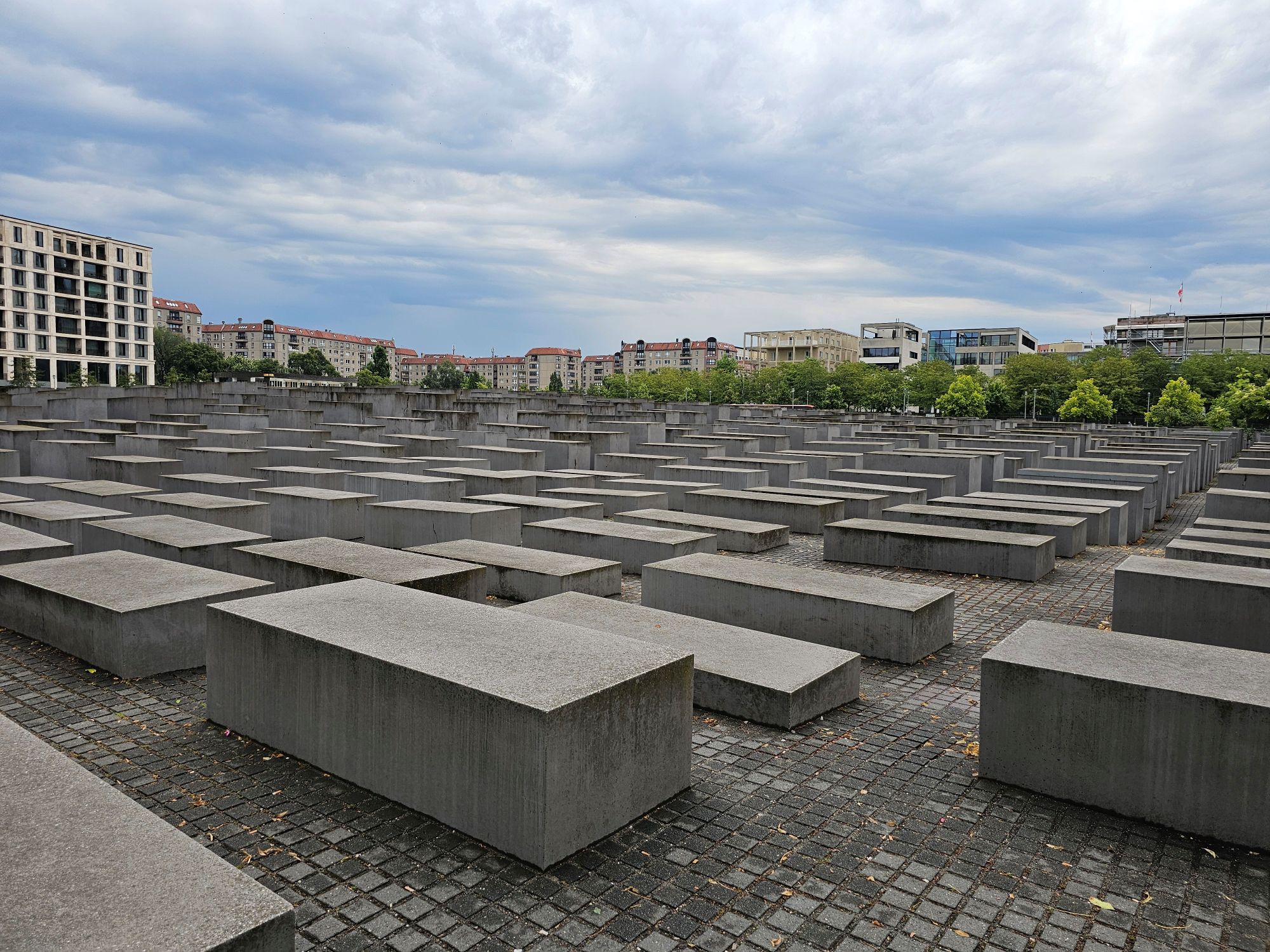
Berlin is a city that does not hide from its past. Among its many monuments and historical sites, few are as emotionally powerful and symbolically complex as the Memorial to the Murdered Jews of Europe, known in German as Denkmal für die ermordeten Juden Europas. Located in the very center of Berlin, this memorial does not offer easy explanations or comforting narratives. Instead, it invites visitors into a space of reflection, discomfort, and remembrance.
This is not a monument meant to be admired from a distance. It is a place to walk through, to feel disoriented within, and to confront one of the darkest chapters of European history through physical experience rather than words alone.

Location and Urban Context
The memorial stands just south of the Brandenburg Gate, between major avenues and government buildings. Its proximity to symbols of German statehood is intentional. The memorial is not hidden on the margins of the city but placed at its political and historical core, asserting that remembrance must exist alongside power, governance, and everyday life.
Surrounded by traffic, embassies, offices, and tourists moving between landmarks, the memorial forms a striking contrast. As soon as you step into the field of concrete slabs, the noise of the city begins to fade, replaced by a subdued, almost unsettling quiet.

First Impressions: An Abstract Landscape
At first glance, the memorial appears deceptively simple. A grid of 2,711 concrete stelae stretches across a vast open space. The slabs are uniform in width and length but vary dramatically in height. From the edges, the memorial seems orderly and minimal. But this impression changes the moment you step inside.
As you walk deeper, the ground slopes downward and the stelae rise above you. Paths narrow, light diminishes, and orientation becomes uncertain. You begin to lose sight of the surrounding city, replaced by towering grey forms that block your view and distort your sense of scale.


Experiencing Disorientation and Isolation
The design of the memorial is intentionally abstract. There are no names carved into the stelae, no dates, no explicit symbols. Instead, the experience itself carries meaning. The uneven ground and changing heights create a physical sense of instability and unease.
Walking through the memorial, many visitors describe feelings of isolation, vulnerability, or quiet anxiety. You may hear footsteps echoing from unseen paths or briefly lose track of companions walking only meters away. This disorientation is central to the memorial’s impact. It resists passive observation and demands emotional engagement.

Architecture as Memory
The memorial was designed by architect Peter Eisenman, who deliberately avoided traditional representational forms. There are no figurative statues or heroic imagery. Instead, the abstract field allows each visitor to confront the space personally, without prescribed interpretation.
This openness has been both praised and debated. Some argue that the lack of explicit symbolism risks ambiguity. Others believe that this ambiguity is precisely what makes the memorial enduring—allowing each generation to encounter it anew and draw meaning from the experience rather than from instruction.
The Underground Information Centre
Beneath the field of stelae lies the Information Centre, an essential part of the memorial experience. Entering this underground space shifts the encounter from abstraction to historical specificity.
Inside, exhibitions provide detailed documentation of the Holocaust, including personal letters, photographs, biographies of victims, and explanations of Nazi persecution across Europe. One of the most powerful sections focuses on individual families, tracing their lives before persecution and their eventual fates.
The contrast between the abstract landscape above and the factual, deeply personal material below is deliberate. Together, they form a complete narrative—emotion above, history below.

Silence, Behavior, and Respect
One of the most discussed aspects of the memorial is how visitors behave within it. The space is open and accessible, without fences or formal entry points. This openness reflects the idea that remembrance should be integrated into public life.
At the same time, the memorial raises questions about respect and responsibility. Visitors are encouraged to move quietly, avoid climbing on the stelae, and treat the space as one of reflection rather than recreation. The absence of explicit rules places ethical responsibility on each individual.
A Memorial Without Closure
Unlike traditional monuments that offer resolution or catharsis, the Memorial to the Murdered Jews of Europe provides no closure. There is no final viewpoint, no single plaque that explains everything, no moment where the experience clearly ends.
This lack of resolution mirrors the historical reality it commemorates. The Holocaust cannot be neatly summarized or emotionally resolved. The memorial’s design ensures that visitors leave with questions rather than answers.

Emotional Impact on Visitors
The emotional responses to the memorial vary widely. Some visitors feel overwhelmed, others feel contemplative, and some struggle to articulate their reaction at all. The space does not dictate emotion—it creates conditions in which emotion may arise.
Many travelers find that the memorial lingers in their memory long after they leave Berlin. It is not a site you simply “see”; it is a site you carry with you.
Why This Memorial Matters
In a Europe where history is sometimes simplified or politicized, the Memorial to the Murdered Jews of Europe stands as a commitment to remembrance without dilution. It acknowledges responsibility, confronts absence, and resists forgetting.
For visitors, especially those unfamiliar with Germany’s approach to historical accountability, the memorial offers insight into how a nation can confront its past openly and publicly—without erasing discomfort.

Visiting as a Traveler
When planning a visit, it is worth allowing time not only to walk through the memorial but also to sit quietly nearby or visit the Information Centre. Rushing through diminishes the experience. This is a place where slowing down matters.
It is also important to approach the memorial emotionally prepared. This is not a casual stop between attractions but a moment of confrontation with history that deserves attention and respect.
Practical Information
Name: Memorial to the Murdered Jews of Europe
German Name: Denkmal für die ermordeten Juden Europas
Location: Near Brandenburg Gate, Berlin, Germany
Type: Holocaust memorial and documentation center
Key Features: Field of 2,711 concrete stelae, underground Information Centre
Recommended Visit Time: 45–90 minutes
Alexanderplatz, Berlin: The Dynamic Heart of the German Capital