

The East Side Gallery in Berlin is not simply an artistic attraction—it is one of the world’s most powerful examples of how history can be transformed rather than erased. Spanning 1.316 kilometers along Mühlenstraße in the Friedrichshain-Kreuzberg district, it stands as the longest preserved section of the Berlin Wall in its original location. Today, this open-air museum represents a remarkable fusion of political memory, artistic expression, and cultural identity. What was once a symbol of oppression, separation, and fear has been reclaimed by artists and citizens as a monumental celebration of unity, freedom, and creativity. Walking this stretch of the Wall is not just a sightseeing activity—it is a deeply emotional and reflective journey into the heart of Berlin’s past and present.


From Oppression to Expression
Before it became a gallery, this wall served as part of the inner border dividing East Berlin from West Berlin from 1961 to 1989. It was a heavily guarded barrier, patrolled day and night, and reinforced by the East German government as a means of controlling movement and maintaining political power. Escape attempts were dangerous and often tragic. The Wall’s presence cast a long shadow over Berliners’ daily lives, shaping the social, cultural, and emotional fabric of the city.
The fall of the Berlin Wall on November 9, 1989, marked an extraordinary turning point. In the months that followed, 118 artists from 21 different countries gathered to paint directly onto the Wall’s grey concrete surface. Their goal was clear: to document the trauma of division, honor the hope of reunification, and give the Wall a new identity as a canvas for healing and expression. By September 1990, the East Side Gallery officially opened as the world’s longest open-air art gallery, drawing international attention for its cultural and historical significance.


Iconic Murals and Their Stories
The East Side Gallery is home to over 100 murals, each carrying its own message, artistic style, and historical reference. Among them, Dmitri Vrubel’s “My God, Help Me to Survive This Deadly Love” stands out as one of the most recognized murals worldwide. The artwork depicts the socialist fraternal kiss between Soviet leader Leonid Brezhnev and East German leader Erich Honecker—a moment captured in a 1979 photograph. Painted on a monumental scale, the mural blends satire with political commentary, highlighting the contradictions and complexities of Cold War alliances.
Another beloved mural is Birgit Kinder’s “Trabant Breaking Through the Wall,” which features the iconic East German Trabant car bursting through cracked concrete. This image symbolizes the dream of movement and freedom that many East Germans longed for during the years of division. With its humorous yet meaningful message, it has become one of the most photographed images along the Gallery.
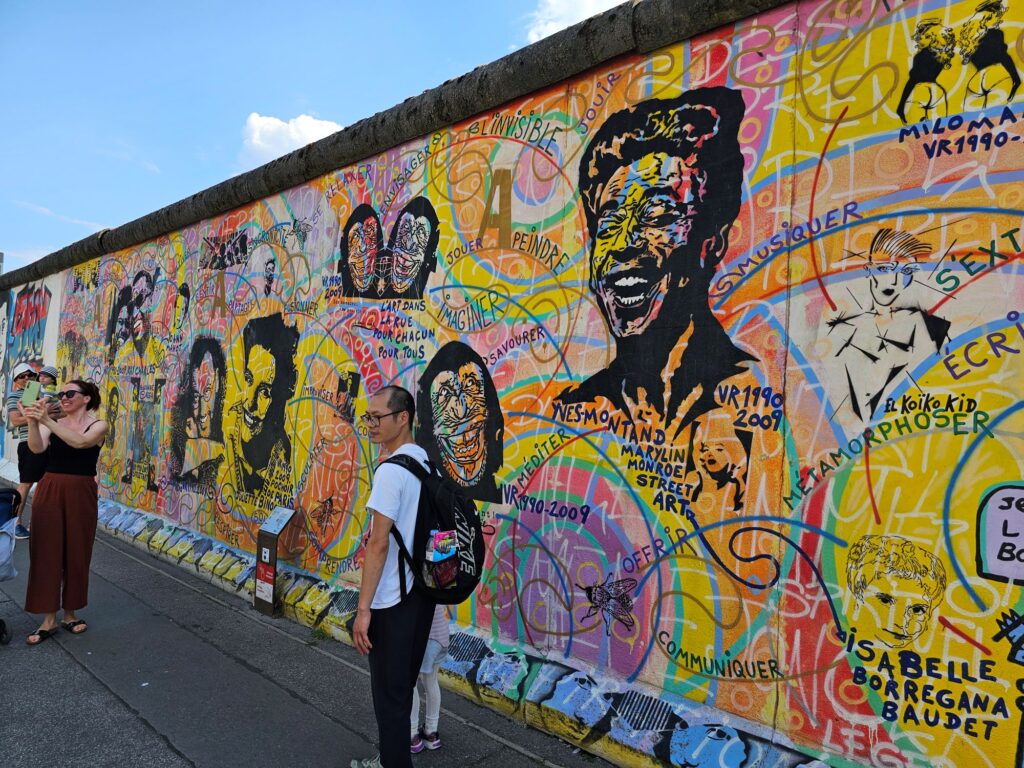
Beyond these two famous works, visitors encounter a variety of artistic expressions—abstract patterns, poetic lines, symbolic figures, and contemporary political interpretations. The diversity of murals reflects the diversity of experiences surrounding the Berlin Wall, inviting viewers to interpret the artworks through their own perspectives.

Experiencing the Atmosphere Along the Spree
Walking along the East Side Gallery is an emotional experience shaped by the contrast between past and present. During my visit, I started from Ostbahnhof and followed the path beside the Spree River. The water moved calmly, while the Wall stood tall and commanding. The air carried a quiet seriousness, with visitors pausing thoughtfully in front of the murals.
Standing before the Brezhnev–Honecker mural, I tried to imagine the fear, uncertainty, and tension that once filled this exact location. Yet the same space now hosts laughter, curiosity, art, and connection. Further along, the atmosphere became lighter. People took photos, pointed out symbolism in the murals, and discussed Berlin’s history.
As the sun started to set, warm light softened the concrete surface. The murals gained new depth and texture, while reflections danced across the Spree. Evening brought a calm stillness that contrasted beautifully with the Wall’s traumatic past. This emotional shift—between darkness and light, sorrow and hope—captures the essence of the Gallery’s significance.


Layers of Preservation and Urban Change
Since its establishment, the East Side Gallery has faced numerous preservation challenges: vandalism, weather erosion, pollution, and the rapid modernization of Berlin. A major restoration was completed in 2009, with many of the original artists returning to repaint or repair their works. Still, debates continue. Should the murals be restored or preserved in their aging state? Should sections be moved to accommodate new construction? These questions highlight the complex balance between maintaining historical integrity and accommodating the city’s evolving needs.
The Gallery’s vulnerability contributes to its power. The visible cracks, fading colors, and restoration marks serve as reminders that memory is never static. The Wall itself continues to evolve, just as Berlin does. This living quality is part of what makes the East Side Gallery so moving—it reflects both the fragility and the resilience of human memory.


The Human Story Behind the Wall
For Berliners, the East Side Gallery is deeply personal. It reflects decades of struggle, separation, and sacrifice. Many families were divided; friends were isolated; entire communities were shaped by the Wall’s existence. The murals give voice to these individual experiences, even when they don’t explicitly depict people. Visitors may not know the names or stories of those affected, but the emotional weight lingers in the atmosphere.
For international visitors, the Gallery provides a powerful introduction to the realities of totalitarianism, resistance, and the universal desire for freedom. It offers a space for reflection, empathy, and understanding—reminding us how political decisions can deeply shape human lives and how societies can rebuild after conflict.


The Gallery at Sunset and Into the Evening
One of the most beautiful ways to experience the East Side Gallery is during sunset. The changing light casts soft shadows across the murals, highlighting subtle textures and worn surfaces. As the sky turns orange and pink, the Gallery becomes almost serene. People slow their pace, leaning against the riverside railing, watching the sky change above the historic concrete.
After sunset, the atmosphere grows intimate. The Offenbach lights reflect on the river, and the murmur of the city softens. This peacefulness stands in striking contrast to the Wall’s original purpose. Once a border of fear, the Wall now welcomes visitors into a shared space of reflection, artistic appreciation, and connection.


A Walk Through Berlin’s Identity
The East Side Gallery sits in one of Berlin’s most vibrant districts. Friedrichshain-Kreuzberg is known for its multicultural energy, alternative culture, and artistic imagination. After exploring the murals, many visitors cross the Oberbaum Bridge into Kreuzberg, where musicians, artists, and cafés fill the streets with life.
This blend of history and modern culture captures Berlin’s spirit. The city is a place where creativity thrives despite past trauma, where new stories grow from old wounds, and where diverse communities come together. The East Side Gallery is a living example of that identity—a bridge between generations, ideas, and experiences.

Tips for a Meaningful Visit
The East Side Gallery is open 24 hours a day and free to visit. Early morning and late afternoon provide ideal lighting and fewer crowds. Walk slowly, take your time with each mural, and read the plaques for additional context. If you enjoy photography, you’ll find endless inspiration—vivid colors, cracked textures, powerful symbols, and reflections on the water.
Please remember that the murals are fragile. Touching, climbing, or leaning on the Wall can cause damage, so visitors are encouraged to preserve this important cultural landmark for future generations.

Practical Information
Name: East Side Gallery
Address: Mühlenstraße 10243 Berlin, Germany
Length: 1.316 km – the longest preserved section of the Berlin Wall
Admission: Free, open 24 hours
Nearest Stations: S-Bahn Ostbahnhof / U-Bahn Warschauer Straße
Famous Murals: “My God, Help Me to Survive This Deadly Love,” “Trabant Breaking Through the Wall”
Final Thoughts
The East Side Gallery is more than a tourist destination—it is a space where history, art, and humanity meet. When you walk its length, you are not only observing murals; you are entering a conversation about freedom, trauma, resilience, and hope. It is a reminder that societies can heal, that new meaning can emerge from old wounds, and that art has the power to transform even the darkest chapters of history.
Whether you are a history enthusiast, an art lover, or simply curious about Berlin’s past, the East Side Gallery offers one of the city’s most meaningful and inspiring experiences.
Alexanderplatz, Berlin: The Dynamic Heart of the German Capital
Berlin Hauptbahnhof: A Modern Marvel of Transit and Design in the Heart of Germany