
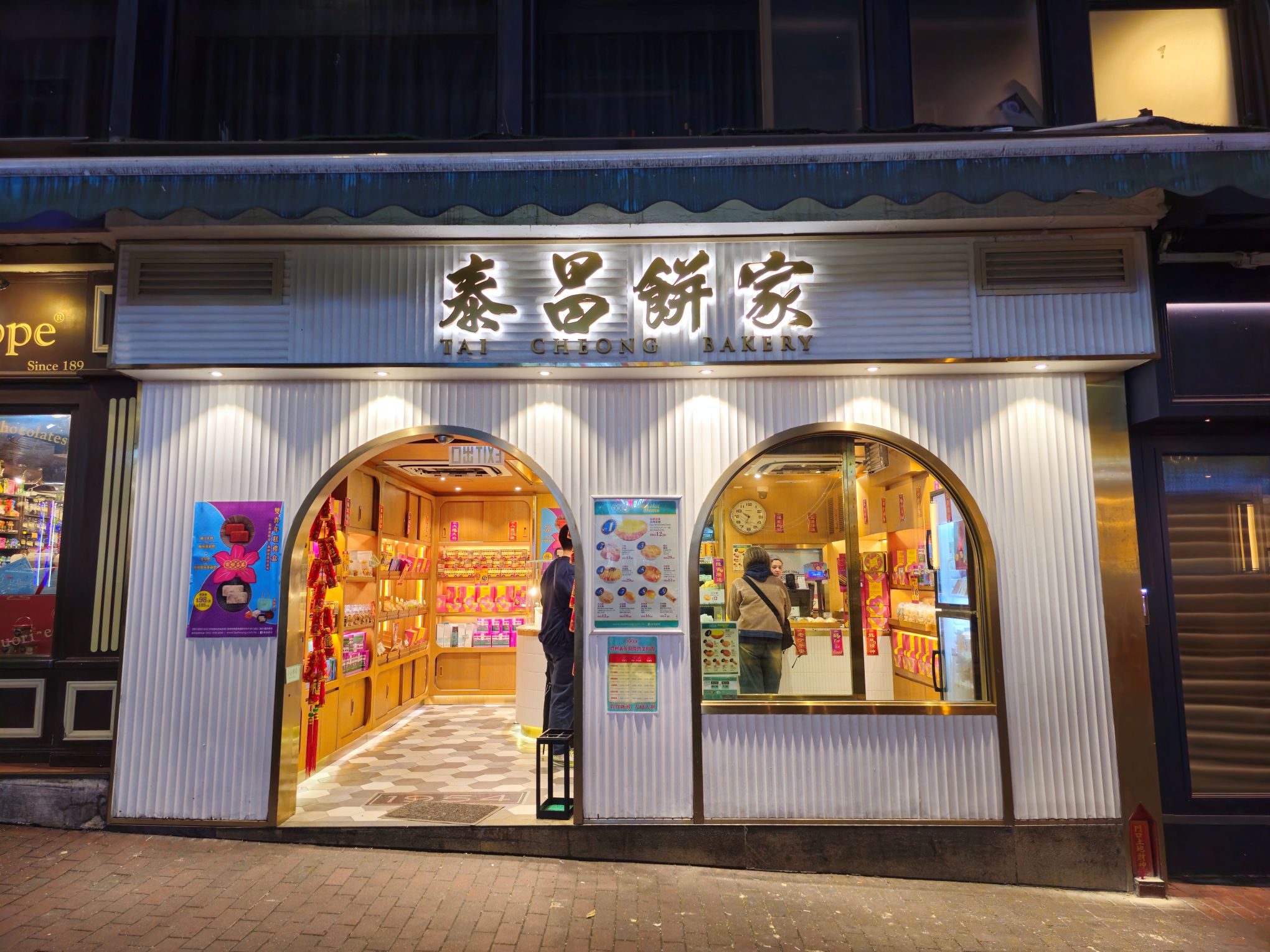
Some food reputations are built on nostalgia and maintained by inertia — the famous restaurant that was once excellent and now coasts on its name. Tai Cheong Bakery is not that. I visited in the evening, stopping after dinner at Tsim Chai Kee nearby, and found an egg tart that justified every word written about it: warm from the oven, the shortcrust shell properly crumbly and buttery, the custard smooth and correctly set with the slight wobble that indicates fresh production. The reputation is earned.
This review covers Tai Cheong Bakery honestly — the history, the egg tart in detail, the broader pastry range, and how it compares to Bakehouse, its most frequently cited contemporary rival.
Background: Seventy Years of Egg Tarts
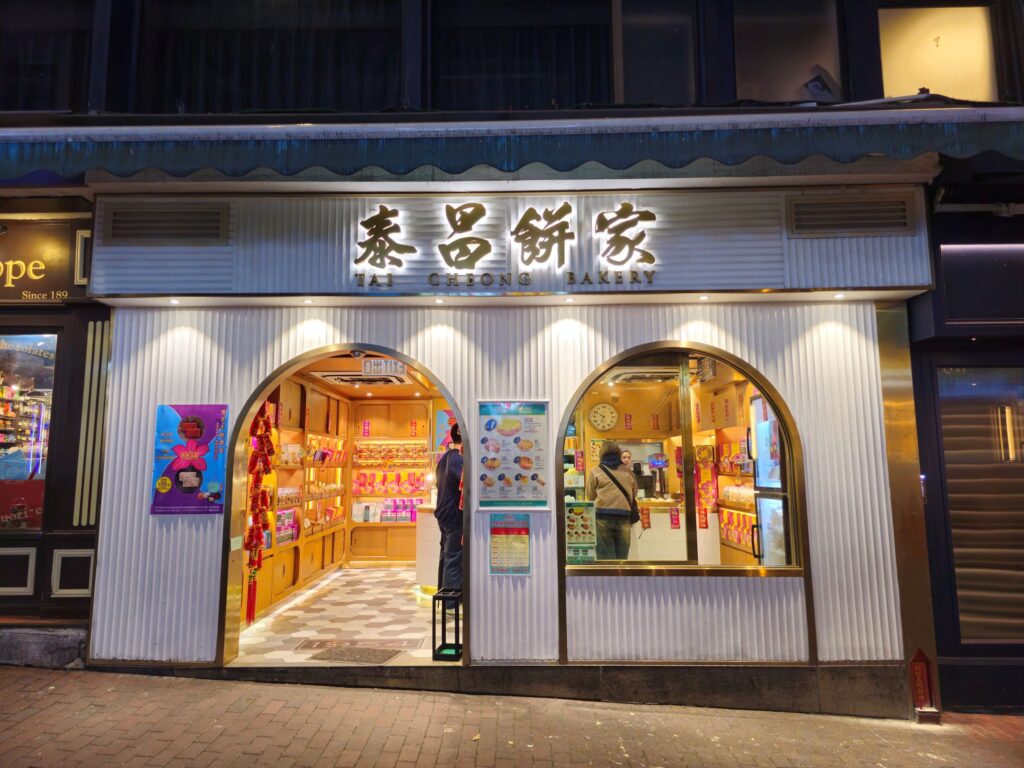
Tai Cheong Bakery (泰昌餅家) has been making Hong Kong egg tarts since 1954 — over 70 years of continuous production from its Central location. The bakery became internationally known in the 1990s when Chris Patten, the last British Governor of Hong Kong, was photographed buying egg tarts here regularly — an association that generated significant international coverage and established the bakery’s reputation beyond Hong Kong’s Chinese-speaking community.
A photograph of Governor Patten remains displayed prominently in the shop — a small piece of the bakery’s history that functions as both documentation and gentle marketing. The association is legitimate: Patten did patronize the bakery regularly, and the coverage it generated was genuine rather than manufactured.
What matters more than the historical association is that Tai Cheong has maintained quality through seven decades of operation — the egg tart produced today is the product of the same recipe and technique that built the reputation, refined rather than degraded by the years.
Getting There
From Central MTR (Exit D1): Walk south along Pedder Street then turn right onto Des Voeux Road, left onto Cochrane Street — Tai Cheong is on Lyndhurst Terrace, which connects from Cochrane Street. Approximately 8–10 minutes on foot.
From AKVO Hotel: A 10-minute walk through the Central streets — the route passes through the neighborhood that makes Central worth staying in, along Wellington Street and through the small connecting lanes.
From Tsim Chai Kee: The two restaurants are within a few minutes’ walk of each other on Wellington Street and its connecting lanes — the natural sequence is wonton noodles at Tsim Chai Kee followed by an egg tart at Tai Cheong, which is exactly the sequence I followed on January 26th.
From Lan Fong Yuen: Approximately 5 minutes on foot — another natural pairing for a Central food walk.
The Location
The most famous Tai Cheong location is at 35 Lyndhurst Terrace in Central — a narrow street running between Hollywood Road and Wellington Street that rewards slow walking for its independent shops and galleries alongside the bakery.
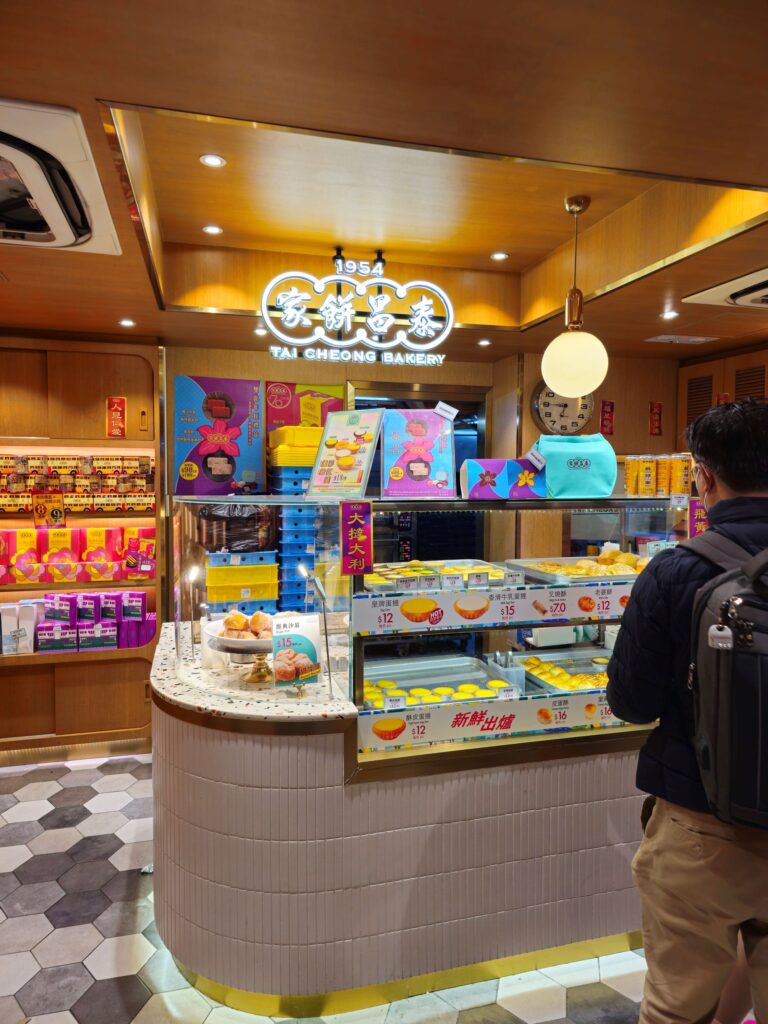
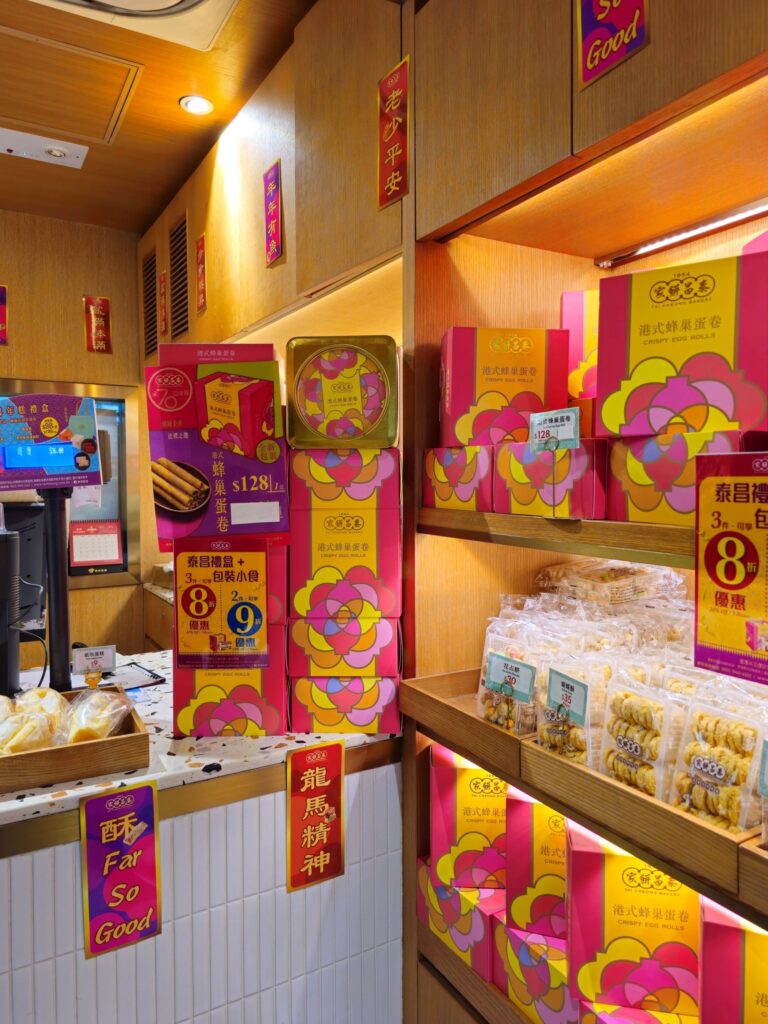
The shop is small: a serving counter with display cases showing fresh-baked goods, the kitchen visible through the back, and a queue that extends onto the pavement when the bakery is at full production. The interior is functional rather than designed — white walls, display cases, the smell of butter and baking that reaches the street before you reach the shop.
There are multiple Tai Cheong locations throughout Hong Kong — in Wan Chai, in the IFC mall, and elsewhere. The Lyndhurst Terrace original is the one worth visiting: the location that carries the history and the atmosphere that the satellite branches replicate in form but not in character.
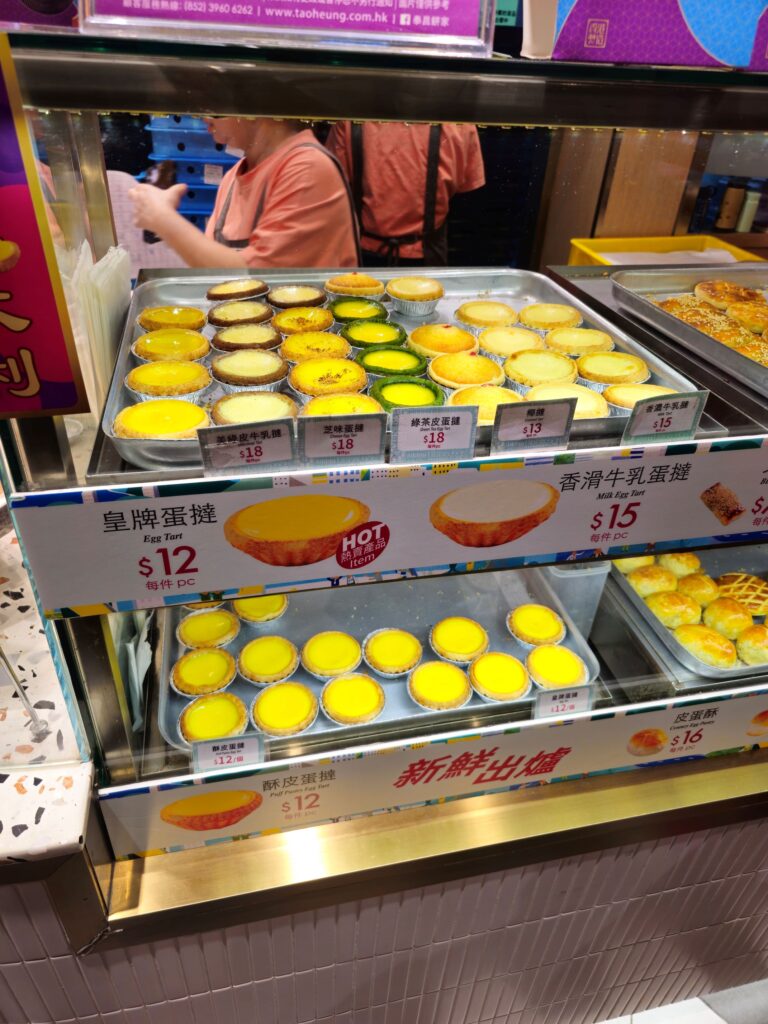
The Egg Tart: A Detailed Assessment
The Pastry Shell
Tai Cheong uses a shortcrust pastry (酥皮) — the traditional Hong Kong style, distinct from the flaky Macanese-influenced pastry that Bakehouse uses. Understanding the shortcrust style requires understanding what shortcrust pastry is and what it’s supposed to achieve.
Shortcrust pastry is made by working butter into flour until the mixture resembles breadcrumbs, then binding with egg and a small amount of liquid. The result bakes into a firm, crumbly shell that holds its shape cleanly and provides a buttery richness as the foundation for the custard.
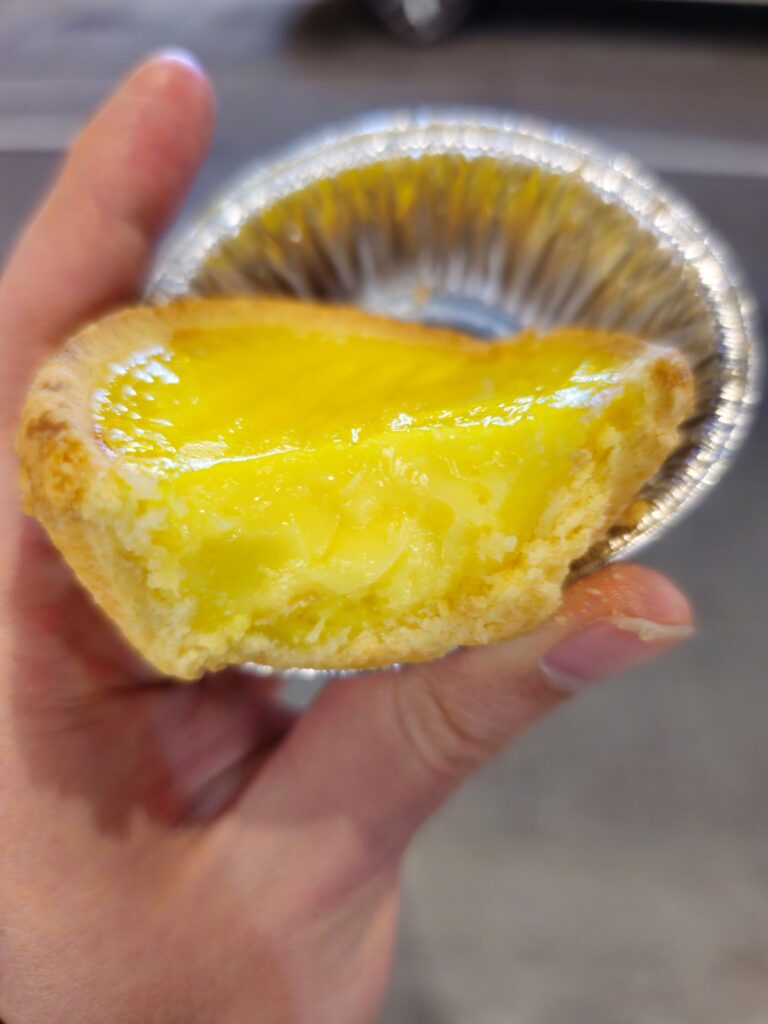
Tai Cheong’s shortcrust shell is golden-brown across the full surface — indicating even baking and correct oven temperature. The color is slightly darker than a pale shortcrust, suggesting a slight caramelization of the sugars in the dough that adds flavor without tipping into bitterness. The texture when bitten is crumbly rather than flaky — the shell breaks cleanly under gentle pressure, releasing a buttery fragrance.
The thickness is calibrated correctly: substantial enough to hold the custard and provide the textural contrast that makes the egg tart work, not so thick as to dominate the filling. Running a thumb along the inside of the shell after eating reveals an even thickness throughout — consistent production rather than variable handwork.
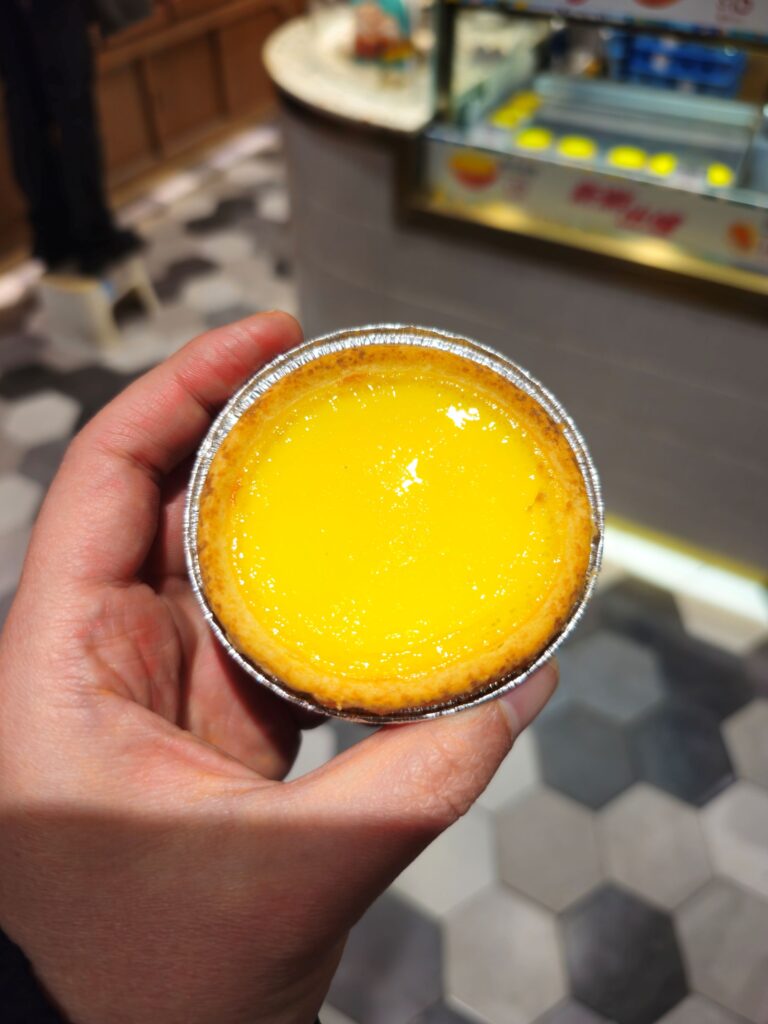
The Custard
The custard filling at Tai Cheong is smooth, uniformly colored, and correctly set — the three primary indicators of quality custard in a Hong Kong egg tart.
Color: Pale golden yellow — the natural color of fresh eggs combined with milk and sugar, without the deeper orange that artificial coloring produces. The color is consistent across the surface without patches or gradients.
Set: Firm enough to hold its shape when the tart is lifted but soft enough to have a slight wobble at the center when fresh. This specific texture — set but trembling — indicates that the custard was removed from the oven at the correct moment. Over-baking produces a custard that’s firm throughout without the center wobble; under-baking produces a custard that’s liquid in the center. Tai Cheong consistently hits the correct point.
Flavor: Clean and eggy — the taste of fresh eggs and good dairy with restrained sugar. The sweetness is present but doesn’t dominate; the egg flavor is the primary note. There’s a slight richness from the milk fat that rounds the custard without making it heavy.
Temperature: Eaten warm, immediately after purchase, the custard is at its most expressive — the texture most apparent, the flavor most fresh, the contrast with the crumbly pastry most pronounced. Tai Cheong’s egg tarts are at their best within 15 minutes of baking; the temperature drop over the following hour changes the experience significantly.
The Complete Experience
Biting into a warm Tai Cheong egg tart produces a specific sequence: the crumble of the shortcrust shell, releasing buttery fragrance; the give of the custard beneath, slightly resistant then yielding; the combined flavor of butter pastry and fresh egg custard. The experience lasts perhaps 45 seconds for a single tart eaten standing on the pavement outside the shop. Those 45 seconds are as good as simple food gets.
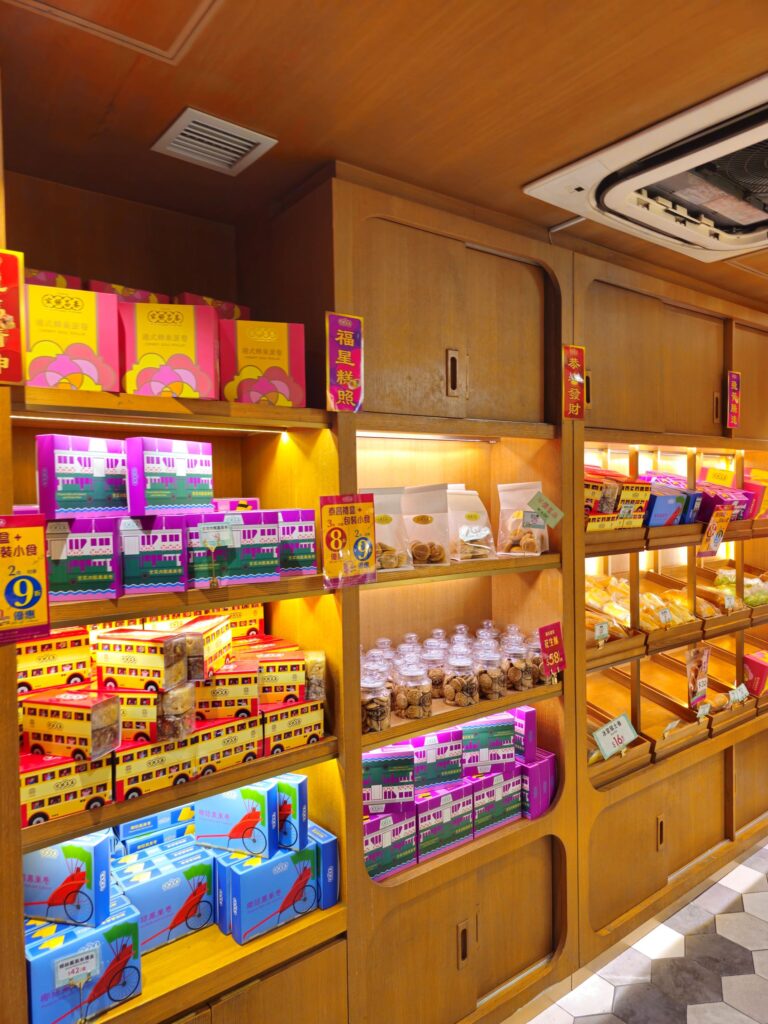
Buying the Egg Tart
Timing
Tai Cheong bakes throughout the day — fresh batches come out of the kitchen at intervals that vary by the day’s demand. The best strategy is to ask when the next batch will be ready (staff can indicate this) and wait for fresh rather than buying from a display that’s been sitting for an hour.
Signs of freshness:
- Visible steam from the custard surface
- Pastry that’s still warm to the touch
- Custard that has the slight wobble at the center indicating very recent baking
Signs of age:
- Custard that’s firm throughout without any wobble
- Pastry that’s cooled to room temperature
- No steam visible
Fresh is always better. If the current display looks old, waiting 10 minutes for a new batch is consistently the right decision.
How Many to Buy
One egg tart is the minimum experience — enough to assess the quality and decide whether you want more. Two is the appropriate amount for most visitors: one to eat immediately outside the shop, one for the walk.
Buying a box to take home or to the hotel is possible and the packaging is appropriate for travel, but the egg tart degrades over hours — the pastry softens as it cools and the custard firms up. Buying more than you’ll eat within an hour or two is wasted effort.
The Governor Patten Connection
The photograph of Governor Patten in the shop is worth a moment. Patten’s public affection for Tai Cheong egg tarts during his governorship from 1992 to 1997 — the period leading up to the handover — gave the bakery international exposure that established its reputation outside Hong Kong. That a British colonial governor’s last years in the territory were marked, in part, by a daily ritual at a local bakery is a specifically Hong Kong story: the collision of imperial history and domestic food culture that the city has always produced.
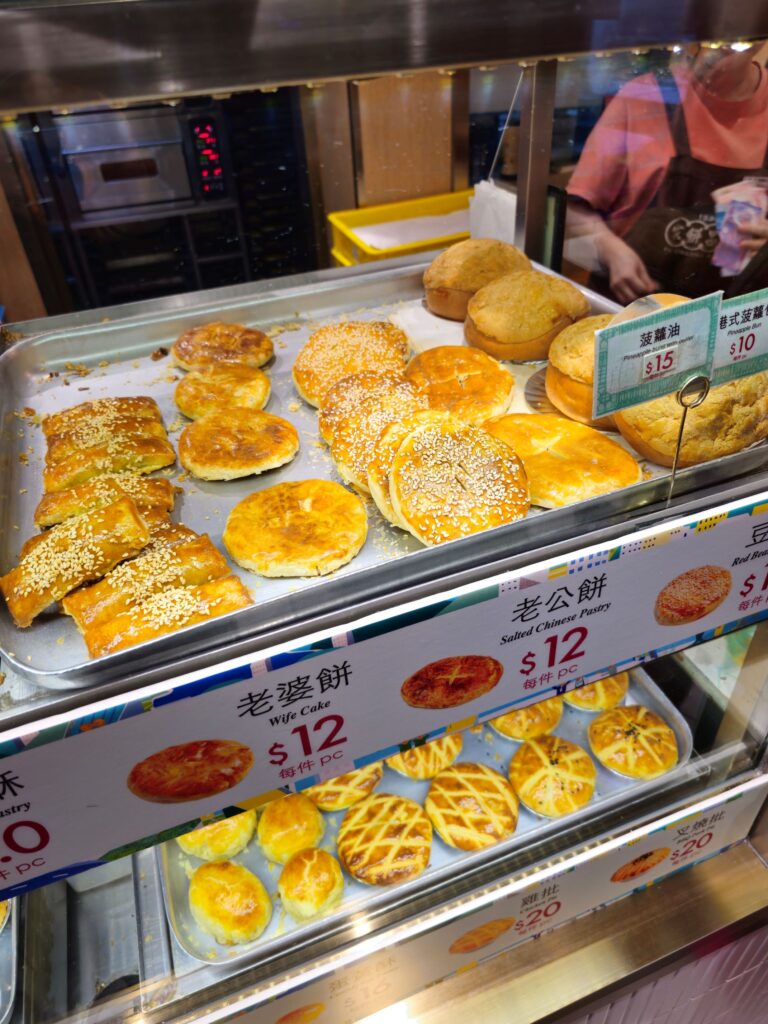
The Broader Pastry Range
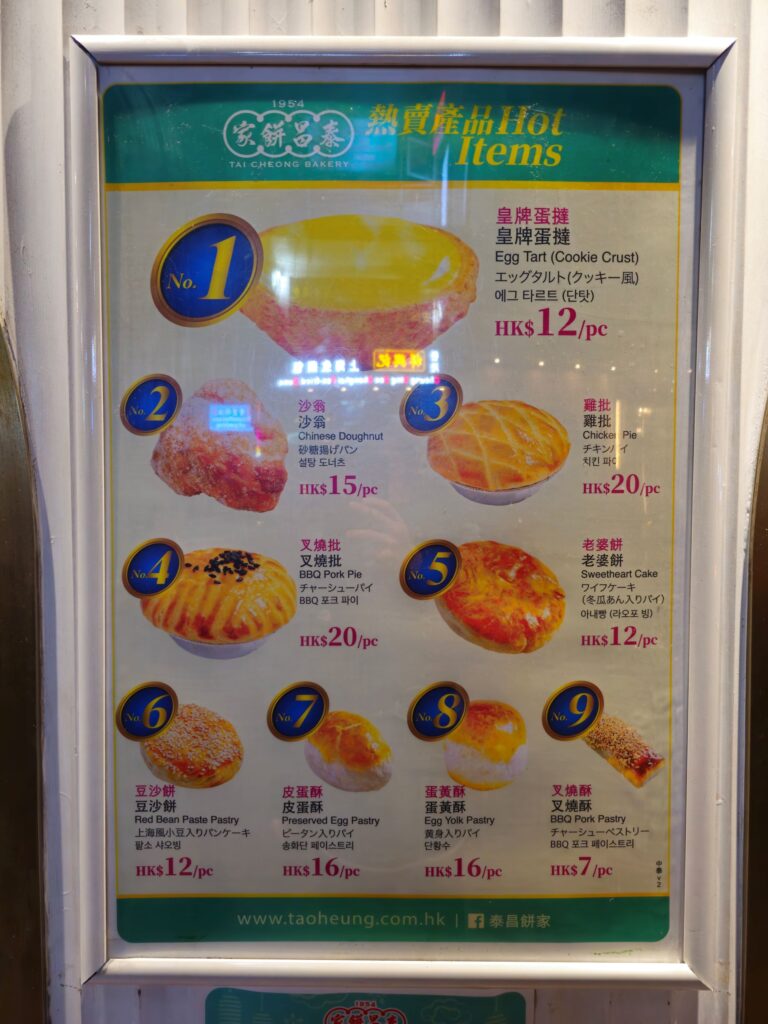
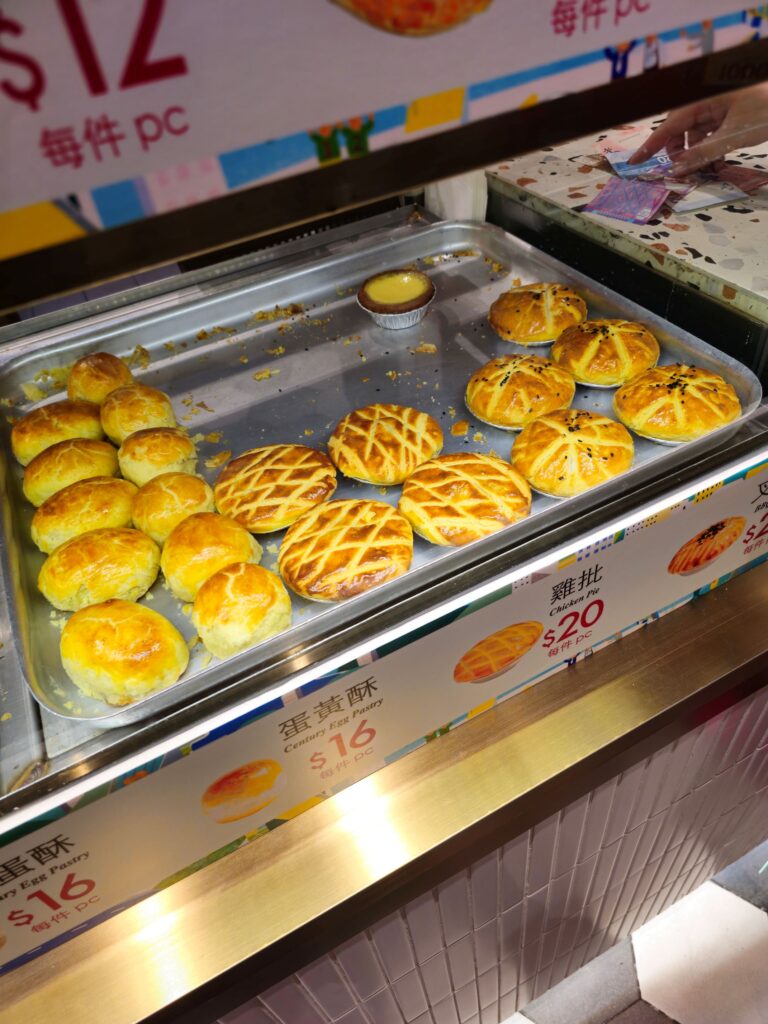
Beyond the egg tart, Tai Cheong’s broader range is worth attention:
Wife Cake (老婆餅)
The wife cake — a flaky pastry filled with winter melon paste, sesame, and almond — is one of Tai Cheong’s other signature products and a traditional Cantonese pastry with more regional specificity than the egg tart. The version at Tai Cheong is well-made: the pastry is properly flaky (a different pastry from the shortcrust egg tart shell), the filling has the characteristic sweet-savory balance of the traditional recipe.
Wife cakes travel well — they keep for several days and the packaging is appropriate for carrying home as a gift. A better souvenir from Tai Cheong than the egg tart, which doesn’t survive the journey.
Cocktail Bun (雞尾包)
A soft bun filled with coconut cream — a Hong Kong bakery staple available fresh at Tai Cheong. The version here is well-made and worth buying if the appetite extends beyond the egg tart.
Pineapple Bun (菠蘿包)
Available at Tai Cheong but less distinctive than at Lan Fong Yuen or a dedicated cha chaan teng. The version here is good — fresh, properly sweet top — but the pineapple bun is not the primary reason to visit Tai Cheong.
Tai Cheong vs Bakehouse: The Definitive Comparison
The comparison between Tai Cheong and Bakehouse is Hong Kong’s most frequently discussed egg tart question, and having eaten at both during my January trip — Tai Cheong on the evening of January 26th, Bakehouse in Causeway Bay on the afternoon of January 27th — I can make the comparison directly.
The Pastry
Tai Cheong (shortcrust): Firm, crumbly, buttery. Breaks cleanly under pressure. Dense and substantial in character.
Bakehouse (flaky): Light, layered, shattering. Releases a strong butter fragrance on the first bite. More delicate and technically complex.
Neither is objectively better — they represent genuinely different approaches to the pastry component of the same dish.
The Custard
Tai Cheong: Smooth, cleanly egg-flavored, correctly set with a firm wobble. Traditional in character.
Bakehouse: Silkier, slightly creamier, marginally more refined in technique. The tighter control of the baking process produces a more consistent set across the surface.
Bakehouse’s custard has a slight technical edge; Tai Cheong’s custard has the character of the traditional form.
The Overall Experience
Tai Cheong: The original. The establishment that most people mean when they say “Hong Kong egg tart.” The shortcrust style that the tradition is built on. Standing outside on Lyndhurst Terrace eating a warm tart with the Governor Patten photograph visible through the window.
Bakehouse: The refined contemporary version. European pastry technique applied to a Hong Kong form. The result is excellent and slightly more technically accomplished. Standing outside a modern bakery eating a tart that represents the tradition’s future rather than its past.
The verdict: Both are excellent. The comparison between them is the most enjoyable food project available in Hong Kong — two different approaches to the same dish, reflecting different moments in the tradition’s history, both worth experiencing on the same trip. Start at Tai Cheong for the original; end at Bakehouse for the refined version. Or reverse the order. Both deserve the visit.
Practical Tips
Buy fresh: Ask when the next batch will be ready if the current display looks cool. Wait for fresh — it’s worth 10 minutes.
Eat immediately: Outside the shop, while still warm, is the correct approach. Don’t photograph extensively before eating.
Evening visits: My January visit was in the evening — the bakery was still producing fresh tarts, the queue was manageable, and the Lyndhurst Terrace street was pleasantly quiet after the working day. Evening is an underutilized time to visit Tai Cheong.
Combine with Tsim Chai Kee: The two are a few minutes’ walk apart in Central — wonton noodles at Tsim Chai Kee followed by egg tart at Tai Cheong is one of Central’s better food sequences.
Wife cake for gifts: Buy the wife cakes rather than egg tarts if you want to bring something home — they travel better and are a more specifically Hong Kong product.
Multiple locations: The Lyndhurst Terrace original is the one to visit. The IFC and other branches serve the same products but without the atmosphere.
Final Thoughts
Tai Cheong Bakery earns its reputation not through nostalgia or the Governor Patten association — though both are part of the story — but through the consistent quality of an egg tart that has been made the same way for 70 years and remains among the best available in Hong Kong.
The shortcrust shell is what it should be. The custard is what it should be. The temperature, when bought fresh and eaten immediately, is what it should be. The 45 seconds of eating a warm Tai Cheong egg tart on Lyndhurst Terrace are among the best 45 seconds of simple food available in Central.
Buy it fresh. Eat it immediately. Compare it with Bakehouse the next day. And understand that a city that has been making and refining a small pastry for 70 years has its food culture exactly right.
Hong Kong Egg Tart Guide: Tai Cheong vs Bakehouse (And Everything In Between)
Hong Kong Food Guide: What to Eat and Where
Bakehouse Hong Kong Review: The Egg Tart Reinvented