
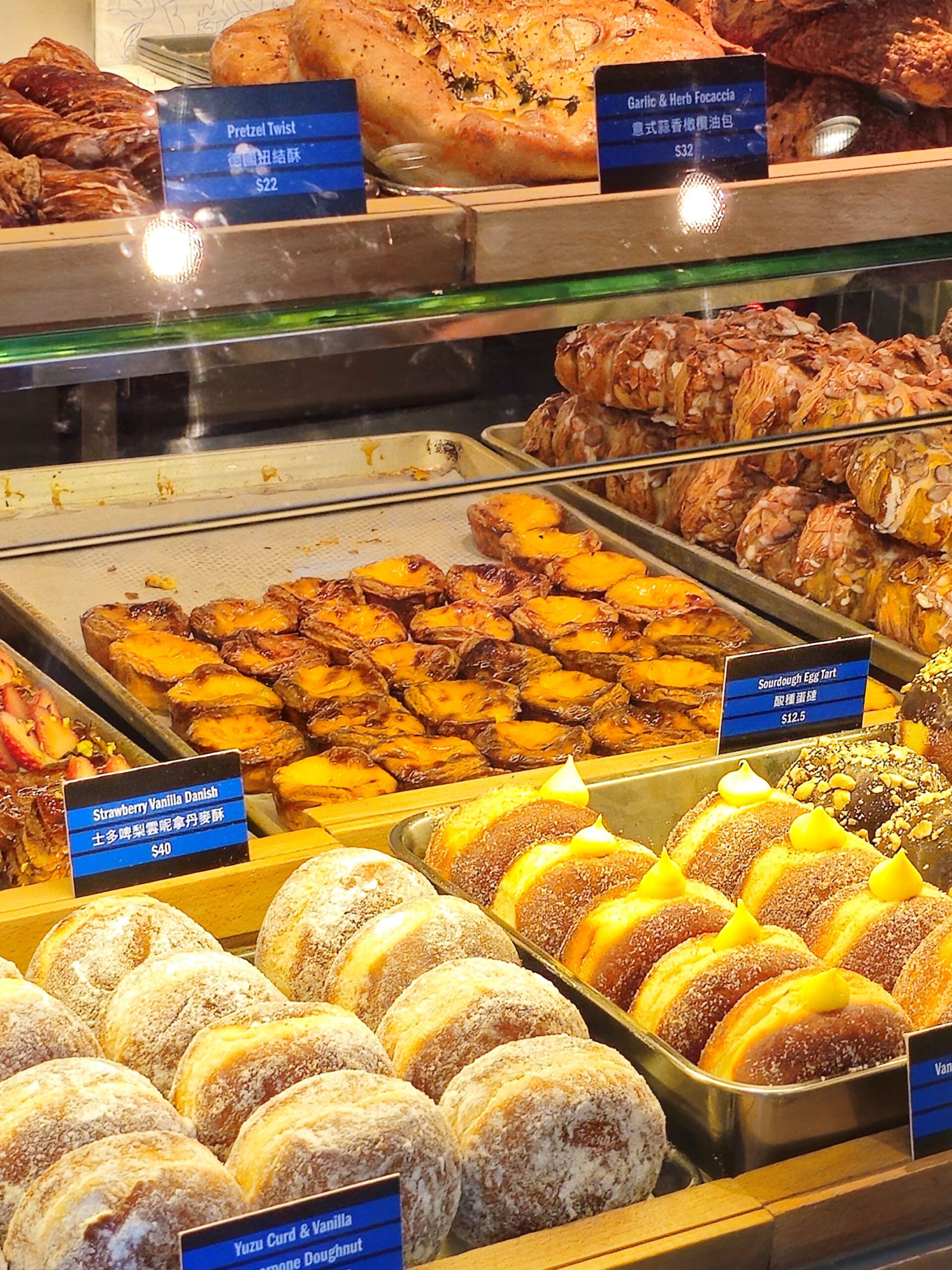
There are two ways to approach a beloved traditional food. The first is to replicate it faithfully — to honor the form and the recipe that have worked for decades. The second is to understand what makes it good and apply better technique to achieve a more refined version of the same thing. Bakehouse chose the second approach, and the result is the most technically accomplished egg tart available in Hong Kong.
I visited the Causeway Bay location during an afternoon spent in the neighborhood — arriving after time at Hysan Place, buying a tart at the counter, and eating it immediately on the pavement outside. The experience confirmed what the reputation had suggested: this is an egg tart that rewards attention, made by someone who has thought seriously about what an egg tart is supposed to be and applied professional pastry skill to achieving it.
This review covers Bakehouse honestly — the background, the egg tart in detail, the broader pastry range, and how it compares to Tai Cheong.

Background: European Technique Meets Hong Kong Tradition
Bakehouse (焙房) was founded by Grégoire Michaud — a Swiss pastry chef with serious European training who spent years working in Hong Kong’s fine dining scene before choosing to apply his technical background to the city’s traditional bakery forms. The decision was deliberate: rather than opening a European-style pâtisserie in Hong Kong, Michaud chose to work with the forms that Hong Kong already had and loved — the egg tart, the pineapple bun, the cocktail bun — and improve them through the application of professional technique and better ingredients.
The philosophy is visible in every product: recognizably Hong Kong in form, elevated in execution. The egg tart is still an egg tart — not a pastel de nata, not a custard tart in the French tradition, but specifically a Hong Kong egg tart made with the technical precision that European pastry training provides.
Bakehouse has expanded from a single location to multiple shops across Hong Kong Island since opening — a reflection of genuine quality rather than aggressive marketing. The Causeway Bay branch is one of the most conveniently located for visitors based on the Island side.

Getting There
Causeway Bay Branch
The Causeway Bay location is the most convenient for visitors spending time in that neighborhood — a short walk from Hysan Place and the main Causeway Bay shopping area.
From Causeway Bay MTR: Walk from the station toward the Hysan Place area — the Bakehouse branch is in the surrounding streets. Google Maps handles the specific routing to the current branch location.
The natural sequence: Hysan Place browsing followed by Bakehouse egg tart, then Bus 56 to the Peak Tram — this is the Causeway Bay afternoon itinerary that makes most sense, and it’s the sequence I followed.
Other Locations
Bakehouse has multiple branches across Hong Kong Island. The specific locations change as the business expands — check the Bakehouse website or Google Maps for current branch locations before visiting. Any branch serves the same products; the Causeway Bay location is noted here for its convenience relative to other tourist-area activities.

The Egg Tart: A Detailed Assessment
The Pastry Shell
Bakehouse uses a flaky laminated pastry — the Macanese-influenced style rather than the traditional Hong Kong shortcrust. Understanding why this matters requires understanding what laminated pastry is and what it achieves differently from shortcrust.
Laminated pastry is made by folding butter into dough repeatedly — the process creates hundreds of thin layers of pastry and butter that, when baked, produce a structure that shatters into multiple flaky layers rather than crumbling as a single piece. The technique is the same used in croissants and puff pastry, applied at a different scale and with different proportions to produce the egg tart shell.
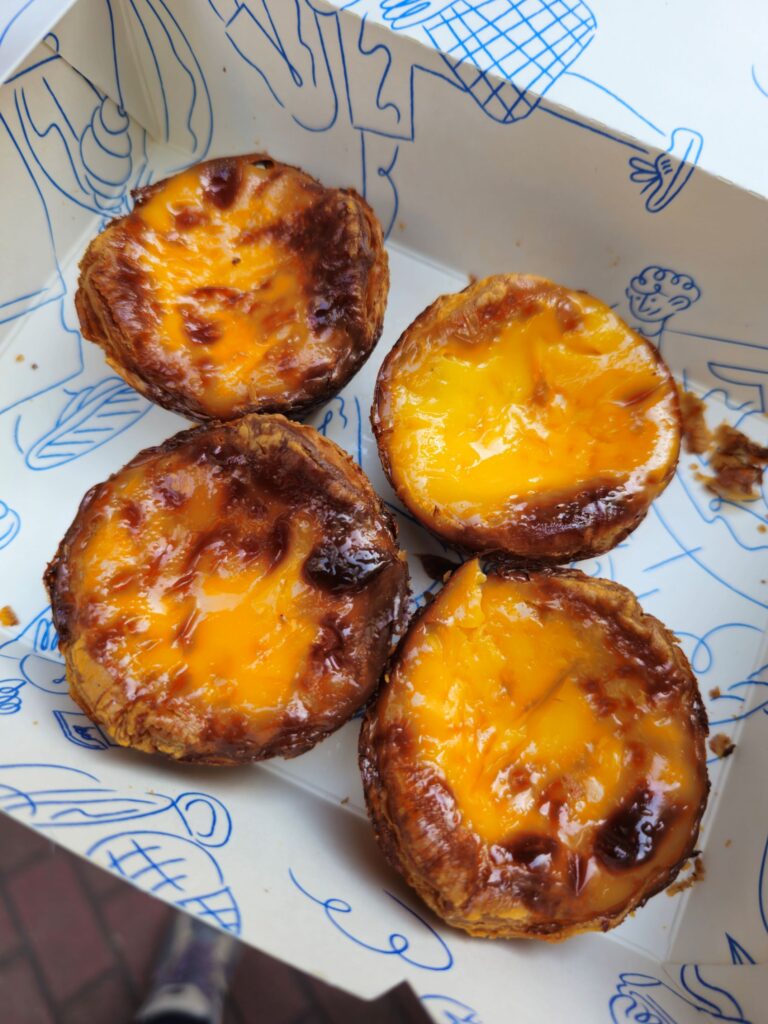
Bakehouse’s flaky shell is immediately distinguishable from Tai Cheong’s shortcrust on visual inspection: the spiral pattern on the base of the shell indicates the lamination structure, and the edges show the layered cross-section where the pastry has puffed and separated during baking. The color is slightly darker than Tai Cheong’s — a deeper caramelization of the butter in the outer layers that adds flavor.
The first bite: The flaky pastry shatters rather than crumbles — the layers separate with a delicate crunch that releases a strong butter fragrance. This fragrance is more pronounced than in shortcrust pastry because the lamination process creates a higher concentration of butter at the surface layers. The texture is lighter than shortcrust — the flaky structure has more air incorporated into it, giving the shell a more delicate mouthfeel.
The structural trade-off: The flaky pastry is more delicate than shortcrust — it’s more susceptible to becoming soggy from the custard over time, and the layers can separate if the tart is handled roughly. This is why eating Bakehouse tarts immediately after purchase is even more important than with Tai Cheong: the flaky structure at its best is a 15-minute window.
The Custard
Bakehouse’s custard is the dimension that most clearly reflects the founder’s professional pastry background — a silkier, more refined version of the Hong Kong egg custard that achieves its texture through tighter control of the baking process.
Set: The custard at Bakehouse is set to a consistency that’s slightly looser than Tai Cheong’s — more wobble at the center, a texture that’s almost liquid at the very middle of the tart when very fresh. This looser set reflects Michaud’s preference for a custard that’s closer to a crème brûlée consistency than to the firmer traditional Hong Kong egg tart custard.
Smoothness: The surface of Bakehouse’s custard is uniformly smooth — no bubbles, no cracks, no variations in color. The consistency of the baking process across every tart in the batch is apparent in this uniformity. Professional pastry kitchen standards applied to a product that traditional Hong Kong bakeries produce with good but less consistent results.
Flavor: Clean egg flavor with the particular richness that comes from higher-quality dairy ingredients. The sweetness is restrained — the custard tastes primarily of fresh eggs and good cream rather than of sugar. There’s a slight vanilla undertone in some versions that adds complexity without overwhelming the egg flavor.
Temperature sensitivity: Bakehouse’s looser custard is more temperature-sensitive than Tai Cheong’s firmer version. Eaten warm, the texture is extraordinary — the layers of flaky pastry and the barely-set custard interact in a way that fresh-from-the-oven tarts achieve. Left to cool, the custard firms up more noticeably than Tai Cheong’s, and the experience changes significantly.
The Complete Experience
The Bakehouse egg tart eaten warm on the pavement outside the shop is the sequence that produces the best version of the experience. The flaky pastry shatters on the first bite; the butter fragrance rises; the barely-set custard fills the mouth with a creaminess that Tai Cheong’s firmer version doesn’t have; the egg flavor is clean and present throughout.
It’s a more technically sophisticated experience than Tai Cheong — more things are happening simultaneously, more texture contrasts are present, more fragrance is released. Whether this sophistication makes it better than Tai Cheong’s simpler version is a matter of preference rather than a technical judgment.
The Broader Pastry Range
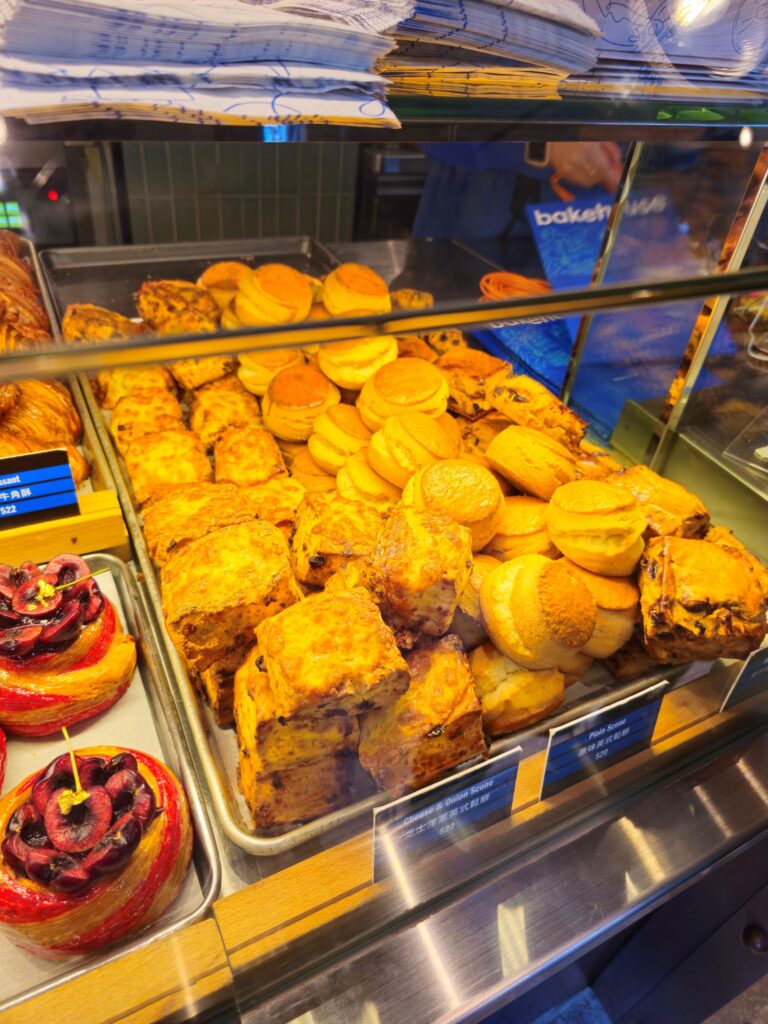
Pineapple Bun (菠蘿包)
Bakehouse’s pineapple bun is the clearest expression of the bakery’s approach applied to a different product: the same Hong Kong form, elevated by better technique and better ingredients. The bun itself is lighter and more refined than the standard version — the crumb structure more open, the texture softer. The sweet, crumbly top is more pronounced and more evenly caramelized than most versions. Eaten warm, with the cold butter filling melting into the bun, it’s the best pineapple bun I ate in Hong Kong.
Cocktail Bun (雞尾包)
The cocktail bun — filled with coconut cream rather than cocktail ingredients, the name being a translation artifact — is another traditional Hong Kong bakery item that Bakehouse makes well. The filling is more refined than the standard version: less sweet, with a cleaner coconut flavor that doesn’t cloy. The bun structure is the same light, open crumb as the pineapple bun.
Portuguese Custard Tart (Pastel de Nata)
Some Bakehouse locations offer the Macanese pastel de nata alongside the Hong Kong egg tart — the direct ancestor of Bakehouse’s flaky-pastry version, with a slightly more caramelized, looser custard in a smaller shell. Eating both in sequence at a location that offers them gives the most complete picture of how the two traditions relate to each other.
Seasonal and Rotating Items
Bakehouse produces seasonal and rotating items beyond the standard range — check the current menu at the branch you’re visiting. The quality standard applied to the signature items extends to the seasonal offerings.


Bakehouse vs Tai Cheong: The Complete Comparison
Having eaten both during the same Hong Kong trip — Tai Cheong one evening, Bakehouse the following afternoon — the comparison is based on direct experience rather than reputation:
Pastry
| Tai Cheong | Bakehouse | |
|---|---|---|
| Style | Shortcrust | Flaky/laminated |
| Texture | Crumbly, firm | Shattering, layered |
| Butter fragrance | Present | More pronounced |
| Character | Traditional, substantial | Refined, delicate |
Custard
| Tai Cheong | Bakehouse | |
|---|---|---|
| Set | Firm wobble | Looser, more trembling |
| Smoothness | Smooth | ✅ More consistent |
| Flavor | Clean, egg-forward | Clean, slightly creamier |
| Temperature sensitivity | Moderate | Higher |
Overall
| Tai Cheong | Bakehouse | |
|---|---|---|
| Tradition | ✅ The original HK style | Contemporary interpretation |
| Technical refinement | Good | ✅ Higher |
| Historical significance | ✅ 70 years, Governor Patten | Recent but excellent |
| Best eaten | Within 30 min | Within 15 min |
| Price | Modest | Slightly higher |
| Location | Lyndhurst Terrace, Central | Multiple Island locations |
The honest verdict: Bakehouse’s egg tart is more technically accomplished. Tai Cheong’s egg tart is more historically significant. Both are among the best versions available in Hong Kong. The comparison between them is more interesting than declaring a winner — the two tarts represent different moments in the same tradition, and experiencing both gives a more complete picture of what Hong Kong’s egg tart culture actually is than choosing one over the other.


Who Should Visit Bakehouse
Visit Bakehouse if:
- Technical refinement in pastry is interesting to you
- You’ve already had Tai Cheong and want to understand the contrast
- The Causeway Bay location is convenient for your afternoon itinerary
- You want the most technically accomplished egg tart currently available in Hong Kong
Also visit Tai Cheong if:
- You’re in Hong Kong for the first time and want the traditional benchmark
- The historical dimension of eating at a 70-year institution matters
- You prefer the firmer, more substantial shortcrust style
- You want the wife cakes as a gift (Tai Cheong’s are better for travel)

Practical Tips
Buy fresh and eat immediately: Bakehouse’s flaky pastry and looser custard make this even more important than at Tai Cheong. The 15-minute window for the best experience is real — buy, step outside, eat.
Check current branch locations: Bakehouse continues to expand — confirm the nearest branch on Google Maps or the Bakehouse website before heading there.
The Causeway Bay sequence: Hysan Place browsing → Bakehouse egg tart → Bus 56 to Victoria Peak is one of the better afternoon-to-evening sequences on Hong Kong Island.
Try the pineapple bun too: The Bakehouse pineapple bun justifies the visit independently of the egg tart — the most refined version of the form available in Hong Kong.
Price: Slightly higher than Tai Cheong — the ingredient quality and technique command a modest premium that the product justifies.


Final Thoughts
Bakehouse is what happens when someone with serious pastry training decides to take Hong Kong’s most beloved pastry form seriously. The result is not a replacement for the traditional egg tart — Tai Cheong remains as relevant as it has always been — but an elevation of it, a demonstration of what the form can achieve when technical precision is applied to it without abandoning what makes it specifically Hong Kong.
The flaky pastry shatters with butter fragrance. The custard trembles when the tart is warm. The combination is more complex than Tai Cheong’s simpler version and rewards the attention that complexity invites.
Buy it warm. Eat it immediately. Compare it with Tai Cheong the previous or following day. And understand that a city with both Tai Cheong and Bakehouse — tradition and refinement existing simultaneously, neither replacing the other — has its food culture in exactly the right condition.
Hong Kong Food Guide: What to Eat and Where
Hong Kong Egg Tart Guide: Tai Cheong vs Bakehouse (And Everything In Between)