

For travelers visiting London, the National Gallery is not simply a museum—it is a deep, living archive of human creativity, emotion, and expression. Standing proudly along the northern edge of Trafalgar Square, the gallery invites millions of visitors each year into its grand halls, offering a journey through more than 700 years of Western art. Even if you are not an art historian or frequent museum-goer, the National Gallery has a unique power to draw you in, slow your pace, and immerse you in stories told through color, light, and movement.
Its presence on Trafalgar Square is iconic. The neoclassical façade—with elegant Corinthian columns, massive stone steps, and a central dome—faces the vibrant plaza filled with fountains, street musicians, and Londoners resting on the steps. This contrast between the liveliness of the square and the calmness inside the gallery is one of its quietest but most beautiful elements.


A Museum Built for the Public
Founded in 1824 with the acquisition of just 38 paintings, the National Gallery was envisioned not as a private royal collection but as an institution for the people. This philosophy is preserved in its free admission policy: anyone can walk in, wander among masterpieces by Da Vinci, Van Gogh, Monet, and Raphael, and leave with a renewed sense of wonder.
Throughout the 19th and 20th centuries, the collection expanded rapidly, necessitating multiple architectural extensions. What began as a modest building has grown into a complex blending classical and postmodern elements. The Sainsbury Wing, completed in 1991, now houses early Renaissance works and serves as one of the most thoughtfully designed museum spaces in London.


Stepping Inside: Quiet, Majesty, and Light
Entering the National Gallery feels like stepping into a sanctuary of art. The noise of the city fades instantly, replaced by soft footsteps, gentle whispers, and the spacious calm of high ceilings and marble corridors. Many visitors describe the gallery as “welcoming,” and it truly is; despite the grandeur of the space, it remains accessible and unintimidating.
The rooms are arranged chronologically, allowing you to walk through Europe’s artistic development from the 1200s to the early 1900s. You are not just viewing paintings; you are moving through time, witnessing how techniques, themes, and human perspectives evolved.

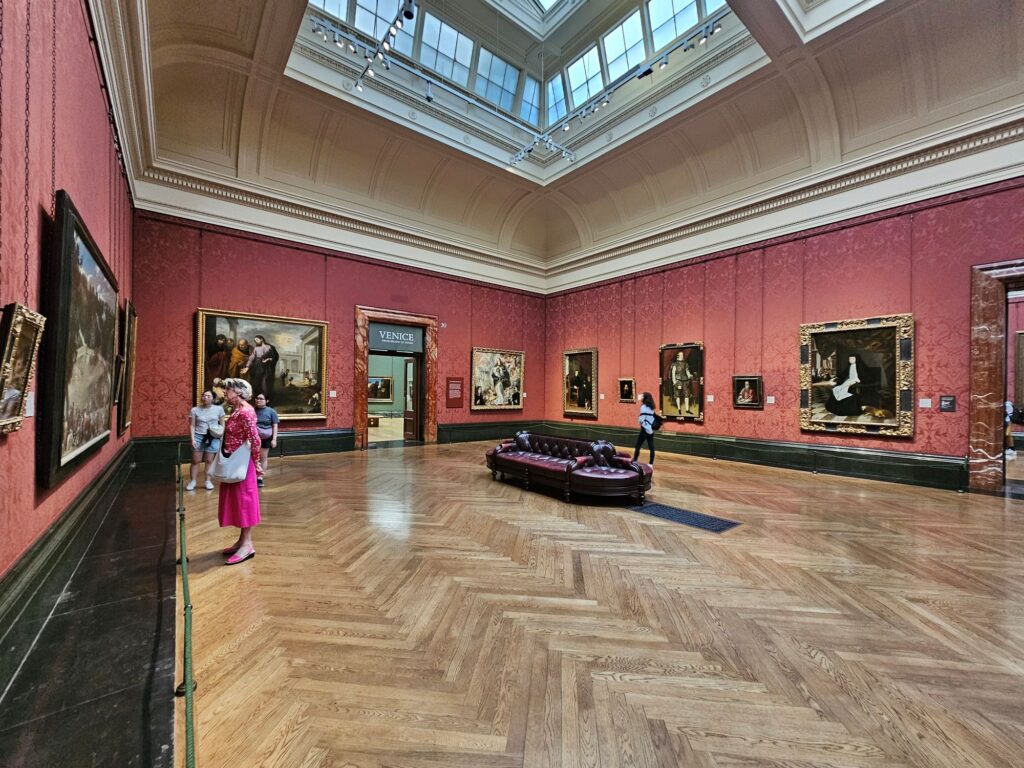

The Renaissance: Where Perspective and Emotion First Bloomed
Early Renaissance rooms introduce you to the foundational transformations of European art:
- Giotto’s early attempts at three-dimensionality
- Duccio’s delicate religious panels
- Fra Angelico’s soft, luminous spiritual paintings
These works may appear simple at first, but when viewed up close, their quiet elegance becomes mesmerizing. The Sainsbury Wing’s carefully designed lighting and warm-toned walls create a contemplative mood perfect for absorbing the significance of these early masterpieces.

The High Renaissance and Baroque: Drama, Depth, and Human Stories
Moving into the 16th and 17th centuries, the paintings grow larger, richer, and more narrative-driven. Here you meet artists whose names dominate art history:
- Raphael, with his harmonious, human-centered compositions
- Titian, whose layers of color feel almost alive
- Caravaggio, dramatically illuminating scenes with intense chiaroscuro
- Rembrandt, capturing human emotion with unmatched subtlety
- Vermeer, creating quiet domestic worlds filled with light
One of the striking things about this part of the gallery is how emotionally powerful the works are. Caravaggio’s The Supper at Emmaus pulls you in with theatrical tension; Rembrandt’s self-portraits confront you with vulnerability and wisdom. These rooms are among the most popular, and for good reason—they show art at its most dramatic and transformative.


The British Masters: Turner and Constable
No visit to the National Gallery is complete without exploring the rooms devoted to Britain’s own artistic legends.
- Constable’s “The Hay Wain” is a serene vision of English countryside life, rendered with extraordinary atmospheric detail.
- Turner, by contrast, uses colour and motion to create scenes that feel closer to emotion than literal landscape. His The Fighting Temeraire is often considered the greatest British painting ever created—a luminous farewell to a warship that once symbolized national pride.
Seeing Turner’s works in person reveals the depth, texture, and luminosity that reproductions simply cannot capture.


Impressionism and the Birth of Modern Art
Toward the end of the gallery’s sequence, the mood shifts again. Here the rooms grow brighter, the brushstrokes looser, and the colours more vibrant. Monet’s shimmering lily ponds, Renoir’s soft portraits, Degas’ ballet dancers, and Cézanne’s angular still-lifes signal the arrival of modernity in art.
The star, of course, is Van Gogh. His Sunflowers draws crowds every day, and standing before it feels like encountering the artist’s energy directly—bold strokes, rich yellows, and an emotional intensity that vibrates through the canvas. Each viewing reveals new details: the rawness of the paint, the subtle variations in tone, the expressive movement of the petals.

How to Explore Without Feeling Overwhelmed
The National Gallery is large—large enough to exhaust you if you attempt to see everything at once. A relaxed, intentional approach makes the experience far more rewarding.
My Recommended Way to Structure a Visit
- Start in the Sainsbury Wing for early Renaissance masterpieces.
- Move into the central galleries for Raphael, Titian, and the Baroque artists.
- Spend time with Turner and Constable, appreciating the evolution of British landscape painting.
- Finish with the Impressionists, letting the softness of Monet and the intensity of Van Gogh close your visit on a high note.
Throughout the museum, benches offer great spots to pause, study the works, and simply breathe in the atmosphere.


A Personal Reflection: The Feeling of the National Gallery
What makes the National Gallery unforgettable is how deeply human the art feels. Even though many pieces are centuries old, the emotions—joy, grief, love, doubt, longing—are instantly recognizable. Standing before these masterpieces, you sense that the artists were trying to understand life in the same way we do today.
Whether you’re spending an hour or an entire afternoon, the gallery creates a gentle shift in your mindset. It slows your steps. It softens your thoughts. It expands your imagination.
And when you step back out into Trafalgar Square, with its fountains glistening under the London sky, you feel refreshed—like you’ve just had a conversation with history itself.
Practical Information
Name: The National Gallery
Address: Trafalgar Square, London WC2N 5DN, United Kingdom
Admission: Free to permanent collection
Opening Hours: Typically 10:00–18:00 (Fridays until 21:00)
Nearest Stations: Charing Cross, Leicester Square
Good For: Art lovers, first-timers in London, families, students, casual visitors, photographers
Big Ben and the London Eye: Timeless Icons of London
Kensington Gardens, London: A Royal Retreat in the Heart of the City