
The AKVO Hotel sits in Central — not on the harbor waterfront, not in the financial district proper, but in the neighborhood’s more interesting middle layer: close enough to the Mid-Levels Escalator to walk to Soho in minutes, close enough to the Star Ferry pier to reach the harbor on foot, and positioned in the kind of Central street that rewards walking slowly rather than moving purposefully between landmarks.
I checked in on the afternoon of January 26th, arriving by Star Ferry from Tsim Sha Tsui with my luggage — the most atmospheric hotel transfer available in Hong Kong, crossing the harbor on the upper deck and walking from Central Pier 7 to the hotel in about 12 minutes. After two nights at the YMCA Salisbury’s harbor-facing position in Tsim Sha Tsui, the AKVO Hotel gave me a completely different version of Hong Kong: less iconic, more textured, and in several ways more interesting.
This review covers the hotel honestly — what the location provides, what the rooms are like, and who should book it.

Location: Central’s Most Useful Middle Ground
The AKVO Hotel’s position in Central is its defining characteristic — and understanding exactly what that position provides requires understanding Central’s geography.
Central divides into three rough layers:
Waterfront layer:    Star Ferry pier, IFC towers,
                     Hong Kong Station (MTR)

Mid-layer:           Central Market, Lan Kwai Fong,
                     the escalator base, Wellington Street

Hillside layer:      Soho, Mid-Levels Escalator,
                     Hollywood Road, residential blocks
The AKVO Hotel sits in the mid-layer — the most useful position for visitors whose itinerary includes the escalator area, Soho dining, Lan Kwai Fong evenings, and the harbor waterfront as equal components of a Central stay. Too far uphill and the waterfront requires a downhill journey; too far waterfront and the escalator area requires an uphill walk. The AKVO’s position splits the difference effectively.
What’s within walking distance:
- Mid-Levels Escalator base: approximately 5 minutes
- Lan Kwai Fong: approximately 5 minutes
- Tsim Chai Kee (wonton noodles): approximately 3 minutes
- Tai Cheong Bakery: approximately 8 minutes
- Lan Fong Yuen (milk tea): approximately 7 minutes
- Central Market: approximately 10 minutes
- Star Ferry Pier 7: approximately 12 minutes
- Central MTR station: approximately 8 minutes
For a two-night stay focused on experiencing Central’s food and neighborhood culture — which is exactly how I used it — this position is nearly perfect. The major Central experiences (escalator, Soho, Lan Kwai Fong, wonton noodles, egg tarts, milk tea) are all walkable without planning a journey.

Getting There
From Tsim Sha Tsui via Star Ferry
The journey I made on January 26th — Star Ferry from Tsim Sha Tsui to Central Pier 7, then a 12-minute walk with luggage to the hotel — is one of the more pleasant hotel transfer experiences available in Hong Kong. Upper deck of the Star Ferry, the Central skyline growing ahead, the walk along the waterfront and then inland through the Central streets with rolling luggage.
The walk from Central Pier 7 is flat and straightforward — no hills until you reach the hotel’s neighborhood, where the Central topography begins. For visitors with heavy luggage, a taxi from the pier covers the distance in minutes.
From the Airport
The Airport Express to Hong Kong Station in Central, followed by a taxi or 8-minute walk to the hotel, is the most direct airport connection. The in-town check-in service at Hong Kong Station — available for most airlines on the departure day — allows guests staying at the AKVO Hotel to check luggage and receive boarding passes at the station before their final day of exploring, which is a significant convenience.
The A11 bus from the airport to various Central stops is the budget alternative — slower than the Airport Express but considerably cheaper. The specific bus stop closest to the AKVO Hotel depends on the exact route; Google Maps handles this routing well.

The Rooms
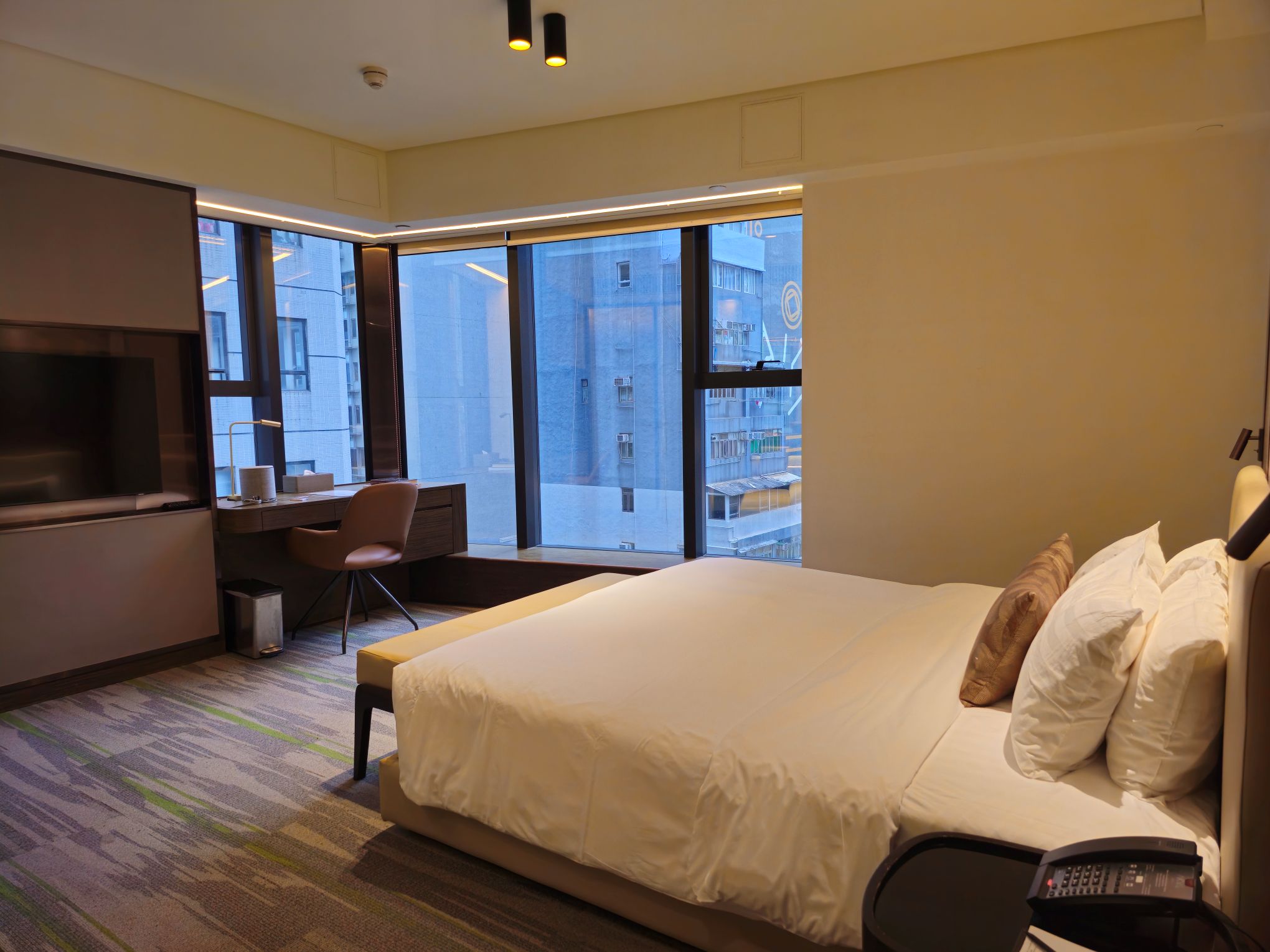
AKVO Hotel rooms reflect the boutique hotel positioning — more design-conscious than the YMCA Salisbury, with a cleaner aesthetic and more attention to room detailing, at a price point above the YMCA but below the major luxury properties.
Room design: The rooms use a neutral palette — clean lines, considered material choices, and the kind of understated design that characterizes Hong Kong’s better boutique properties. The aesthetic reads as contemporary without being aggressively trendy; it will age better than properties that have committed more heavily to a specific design moment.
Room size: Compact — consistent with Hong Kong’s hotel market reality. The AKVO Hotel rooms are well-designed within their dimensions; the space is used efficiently and the layout avoids the cramped feeling that less carefully designed compact rooms produce. For a two-night stay with standard luggage, the room size is entirely workable.
Bathroom: Clean and well-fitted — the bathroom quality is a step above what the YMCA Salisbury provides, with better finishes and more considered design within a similarly compact footprint.
Technology: Reliable Wi-Fi throughout. USB charging ports in convenient bedside positions — a detail that matters more than it sounds after a full day of using your phone for navigation.
Air conditioning: Effective and quiet — important in any Hong Kong hotel, and the AKVO’s climate control handled January’s variable temperatures (cool evenings, mild afternoons) without requiring constant adjustment.

The Boutique Hotel Experience
The AKVO Hotel’s boutique positioning shapes the experience in ways beyond the room design:
Scale: A smaller property than the major chain hotels — fewer floors, fewer rooms, and the more personal service dynamic that smaller scale enables. Staff interaction has a different quality at a 50-room boutique than at a 500-room international chain.
Reception: The check-in experience is more personal than the queue-and-process format of larger hotels. January check-in on a Wednesday afternoon involved no wait and a brief orientation to the neighborhood — useful for the kind of Central exploration I’d planned.
Recommendations: The front desk at a boutique hotel whose business depends on guest satisfaction tends to give more honest neighborhood recommendations than chain hotel concierge desks oriented toward commission-paying establishments. The AKVO’s staff recommendations for nearby eating were accurate and local-facing rather than tourist-facing.

Using the Hotel as a Central Base
The AKVO Hotel’s value as a base is best demonstrated through how I actually used the two days of the stay:
January 26th (check-in day):
Afternoon: Star Ferry from Tsim Sha Tsui
           → Check in to AKVO Hotel
           → Lin Heung Tea House lunch
             (15 minutes walk west)
           → Mid-Levels Escalator walk
             (5 minutes to escalator base)
           → Amo·Ago coffee (escalator area)
           → On Running store
           → Central Market
           → Tsim Chai Kee wonton noodles
             (3 minutes from hotel)
           → Tai Cheong Bakery egg tart
           → Taxi to Observation Wheel
           → Lan Kwai Fong
             (5 minutes from hotel)
January 27th:
Morning:   88 Soondubu breakfast
           → Bus to Monster Building
           → MTR Tai Koo to Causeway Bay
           → Hysan Place, Bakehouse,
             Jardine's Crescent
           → Bus 56 to Peak Tram
           → Victoria Peak night view
           → Bus 15 to Central
           → Maru Korean Pub
             (Central, near hotel)
The hotel’s position meant that Tsim Chai Kee wonton noodles and Tai Cheong Bakery egg tarts — two of the most compelling food stops in Central — were walkable without planning. Lan Kwai Fong was a five-minute walk for evening drinks. The Mid-Levels Escalator was close enough to use without considering it a journey.

Comparison: AKVO Hotel vs Other Central Options
vs YMCA Salisbury (Tsim Sha Tsui)
The comparison I made directly across the two nights of each stay:
YMCA Salisbury: Simpler rooms, lower price, unmatched harbor-promenade location. The hotel to book if the Tsim Sha Tsui harbor experience is the priority and room quality is secondary.
AKVO Hotel: Better room design, higher price, excellent Central neighborhood position. The hotel to book if Central’s food and cultural depth is the priority and harbor proximity is secondary.
Neither is objectively better — they serve different versions of the Hong Kong experience equally well.
vs Mandarin Oriental (Central)
The Mandarin Oriental is one of Hong Kong’s landmark luxury hotels — adjacent to the Star Ferry pier and the financial district, with harbor views, the full luxury amenity suite, and prices that reflect all of the above. The AKVO Hotel offers a fraction of the Mandarin Oriental’s facilities at a fraction of the price, with a more interesting neighborhood position (the Mandarin’s waterfront location is less useful for the escalator and Soho areas than the AKVO’s mid-Central position).
For visitors for whom the hotel experience itself is a significant component of the trip, the Mandarin Oriental is the correct choice. For visitors for whom the city experience is primary and the hotel is where you sleep, the AKVO Hotel provides more useful positioning at a more practical price.
vs Boutique Hotels in Sheung Wan
Several boutique properties operate in Sheung Wan — one MTR stop west of Central — at prices comparable to the AKVO Hotel. The Sheung Wan options have a more historical neighborhood character and proximity to Lin Heung Tea House and the antique shops of Hollywood Road; the AKVO Hotel has better positioning for Lan Kwai Fong, the escalator, and the financial district areas of Central.
The choice depends on which Central experiences are the priority — Lin Heung and Hollywood Road (Sheung Wan wins) versus Soho, Lan Kwai Fong, and wonton noodles (AKVO Hotel wins).

What the AKVO Hotel Is Not
Honest reviews require covering what a hotel doesn’t provide:
Harbor view: The AKVO Hotel is not a harbor-view property — the location in Central’s mid-layer means harbor views are not part of the room experience. For visitors for whom waking up to the harbor is important, the YMCA Salisbury or the Tsim Sha Tsui properties are the correct choice.
Extensive facilities: The AKVO Hotel is a boutique property — no swimming pool, limited gym facilities, and a smaller footprint than the major chain properties. The hotel’s value is in its location and room quality, not in on-property amenities.
Iconic lobby: The AKVO Hotel’s entrance and public spaces are well-designed but modest — there’s no Peninsula-style lobby to impress visitors or justify a drink. The hotel is a base rather than a destination.

Practical Information
Address: Central, Hong Kong Island — confirm the specific address on the AKVO Hotel website or Google Maps before booking, as the exact street address matters for the walking distances noted above.
Check-in/Check-out: Standard Hong Kong hotel hours — typically 3pm check-in, 12pm check-out. Luggage storage is available for the final day of exploring after check-out.
Booking: Book directly through the hotel website or major booking platforms. Advance booking is recommended for peak periods.
Getting there: Star Ferry from Tsim Sha Tsui to Central Pier 7 plus 12-minute walk (most atmospheric); Airport Express to Hong Kong Station plus short taxi or walk (most practical from airport); Central MTR station plus 8-minute walk.
Neighborhood orientation: On check-in, ask for the hotel’s neighborhood map and recommendations — the staff’s local knowledge of the immediately surrounding streets is more useful than generic concierge information.

Final Thoughts
The AKVO Hotel earns its place in a Hong Kong itinerary not through impressive facilities or iconic views but through the quality of its positioning within Central — a mid-layer location that makes the neighborhood’s best experiences walkable without planning a journey.
Tsim Chai Kee wonton noodles three minutes away. Lan Kwai Fong five minutes in one direction. The Mid-Levels Escalator five minutes in another. Tai Cheong Bakery eight minutes. Lan Fong Yuen seven minutes. The Star Ferry pier twelve minutes.
For a two-night stay whose purpose is experiencing Central’s food culture, neighborhood character, and evening atmosphere, the AKVO Hotel provides exactly the right base. The rooms are well-designed within Hong Kong’s compact hotel dimensions. The service is personal in the way boutique hotels can be. And the location means that most of what makes Central worth staying in is accessible by walking out of the front door.
That’s what a good hotel base should do. The AKVO Hotel does it.
YMCA Salisbury Hotel Hong Kong Review: The Best Location in Tsim Sha Tsui
Where to Stay in Hong Kong: Complete Area-by-Area Guide