

Rome doesn’t ease you in gently. From the moment you step out of the airport transfer and into the city, it hits you all at once — ancient ruins sitting casually between modern apartment buildings, scooters weaving past 2,000-year-old walls, the smell of espresso from a bar that’s been in the same spot for decades. I’ve been to Rome in every season, multiple times, and the city has never once felt ordinary.
This 4-day itinerary is built around the way Rome actually works — grouping sights by area to minimize transit time, front-loading the must-sees while leaving room for the kind of wandering that Rome rewards more than almost any other city. Whether it’s your first visit or your fourth, this is how to do it properly.

Before You Go: Quick Essentials
Getting around Rome Rome’s historic center is surprisingly walkable — many of the city’s most famous sights are within 20–30 minutes of each other on foot, and walking between them is often the best way to discover the city’s layers. That said, Rome’s public transport covers the gaps well when distances are too long.
The Metro has two main lines useful for tourists: Line A connects Termini station to the Spanish Steps (Spagna), Vatican area (Ottaviano), and out to the northwest; Line B connects Termini to the Colosseum (Colosseo). Buy a 48-hour or 72-hour travel pass rather than individual tickets if you’re using public transport regularly — it covers metro, buses, and trams.
Buses cover the areas the metro doesn’t reach — particularly useful for getting between Trastevere, the historic center, and the Vatican. They’re slower than the metro but give you the city at street level.
For short distances, walking is almost always the right answer in central Rome. The map looks large but collapses quickly on foot, and the streets between major sights consistently reward exploration.
Taxis are metered and reliable. Use them for late nights, airport transfers, or when carrying luggage. Rideshare apps (Uber operates in Rome in a limited capacity) are an alternative.
Weather Rome’s best seasons are spring (April–May) and autumn (September–October) — warm, comfortable, and manageable crowds. Summer (June–August) is hot, often exceeding 35°C, and extremely crowded at major sites. Winter is mild by northern European standards (10–15°C) and significantly quieter — a genuinely good time to visit if heat and crowds are a concern. I’ve been in all four seasons and each has its own character; spring and autumn remain the most comfortable overall.
Practical tips
- Book Vatican Museums and Colosseum tickets well in advance — both sell out days or weeks ahead in peak season
- Carry cash for smaller restaurants, bars, and markets — many don’t accept cards
- Tap water in Rome is safe and excellent — drinking fountains (nasoni) are throughout the city
- Dress code applies at Vatican and major churches — shoulders and knees must be covered
- Most major churches are free to enter; some require timed entry tickets

Where to Stay in Rome
Historic Center (Centro Storico) The most convenient base — walking distance from the Pantheon, Campo de’ Fiori, Piazza Navona, and Trastevere. More expensive than other areas but unbeatable for access and atmosphere.
Trastevere Rome’s most atmospheric neighborhood — cobblestone streets, ivy-covered buildings, excellent restaurants, and a lively evening scene. Slightly removed from the main sights but easy to reach by bus or on foot. A strong choice for repeat visitors who want something beyond the tourist center.
Termini Area The most practical and affordable option — well-connected by metro and bus to everywhere in the city. Less atmospheric than the historic center but significantly cheaper, and the area has improved considerably in recent years.
Prati (near Vatican) Quiet, residential, and well-connected. Good choice if Vatican is a priority and you want a calmer base than the historic center.

Day 1 — The Ancient City: Colosseum, Roman Forum, and Capitoline Hill
Give your first full day to ancient Rome — the layer of the city that sits beneath everything else and gives Rome its singular weight in the world.
Colosseum
Start at the Colosseum (Colosseo) — the largest amphitheater ever built and one of the most recognizable structures in human history. Construction began under Emperor Vespasian in 72 AD and was completed in 80 AD; at its peak it held 50,000–80,000 spectators for gladiatorial contests, animal hunts, and public spectacles that defined Roman entertainment for centuries.
Standing inside the Colosseum — looking down at the exposed hypogeum (the underground tunnels where gladiators and animals were held before entering the arena), up at the tiered seating rising around you — gives a sense of the Roman Empire’s organizational capacity and appetite for spectacle that no photograph communicates. The scale is genuinely impressive even after you’ve seen it in every form of media.
Book tickets online well in advance — the Colosseum sells out regularly in peak season and the queue for same-day tickets can stretch for hours. The combined ticket includes the Roman Forum and Palatine Hill, which you’ll visit immediately after.
Tip: The standard ticket gives you access to the arena floor and lower levels. The underground and upper tier experiences require separate booking and are worth it for a second visit — for a first visit, the standard access is the right choice.
Roman Forum and Palatine Hill
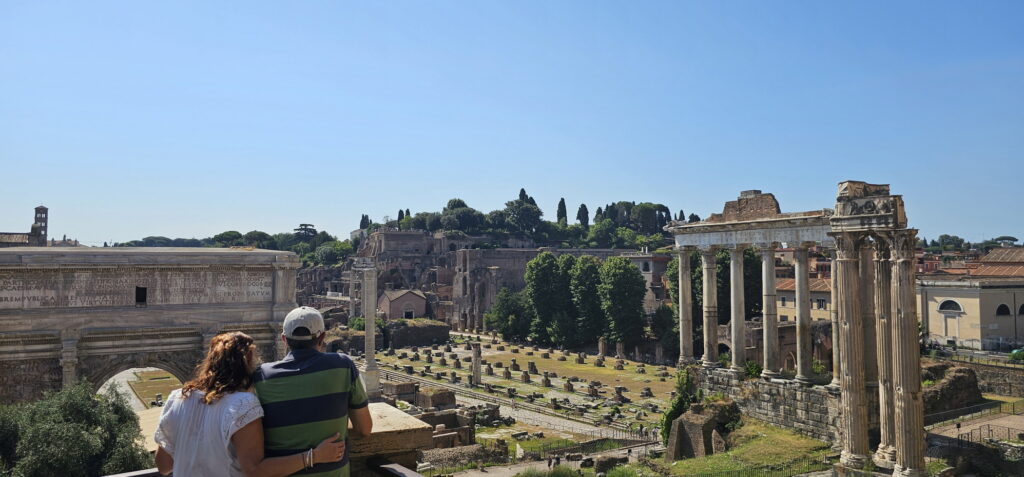
Directly adjacent to the Colosseum, the Roman Forum (Foro Romano) is the ancient heart of the Roman Empire — the central public space around which Roman political, religious, and commercial life organized itself for centuries. Walking through it today, the ruins of temples, basilicas, and triumphal arches rise from the ground in various states of preservation, with the Palatine Hill rising above.
It requires some imagination to reconstruct what the Forum looked like at its height — an audio guide or a guidebook with reconstructed illustrations helps considerably. Take your time here; the Forum is larger than it appears from the outside and the individual structures reward closer attention.
Palatine Hill above the Forum is where Rome’s emperors built their palaces — the word “palace” derives from Palatine — and the views from the top over the Forum below and toward the Colosseum are among the finest in the city.

Campidoglio (Capitoline Hill) and Altare della Patria
From the Forum, climb to Campidoglio (Capitoline Hill) — the civic heart of Rome since antiquity, redesigned by Michelangelo in the 16th century. The Capitoline Museums here are the world’s oldest public museums, housing an extraordinary collection of ancient sculpture including the original Marcus Aurelius equestrian statue and the Capitoline Wolf. Budget 2–3 hours if you visit.
Walk to the back of the Campidoglio square for the Tarpeia Rock viewpoint — one of the most underrated views in Rome, looking directly down into the Forum below with the Colosseum beyond.
Just below Capitoline Hill on Piazza Venezia stands the Altare della Patria (Vittoriano) — the massive white marble monument built to honor unified Italy and the first king, Victor Emmanuel II. It’s overwhelming in scale and polarizing among Romans (nicknamed “the wedding cake” and “the typewriter”), but the free elevator to the top offers a 360-degree panoramic view over the entire city that is genuinely spectacular. Go at golden hour.
🗓 Local tip for Day 1: The Colosseum is best visited when it opens (9am) or in the last hour before closing. Midday crowds in summer are genuinely overwhelming — timing your visit to either end of the day makes a significant difference to the experience.

Day 2 — Vatican City: St. Peter’s and the Museums
Give a full day to Vatican City — the world’s smallest sovereign state and the spiritual center of the Catholic Church. There’s more here than most visitors realize, and attempting to rush it in half a day consistently results in missing the best of it.
Vatican Museums and Sistine Chapel
The Vatican Museums house one of the greatest art collections in the world — accumulated over five centuries of papal patronage. The collection spans ancient Egyptian artifacts, Greek and Roman sculpture (the Laocoön group, the Apollo Belvedere), Renaissance paintings, maps, and the apartments of the Borgia popes — all leading eventually to the Sistine Chapel.
The Sistine Chapel ceiling — painted by Michelangelo between 1508 and 1512 — is one of the supreme achievements of Western art. The scale of the undertaking (roughly 500 square meters of fresco, painted lying on scaffolding over four years) and the quality of the result are both more impressive in person than any reproduction suggests. The Last Judgment on the altar wall, painted 25 years later, is equally extraordinary.
Book tickets online well in advance — Vatican Museums tickets sell out regularly and the queue for same-day entry can be 2–3 hours. Early morning entry (first slot of the day) gives you the museums with significantly fewer people and is worth the early start.
Budget at least 3 hours for the museums, more if you want to spend proper time in the galleries rather than moving steadily toward the Sistine Chapel.

St. Peter’s Basilica
St. Peter’s Basilica is free to enter — no ticket required, though the queue to enter can be long at peak times. The interior scale is difficult to fully process at first: the nave stretches 186 meters, the dome rises 136 meters above the floor, and the total area covers over 15,000 square meters. Every element is executed at a level of craft and ambition that reflects four centuries of continuous construction and the resources of the Catholic Church at its most powerful.
Michelangelo’s Pietà — in the first chapel on the right as you enter — is one of the most moving sculptures in existence. The marble is worked to a degree of refinement that still defies understanding five centuries after its completion.
Climb St. Peter’s dome for the best elevated view of Rome available — 551 steps (or elevator partway, then steps for the final section). The view from the top, over the colonnade of St. Peter’s Square and across the rooftops of Rome, is extraordinary. The climb through the curved walls of the dome interior is itself an architectural experience.
St. Peter’s Square below — designed by Bernini, surrounded by his colonnade of 284 columns — is one of the finest public spaces in Europe. Arrive early morning before the crowds gather for the clearest sense of its scale and geometry.
🗓 Local tip for Day 2: Wednesday mornings when the Pope holds a public audience in St. Peter’s Square draw very large crowds — plan your Vatican visit on a different day unless attending the audience is a priority.

Day 3 — The Historic Center: Pantheon, Trevi Fountain, and Spanish Steps
Day three covers the historic center — the Rome of Baroque fountains, ancient temples converted to churches, and the streets that most people picture when they think of the city.
Pantheon
Start at the Pantheon — built by Emperor Hadrian around 125 AD and the best-preserved ancient Roman building in existence. It has been in continuous use for nearly 2,000 years — as a temple, then as a church from 609 AD to the present. The engineering achievement at its center is the unreinforced concrete dome, 43.3 meters in diameter with an open oculus (eye) 8.7 meters wide at its apex — a feat of structural engineering that remained unsurpassed for over 1,300 years.
Standing beneath the dome and looking up at the oculus — through which a perfect circle of sky (or rain, in wet weather) is visible — is one of Rome’s most affecting experiences. The light that falls through the oculus moves across the interior as the day progresses, creating a natural sundial effect that Hadrian almost certainly intended.
Entry now requires a timed ticket — book online in advance. Early morning is the best time to visit, when the interior light is at its most atmospheric.
Campo de’ Fiori
Walk from the Pantheon to Campo de’ Fiori — one of Rome’s most lively squares, home to a daily morning market selling fresh produce, flowers, cheese, and street food. The market runs until early afternoon and is one of the most enjoyable ways to spend a Rome morning — browsing the stalls, eating suppli (fried rice balls) from a nearby bar, watching the square operate at its own pace.
In the evening, Campo de’ Fiori transforms into one of the city’s main social hubs — bars and restaurants line the square, and the atmosphere from aperitivo hour onward is lively and very Roman.

Trevi Fountain
Walk to the Trevi Fountain (Fontana di Trevi) — the largest Baroque fountain in Rome and one of the most visited sites in the world. Completed in 1762, it depicts Neptune’s chariot emerging from the sea on the facade of Palazzo Poli. The scale of it — arriving through a narrow street to find this enormous fountain filling an entire small piazza — is always a surprise, even when you know what’s coming.
The tradition of throwing a coin over your left shoulder with your right hand to ensure a return to Rome has been practiced here since the mid-20th century. Approximately €3,000 in coins are collected from the fountain daily and donated to charity.
Visit early morning (before 8am if possible) or late evening for the best experience — midday crowds make it difficult to properly appreciate. The fountain illuminated at night, with fewer people and the water lit from below, is the most atmospheric version.

Piazza di Spagna and Spanish Steps
Walk from Trevi to the Spanish Steps (Scalinata di Trinità dei Monti) — 135 steps connecting Piazza di Spagna below to the Trinità dei Monti church above, built in the 18th century and one of Rome’s most famous gathering places. The steps themselves are the attraction — a broad, curving staircase that fills with people at all hours, particularly at sunset when the light is at its best.
At the base of the steps, the Barcaccia Fountain — designed by Pietro Bernini (father of Gian Lorenzo) — takes the form of a half-submerged boat, an unusual and charming piece of Baroque design.
The Pincian Hill (Pincio) above the Spanish Steps connects to the Villa Borghese gardens — walk up through the gardens for one of the best panoramic views over Rome, looking west toward St. Peter’s dome. The terrace at the top of the Pincian Hill at golden hour is one of Rome’s finest viewing points and consistently overlooked by visitors focused on the steps below.
🗓 Local tip for Day 3: The Trevi Fountain is cleaned and briefly drained for maintenance periodically — check before your visit. The fountain lit at night with minimal crowds is the version worth seeing; plan your visit accordingly.

Day 4 — Borghese Gallery, Castel Sant’Angelo, and Trastevere
Borghese Gallery and Villa Borghese
The Borghese Gallery (Galleria Borghese) is, by some measure, the finest small museum in Rome — and the booking requirement that frustrates visitors is the reason it remains so. Entry is strictly limited to 360 people per 2-hour slot, which means the galleries are never crowded and every work can be seen properly. Book online months in advance — this is not an exaggeration. The gallery sells out weeks ahead during peak season.
The collection assembled by Cardinal Scipione Borghese in the early 17th century represents an extraordinary concentration of genius: six early Bernini sculptures — including Apollo and Daphne, The Rape of Proserpina, and David — occupy the ground floor rooms alongside Caravaggio paintings including Boy with a Basket of Fruit and David with the Head of Goliath. The upper floor contains Raphael’s Deposition, Titian’s Sacred and Profane Love, and works by Rubens and Correggio.
The Bernini sculptures alone justify the visit — Apollo and Daphne in particular, with Daphne’s fingers transforming into laurel branches at the moment of Apollo’s touch, is one of the most technically extraordinary sculptures ever made. Give it the time it deserves.
The Villa Borghese gardens surrounding the gallery are Rome’s largest public park — pleasant for a walk before or after the museum, with rowing boats available on the lake and good views from the Pincian Hill terrace.

Castel Sant’Angelo
Walk from the Borghese area down toward the Tiber to Castel Sant’Angelo — originally built as a mausoleum for Emperor Hadrian in 139 AD, converted into a papal fortress in the medieval period, and connected to the Vatican by the covered passageway (the Passetto di Borgo) through which popes escaped during sieges. Today it’s a museum with excellent views from the top terrace over the Tiber and toward St. Peter’s.
The Ponte Sant’Angelo (Bridge of Angels) leading to the castle — lined with Bernini’s angel sculptures — is one of the most beautiful bridge approaches in Rome and worth crossing slowly in both directions.
Trastevere
End your final evening in Trastevere — Rome’s most atmospheric neighborhood, a tangle of cobblestone streets and ochre-colored buildings on the west bank of the Tiber. It’s the neighborhood that most consistently delivers the Rome of imagination — streets narrow enough to touch both walls simultaneously, laundry strung between windows, ivy growing over ancient brickwork, the smell of dinner coming from restaurants that have been in the same family for generations.
Santa Maria in Trastevere — one of Rome’s oldest churches, with 12th-century mosaics covering the apse — is worth visiting before dinner. The square outside is one of the most pleasant in the city for an aperitivo.
Eat dinner in Trastevere rather than the tourist center — the neighborhood has some of Rome’s best trattorias at prices that reflect a local clientele. Look for places without a menu posted outside in six languages and without a host standing at the door encouraging you to enter.
🗓 Local tip for Day 4: Borghese Gallery tickets require booking months ahead during peak season — this is the single most important advance booking in Rome. If the gallery is sold out, the gardens and Pincian Hill terrace are free and still excellent.

What to Eat in Rome
Roman cuisine is one of the most distinctive regional food cultures in Italy — focused on a small number of dishes executed with exceptional consistency, built around a few key ingredients.
Pasta
- Cacio e pepe — pasta with pecorino romano cheese and black pepper. Three ingredients, infinite variation in quality. The version at a good Roman trattoria is completely different from what’s sold as cacio e pepe outside Italy.
- Carbonara — egg yolk, guanciale (cured pork cheek), pecorino, black pepper. No cream. Ever. The Roman version is rich, silky, and definitive.
- Amatriciana — tomato, guanciale, pecorino. The foundational Roman pasta sauce, originating from the nearby town of Amatrice.
- Gricia — guanciale and pecorino without tomato — the oldest of Rome’s pasta dishes and the least known outside Italy. Order it if you see it.
Street food
- Supplì — fried rice balls filled with ragù and mozzarella, sold from bars and street stalls throughout the city. Best eaten immediately, standing outside.
- Pizza al taglio — pizza sold by weight from trays in bakeries. The Roman style is thin-crusted, crisp, and available with an enormous variety of toppings. Grab a piece for lunch.
- Artichokes (carciofi) — Rome’s signature vegetable, prepared two ways: alla giudia (deep-fried whole, crisp outside and tender inside, from the Jewish Ghetto tradition) and alla romana (braised with garlic and mint). Order both.
Gelato Roman gelato ranges from tourist-trap to extraordinary. Look for gelaterias where the gelato is stored in covered metal containers rather than piled in colorful mountains — the covered version indicates proper artisanal production. Fior di latte (cream), pistachio, and stracciatella (chocolate chip) are the benchmarks for quality.
Coffee Rome’s bar culture operates differently from what most visitors expect. Espresso is drunk standing at the bar in under two minutes — sitting down typically costs significantly more. Order un caffè (espresso), drink it at the counter, pay, and leave. This is how Romans do it, and doing it the Roman way is the right approach.

Practical Tips for Rome
- Book in advance: Vatican Museums, Colosseum, and Borghese Gallery all require advance booking — do this before you arrive
- Dress code: Vatican and major churches require covered shoulders and knees — carry a scarf or light layer
- Drinking water: Rome’s tap water is excellent; nasoni (street drinking fountains) are everywhere and free
- Cobblestones: Rome’s streets are beautiful and hard on feet — comfortable walking shoes from day one
- Pickpockets: Be aware around the Colosseum, Trevi Fountain, and on buses — keep valuables secure
- Afternoon closures: Some smaller churches and museums close 12–3pm — plan accordingly
- Restaurant timing: Romans eat lunch 1–3pm and dinner from 8pm onward — arriving at 6:30pm you’ll often be the only people in the restaurant

Final Thoughts
Four days in Rome is enough to cover the essential layers — ancient, Renaissance, Baroque — and begin to understand why the city has drawn visitors for centuries. But Rome also rewards returning. Each visit reveals something missed before: a courtyard glimpsed through an open gate, a church with a Caravaggio that wasn’t on the itinerary, a trattoria in Trastevere that becomes the meal you talk about for years afterward.
Go early to the major sites. Eat standing at the bar. Walk everywhere you reasonably can. And leave at least one afternoon without a plan — Rome will fill it better than any itinerary.
Basilica di Santa Maria Maggiore
Vatican Museums, Rome: A Journey Through Faith, Power, and Eternal Beauty