

There is a version of London that most first-time visitors never find. It doesn’t involve Buckingham Palace or the Houses of Parliament. It doesn’t ask you to queue for two hours at a tourist attraction or sit through a double-decker bus commentary delivered by a bored guide with a microphone. It’s the London that actually lives and breathes — the one that smells of curry and freshly cut flowers, sounds like five languages spoken simultaneously at a market stall, and looks like a post-graduate exhibition at an art school where the walls of the entire neighbourhood are the canvas.
That London is Shoreditch and Brick Lane. And once you’ve spent a full day here, you’ll wonder why you ever bothered with the tourist trail at all.
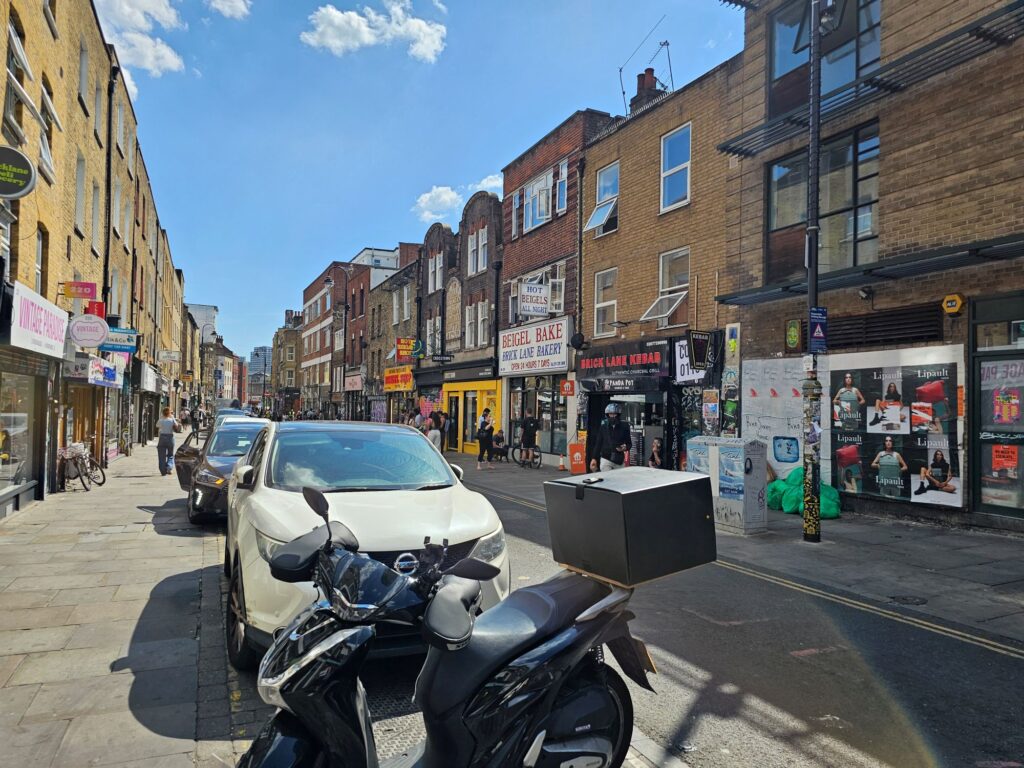
Where Is Shoreditch, and What Exactly Is Brick Lane?
Shoreditch sits in the inner East End of London, technically in the London Borough of Hackney, pressed up against the edge of the City of London — the square mile of glass towers and banking headquarters that represents the capital’s financial heartland. The proximity is deliberate, and it’s part of what makes Shoreditch so fascinating: nowhere else in London does the raw creative energy of an arts district sit in such direct, almost confrontational contrast with the slick corporate world next door.
Brick Lane is the spine that runs through the heart of this area, a long, narrow street connecting the neighbourhoods of Whitechapel to the south and Shoreditch to the north, passing through Spitalfields along the way. It is named, simply enough, for its history as a centre of brick and tile manufacturing dating back to the 15th century — the clay under East London proved ideal for the purpose, and the industry left its name on the street long after it departed.
What came after is a story of successive waves of immigration, each leaving a permanent mark on the character of the street and the neighbourhood around it. French Huguenots fleeing religious persecution arrived in the 17th century, followed by Irish immigrants and then a significant Jewish community in the 19th and early 20th centuries — hence the bagel shops (spelled “beigel” in the older tradition) that still anchor the northern end of the lane. From the 1970s onward, a large community of Bangladeshi and Sylheti immigrants settled here, transforming Brick Lane into London’s most famous curry corridor, a title it holds to this day. More recently, waves of artists, tech workers, and creatives have added yet another layer to a street that seems constitutionally incapable of standing still.
Understanding this history doesn’t just add context to a visit — it transforms the experience entirely. Every curry house, every bagel shop, every mural, every market stall is a chapter in a story that stretches back centuries.
Getting to Shoreditch and Brick Lane
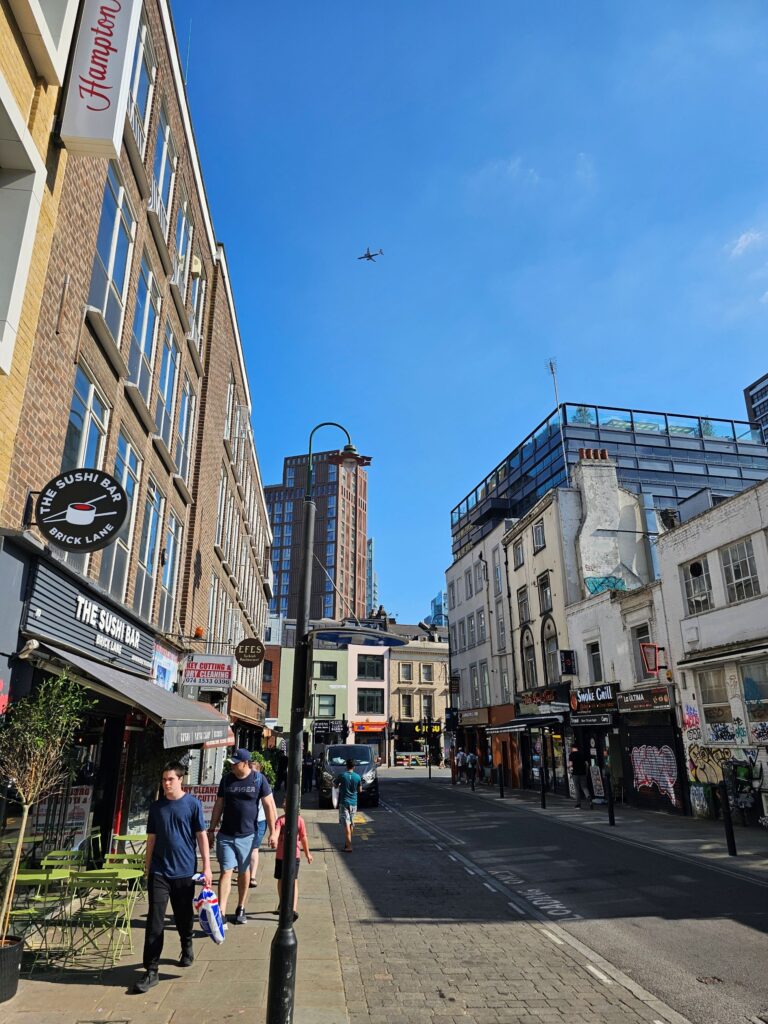
Shoreditch and Brick Lane are extremely well served by public transport, and the area rewards those who arrive on foot or by bike. Here’s how to get there:
By London Underground (Tube)
Aldgate East Station (District Line, Hammersmith & City Line) is the closest Tube station to Brick Lane’s southern end — from the station, it’s roughly an 8–10 minute walk north to reach the heart of the lane. Liverpool Street Station (Central, Circle, Hammersmith & City, Metropolitan, Elizabeth line, plus National Rail and DLR) is slightly further but enormously well connected — from there, Brick Lane is about a 12–15 minute walk east, passing through the historic streets of Spitalfields on the way.
By London Overground
Shoreditch High Street Station (Windrush Line / East London Line) is arguably the most convenient option if you’re coming from other parts of East London or south of the river. It deposits you directly at the northern end of Brick Lane, putting you right in the thick of things within a few minutes’ walk. Hoxton Station (also Windrush Line) is a 10–15 minute walk from Brick Lane and an excellent option if you want to begin your day at Columbia Road Flower Market before heading south.
By Bus
Multiple bus routes serve the area. Routes 8, 26, 35, 47, 48, 55, 78, 149, 242, 243, and 388 all stop within a short walk of Brick Lane. The bus network in this part of East London is dense and reliable, and for visitors staying in central London, it’s often the most direct above-ground option.
By Santander Cycles (Boris Bikes)
Docking stations for London’s public hire bikes are plentiful throughout Shoreditch and the surrounding area. Hiring a bike is an excellent way to explore the neighbourhood at your own pace, allowing you to cover ground between Columbia Road, Brick Lane, and Spitalfields without being constrained to walking speed. Daily access is priced at £1.65, with rides under 30 minutes included in the access fee.
Admission
Entry to Shoreditch and Brick Lane as a neighbourhood is, of course, free. Individual markets, shops, and attractions have their own pricing, detailed below.
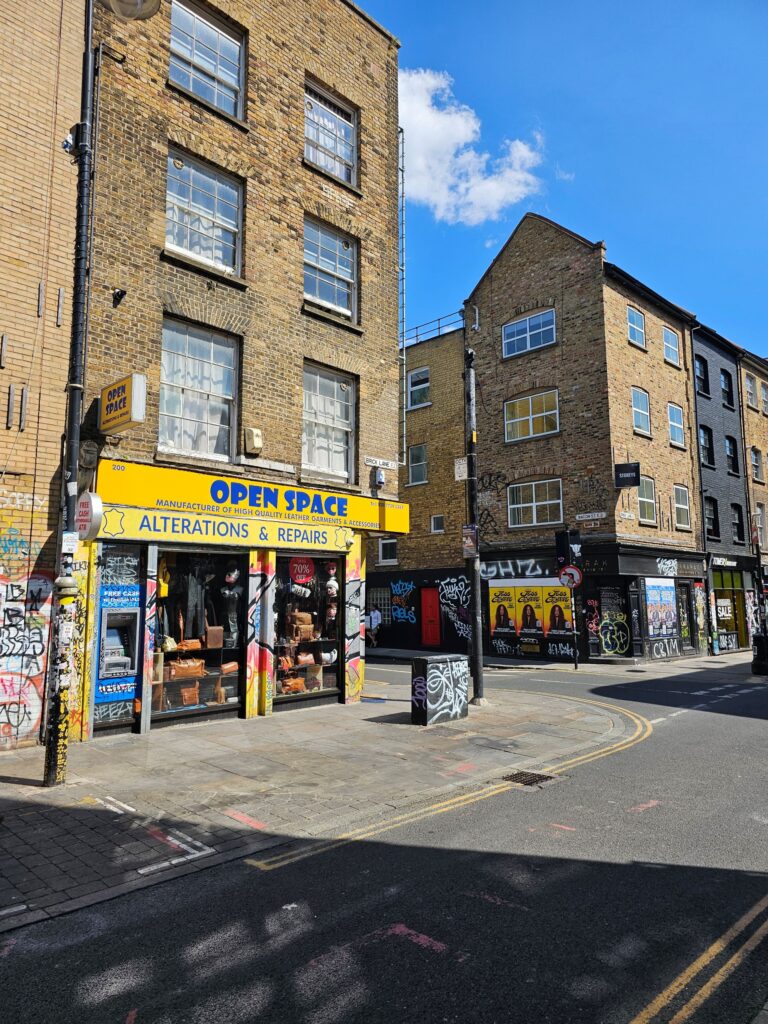
Brick Lane: A Street That Does Everything
The Curry Houses: London’s Most Famous Corridor of Indian Food
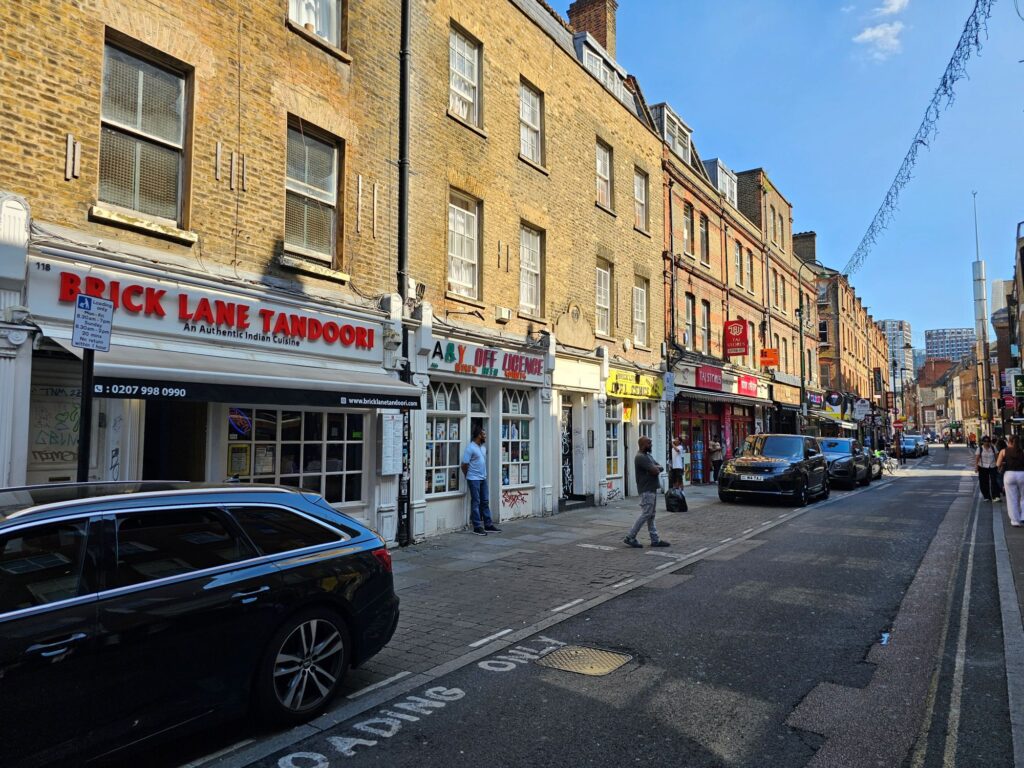
Walk the length of Brick Lane and you’ll pass more than 20 curry houses — Bengali, Indian, Pakistani, and Bangladeshi restaurants that range from decades-old institutions to newer challengers with modern menus. The concentration is so dense and so famous that the street has long been nicknamed “Curry Mile” (though technically the original Curry Mile is in Manchester — Brick Lane’s version is arguably more famous if not longer).
The curry houses here are famous for their enthusiastic door touts, who stand outside each restaurant making their pitch to passing pedestrians. It’s a distinctly Brick Lane experience — charming the first time, slightly overwhelming by the time you’ve walked past the fifth or sixth. The best approach is to decide in advance or ask a local for a recommendation rather than being swept into the first place someone approaches you with a laminated menu.
Aladin Brick Lane at 132 Brick Lane is one of the most consistently recommended of the lot — a straightforward, no-frills Bangladeshi restaurant with an excellent Balti and tandoori menu that has been serving the area for decades. Dishoom at 7 Boundary Street, just off Brick Lane in Shoreditch, takes a more polished approach: it’s an Indian café modelled on the Irani cafés of old Bombay, and it’s one of the most beloved restaurants in London regardless of cuisine. The queues are long and there are no reservations for walk-ins, but the wait is genuinely worth it.
Beigel Bake: 24 Hours of East London Legend
At the northern end of Brick Lane, you’ll find one of the most iconic food establishments in all of East London: Beigel Bake, the round-the-clock Jewish bakery that has been doing exactly what it does since 1977 without any apparent interest in evolving or explaining itself to anyone.
The blue and white sign is immediately recognisable, and the queue outside is a permanent feature regardless of the hour — this place is open 24 hours a day, 7 days a week, and it reportedly sells close to 7,000 beigels a day. The product of choice for the uninitiated is the Salt Beef Beigel — a sturdy, dense bread roll filled with a substantial hunk of salt-cured beef, yellow English mustard, and a sliced gherkin. It is emphatically not a New York bagel: the bread is doughier and less chewy, the whole thing more utilitarian than artisanal. That is entirely the point. It tastes like the East End, and there’s nothing else quite like it.
Prices are extremely reasonable — expect to pay under £5 for the salt beef version, and considerably less for plain bagels or the sweet pastries that fill the front counter.
Address: 159 Brick Lane, London E1 6SB Hours: Open 24 hours, 7 days a week Price: Salt Beef Beigel approx. £4–£5
The Street Art: Shoreditch’s Outdoor Gallery
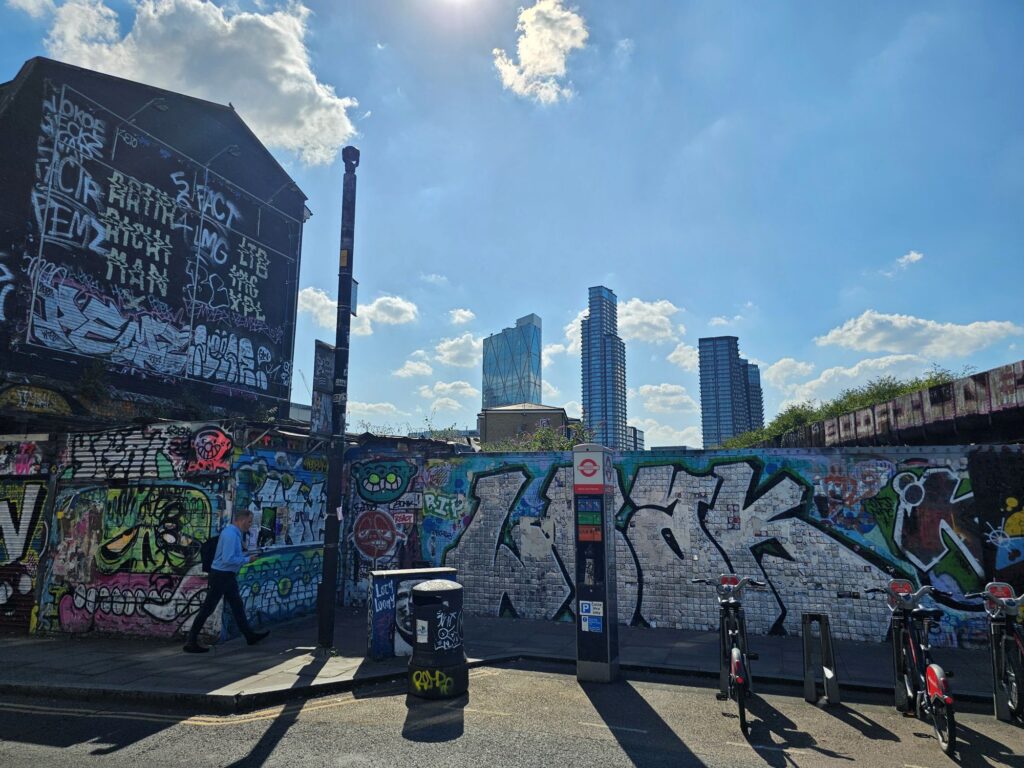
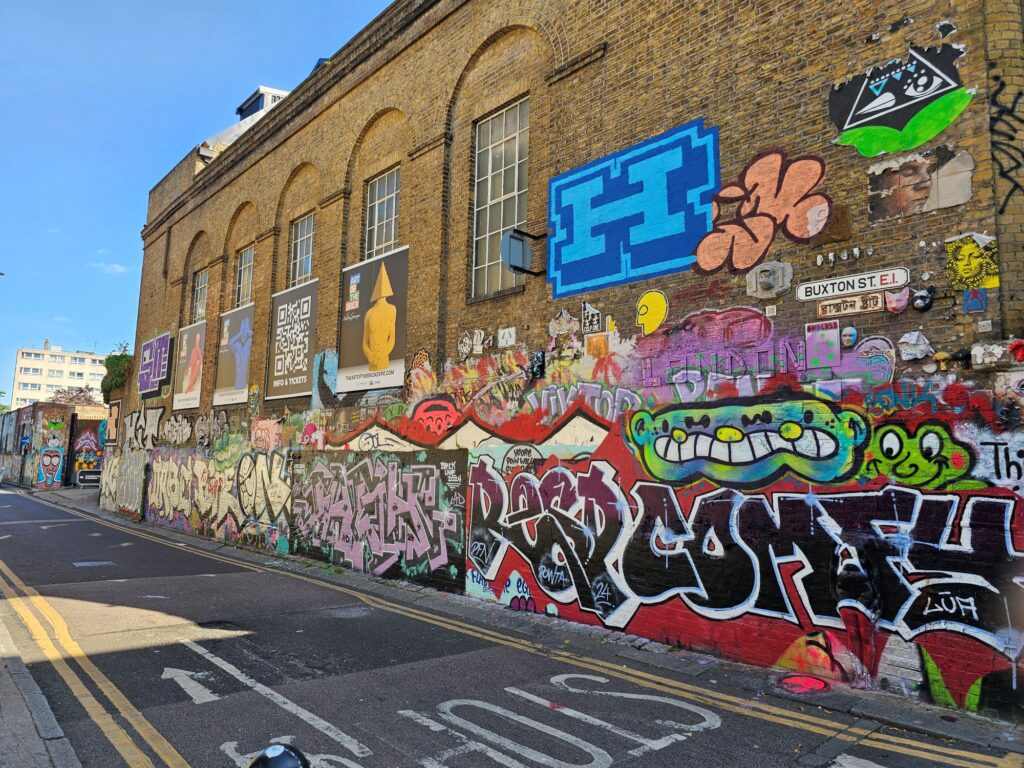
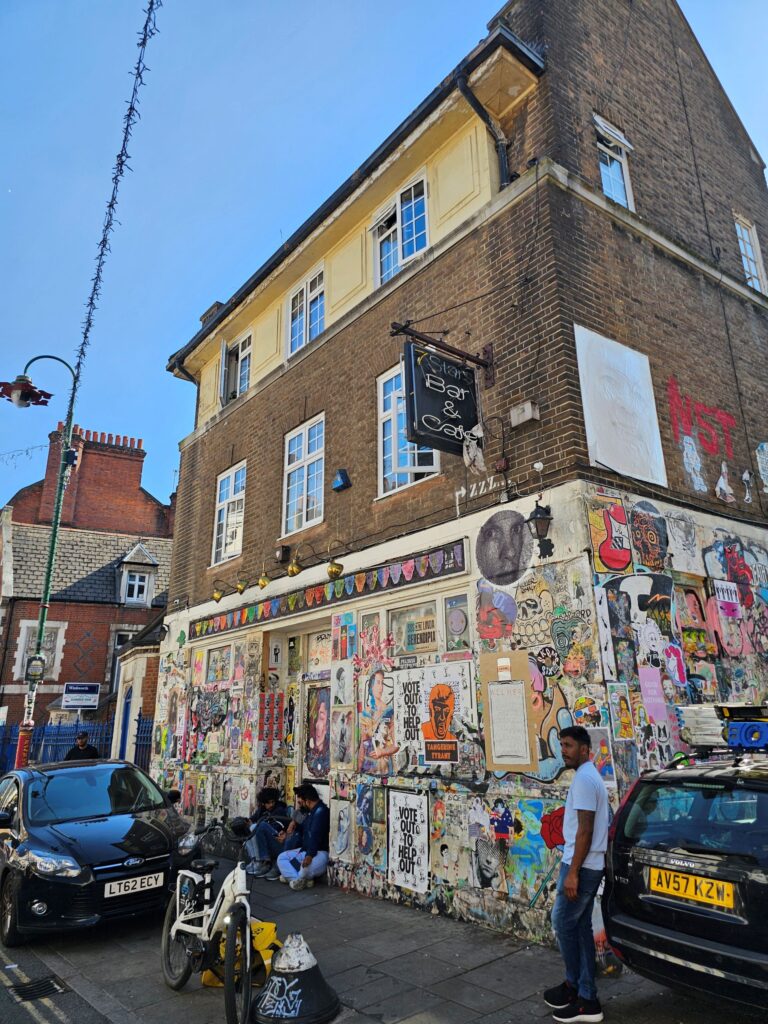
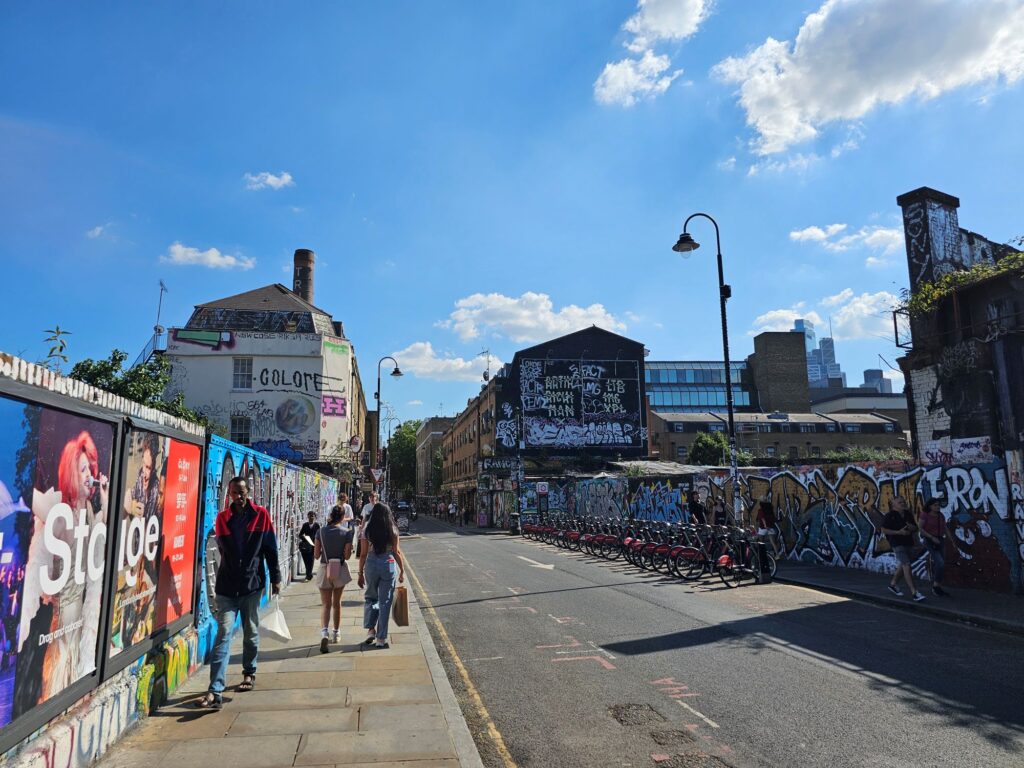
If you’ve read anything about Shoreditch before arriving, you’ll have encountered the phrase “street art capital of London.” It’s not an overstatement. The neighbourhood functions as a living, continuously updated outdoor gallery, where virtually every available wall, shutter, and hoarding has been treated as a potential canvas. Artists from across the UK and around the world have left their mark here, and the collection changes regularly — pieces that were present on your last visit may be gone, replaced by something entirely new.
The most celebrated name associated with the area is Banksy, whose early career work appeared on these streets and whose influence can still be felt in the tone and scale of the art throughout the neighbourhood. But the scene extends far beyond any single artist: ROA, the Belgian street artist known for large-scale black-and-white animal murals, contributed one of the most recognisable pieces in the area — a striking crane on Hanbury Street that has become a landmark. The ever-changing constellation of work on Rivington Street, Redchurch Street, Great Eastern Street, and the alleyways around Pedley Street and Cheshire Street represents one of the best free galleries in London by any measure.
Seven Stars Yard, tucked down a narrow alley off Brick Lane, is a must for anyone who takes street art seriously. Following demolitions in the area, the exposed brickwork created a series of extraordinary raw canvases, and the concentration of work here — constantly evolving as new artists add to and paint over existing pieces — is among the finest you’ll find anywhere in Europe. It’s the kind of spot that serious street art photographers return to repeatedly, and it’s genuinely different every time.
For those who want context and insider knowledge, guided street art tours of Shoreditch are widely available. Several experienced local guides offer regular walking tours for around £15–£20 per person, covering the history of the scene, the most significant works, and the stories behind them. Airbnb Experiences is one of the more reliable platforms for finding these.
Cost to view: Free Best streets: Rivington Street, Redchurch Street, Great Eastern Street, Brick Lane, Pedley Street, Cheshire Street, Seven Stars Yard
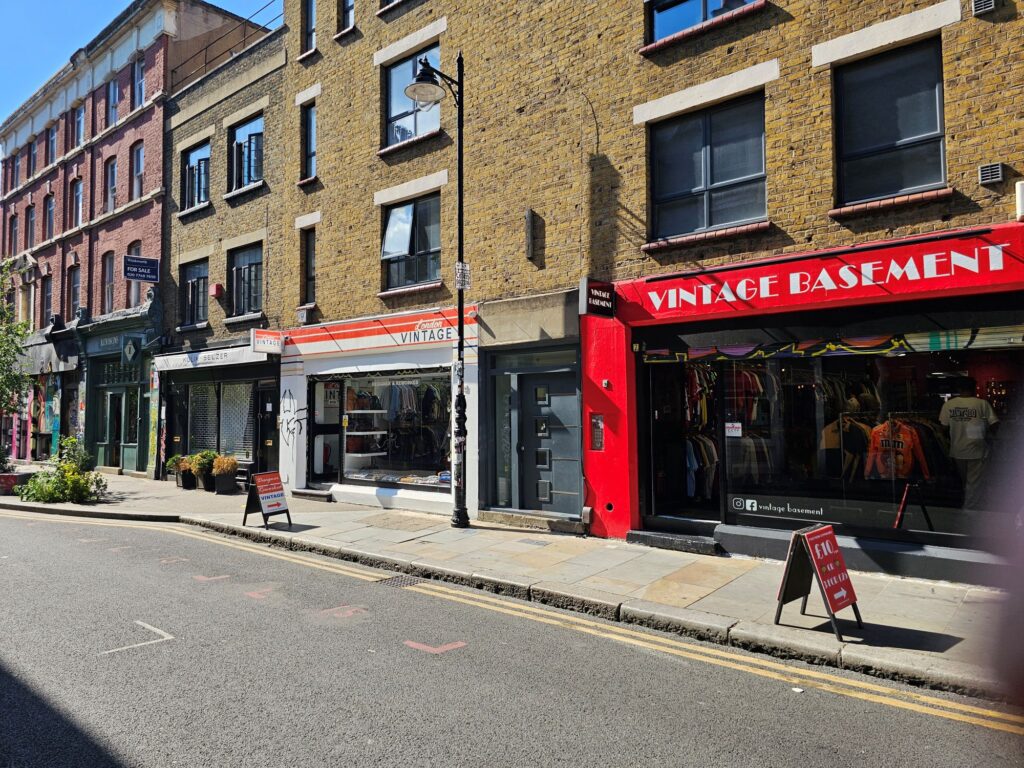
The Vintage Shopping: Britain’s Best Hunting Ground
Brick Lane and its surrounding streets constitute what many dedicated vintage shoppers regard as the single best hunting ground for secondhand and vintage clothing in the United Kingdom. The concentration and variety of shops is extraordinary, ranging from enormous organised markets to small independent boutiques crammed floor to ceiling with carefully curated selections.
Rokit Vintage is one of the most prominent names in London vintage retail, with one of its four London locations on Brick Lane. The stock spans everything from 1970s silk shirts to 90s sportswear, and the curation strikes a reasonable balance between wearability and character. Beyond Retro began in East London and has since become an international brand — their Brick Lane location remains one of the best. Hunky Dory Vintage is a more boutique operation, with the shop’s owner personally selecting high-quality original pieces, including the kind of complete outfits and statement accessories that get you compliments for months.
For maximum choice and a more chaotic, treasure-hunt experience, the Brick Lane Vintage Market (located inside the Old Truman Brewery complex) operates 7 days a week and stocks vintage garments and accessories dating back as far as the 1920s. On any given day, you might find a 1960s mod dress, a 1970s silk suit, a 1980s track jacket in perfect condition, or a complete rack of classic designer pieces. The atmosphere is underground and lively — music playing, vinyl being flipped through nearby, the particular smell of genuinely old fabric filling the air. It’s chaotic in the best possible way.
Brick Lane Vintage Market Hours: 7 days a week, 11:00 AM – 6:00 PM (Sunday from 10:00 AM)
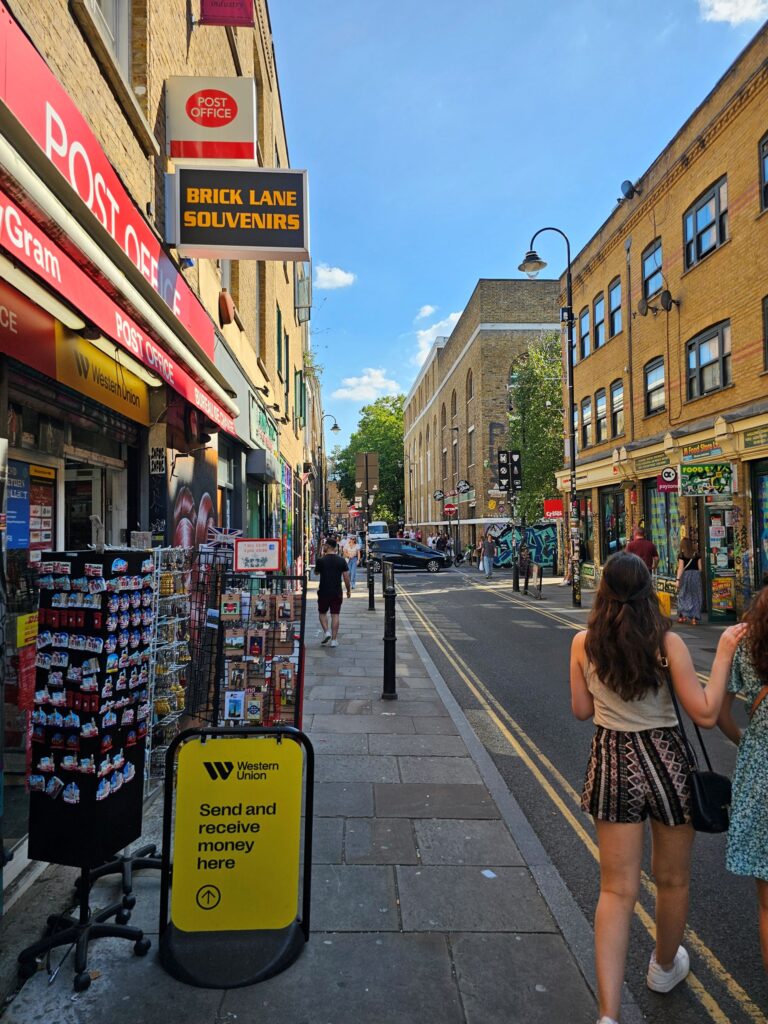
The Markets: A Sunday in This Neighbourhood Is a Different Planet
The single best day to visit Shoreditch and Brick Lane is Sunday. On a Sunday, the entire area transforms into one of the most extraordinary market environments in Europe, with multiple distinct markets operating simultaneously across a relatively compact geography. A well-planned Sunday in this neighbourhood can involve flowers, vintage clothing, street food from twenty different countries, handmade crafts, vinyl records, and antiques — all within a 30-minute walk.
Columbia Road Flower Market
Begin early — and when I say early, I mean it. Columbia Road Flower Market opens at 8:00 AM every Sunday and starts to close around 3:00 PM, and the best of it happens in the morning, when the street is heady with the smell of cut flowers and the vendors are in full voice.
Columbia Road is a narrow Victorian street about a 15-minute walk north of the main Brick Lane area, lined on both sides with around 60 independent businesses — art galleries, vintage clothing shops, antique dealers, Italian and English food shops, cupcake bakeries, and florists. On Sunday morning, the street itself becomes the market, lined with stalls selling everything from bedding plants and seasonal flowers at remarkably affordable prices to 10-foot banana trees and extraordinary orchid displays.
The experience is sensory and slightly overwhelming in the best possible way: the vendors call out their prices in proper market-style (“two for a fiver, two for a fiver!”), street musicians perform at either end of the street, and the crowd of locals, tourists, and regulars creates a density of people and atmosphere that you won’t find anywhere else in London at 9 o’clock on a Sunday morning. Go before noon, bring cash, and pick up flowers even if you have no idea how you’ll get them home.
Address: Columbia Road, London E2 7RG Hours: Sundays only, 8:00 AM – approximately 3:00 PM Nearest stations: Hoxton or Shoreditch High Street (Windrush Line), approx. 5-minute walk from each Admission: Free
Brick Lane Market & Truman Brewery Markets
By mid-morning, make your way south to Brick Lane itself, where the Sunday market is in full operation. The Brick Lane market is actually a collection of smaller markets operating across several sites in and around the street, connected by the general gravitational pull of a Sunday in E1.
The Old Truman Brewery complex — a set of converted Victorian industrial buildings that formerly housed London’s largest brewery and now function as a creative hub — is the focal point. Within the Truman Brewery campus, you’ll find the Sunday Upmarket in the Ely’s Yard area (over 140 stalls with handcrafted jewellery, clothing, homeware, and food), the Backyard Market (art, crafts, and fashion from independent and emerging designers), the Vintage Market (already described above), and multiple street food areas. On Sundays, the food offering alone in and around the Truman Brewery is extraordinary — stalls serving Singaporean laksa, Korean fried chicken, Brazilian churrasco, Japanese bao buns, Mexican tacos, Georgian khachapuri, and much more compete for your attention in a culinary free-for-all that makes choosing anything an act of willpower.
Brick Lane Market Hours: Saturday 11:00 AM – 6:00 PM, Sunday 10:00 AM – 6:00 PM Truman Brewery Markets (Sunday Upmarket, Backyard Market): Sunday only, 10:00 AM – 5:00 PM Address: The Old Truman Brewery, 91 Brick Lane, London E1 6QL Admission: Free
Old Spitalfields Market
A 10-minute walk south from the heart of Brick Lane brings you to Old Spitalfields Market, one of the finest surviving Victorian market halls in London and a genuine highlight of any East End visit. There has been a market on this site since 1638, when King Charles I granted a licence for trading. The current hall was built in 1887 and is a beautiful piece of Victorian commercial architecture — a vast iron-and-glass structure that floods the interior with light regardless of the weather outside.
Today, Old Spitalfields operates daily and offers a rotating programme of themed markets throughout the week. The Thursday Antique Market is a major draw for collectors and browsers, opening early at 8:00 AM to accommodate the serious buyers who arrive first thing. Regular Vinyl Markets and Urban Makers Markets (handcrafted goods from independent makers) are held fortnightly. On any given weekday, the market hosts around 150 independent stalls selling vintage clothing, handmade jewellery, artwork, antiques, and unusual gifts alongside a thriving food court — The Kitchens — offering international street food.
The surrounding streets of Spitalfields are worth lingering in after the market: Brushfield Street and the area around Christ Church Spitalfields (a magnificent Baroque church designed by Nicholas Hawksmoor and completed in 1729) constitute one of the best-preserved Georgian streetscapes in London. And Dennis Severs’ House at 18 Folgate Street — an immersive “still-life drama” set in an 18th-century Huguenot silk weaver’s house, with each room staged as if the family has just stepped out — is one of the most unusual and memorable experiences in the city for those who want something genuinely different.
Address: Old Spitalfields Market, 16 Horner Square, London E1 6EW Hours:
- Monday–Friday: 10:00 AM – 8:00 PM (Thursday: from 8:00 AM for Antiques)
- Saturday: 10:00 AM – 6:00 PM
- Sunday: 10:00 AM – 5:00 PM Nearest station: Liverpool Street (5-minute walk) or Shoreditch High Street (7-minute walk) Admission: Free
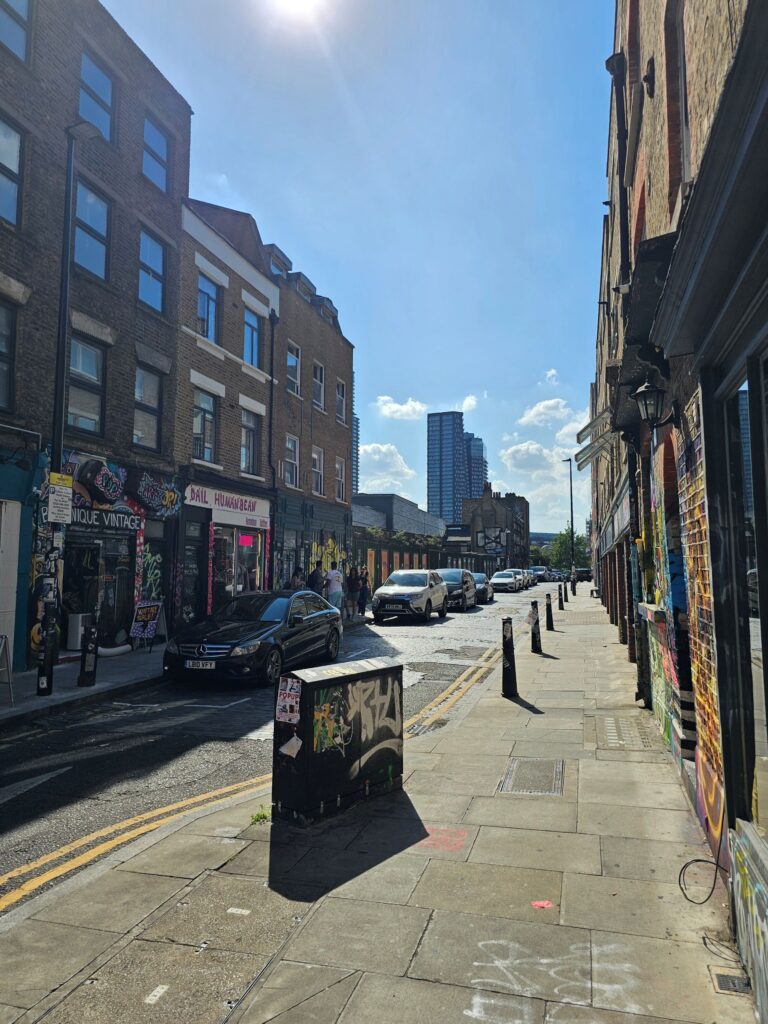
Shoreditch Beyond Brick Lane: What the Neighbourhood Itself Offers
Boxpark Shoreditch: Shopping From Shipping Containers
One of the more charming architectural conceits of modern Shoreditch is Boxpark, a pop-up shopping and dining complex built entirely from repurposed shipping containers stacked two stories high. It opened in 2011 as the world’s first pop-up mall, and while the concept has since been replicated in other cities, the Shoreditch original remains the most characterful.
The ground and upper levels house a rotating mix of independent streetwear and lifestyle brands, food vendors, and coffee shops. It’s best visited as part of a broader wander through the area rather than as a standalone destination — but for anyone with an interest in independent fashion or the street food scene, it’s worth 30 minutes. The rooftop terrace is a decent vantage point on a clear day.
Address: 2–10 Bethnal Green Road, Shoreditch, London E1 6GY Hours: Open daily; retail typically 11:00 AM – 7:00 PM, food until later Admission: Free to enter
The Nomadic Community Garden
One of Shoreditch’s best-kept secrets and a genuinely restorative place to pause during a day of market-going, the Nomadic Community Garden on Pedley Street was established in 2015 on what had previously been a derelict wasteland. The community transformed it into a garden of raised vegetable beds, flowering plants, and genuinely good vibes — there are makeshift bars and coffee stands on weekends, fairy lights strung between trees, and the kind of easy, unhurried atmosphere that makes it feel like a very civilised secret.
It’s also an excellent street art location in its own right, with the walls of the surrounding alley regularly painted by visiting artists. Finding it feels like a small reward — it’s tucked away enough that you have to be looking for it.
Address: Pedley Street, Shoreditch, London E1 (off Brick Lane, near the railway arches) Hours: Open during daylight hours; café/bar open on weekends Admission: Free
Shoreditch Nightlife: After Dark in the East End
It would be incomplete to discuss Shoreditch without acknowledging what the neighbourhood becomes after sunset. The area has one of the most concentrated and varied nightlife scenes in London, built around a cluster of bars, clubs, and live music venues that together represent the cutting edge of the city’s after-dark culture.
XOYO on Cowper Street is one of the most consistently well-regarded clubs in London — a two-floor venue that has, since 2010, maintained a booking policy defined by quality rather than genre, regularly hosting the world’s best DJs and producers. Cargo under the railway arches on Rivington Street is another stalwart, combining outdoor space, a main stage, and a courtyard in a setting that’s genuinely unlike anywhere else in the city. For a more relaxed evening, the bars along Redchurch Street and the surrounding area offer everything from craft cocktail bars to unpretentious pubs that have survived the waves of gentrification with their soul intact.
Flight Club on Worship Street, if your idea of a good evening runs toward competitive darts played over cocktails in a beautifully designed space, is one of the most enjoyable and social bar concepts to have emerged from East London in recent years.
A Suggested Day Itinerary: How to Do It Right
The ideal Shoreditch and Brick Lane day is a Sunday, and it runs something like this:
Start at Columbia Road Flower Market at 8:30 AM while the light is good and the flowers are at their finest. Spend an hour browsing the market and the small shops along the street, picking up flowers and perhaps a coffee from one of the Victorian shopfronts. Walk south through the neighbourhood, passing through Arnold Circus — a perfectly preserved Victorian social housing estate with a bandstand at its centre, one of the most quietly beautiful public spaces in East London — and along Redchurch Street, where the independent shops and street art set the scene for what’s coming.
Arrive at the Brick Lane and Truman Brewery market area around 10:30 or 11:00 AM, just as the Sunday Upmarket is getting into its stride. Browse the vintage market and backyard stalls, pick up street food from the international vendors in Ely’s Yard, and spend time looking at the street art along Brick Lane and the surrounding alleyways. Find Seven Stars Yard. Take your time with it.
Continue south to Old Spitalfields Market in the early afternoon, spending an hour among the stalls before wandering through the Georgian streets of Spitalfields toward Christ Church. If you’ve booked in advance, a visit to Dennis Severs’ House in the late afternoon is one of the most singular experiences London has to offer.
End the day with dinner on Brick Lane or at Dishoom, where by early evening the queue will have settled into something manageable, and the reward of finally being seated at that beautiful corner table with a proper chilli cheese toast and a glass of something cold will feel entirely proportionate to the day you’ve had.
Practical Information
Best Time to Visit
Sunday is the definitive best day to visit — every market is operating simultaneously, the street art is freshly added to, the food vendors are in full swing, and the area has an energy that weekdays simply cannot replicate. If a Sunday visit isn’t possible, Saturday is a solid second choice, with the Brick Lane market (11:00 AM – 6:00 PM) and Spitalfields operating, though without Columbia Road. Weekday visits offer a quieter, more residential experience — Spitalfields is open, the shops and cafes on Brick Lane trade normally, and the street art is just as spectacular, but the market energy is largely absent.
Getting Around
The area is compact and best explored on foot. The walk from Columbia Road to Old Spitalfields is approximately 20–25 minutes at a relaxed pace, covering the full length of the Brick Lane corridor. Comfortable shoes are non-negotiable — the streets are a mix of cobblestones, uneven pavements, and market-day crowds.
Budget
The remarkable thing about a day in Shoreditch and Brick Lane is how little it needs to cost. Admission to every market and outdoor attraction is free. Street food from the Sunday markets ranges from £5–£12 per dish. A sit-down curry on Brick Lane runs £12–£20 per person for a full meal including rice and bread. Coffee from independent cafes averages £3–£5. The primary expense is what you choose to buy, whether that’s a vintage jacket, a bunch of flowers, or a piece of original art from a market stall.
Safety
Shoreditch and Brick Lane are safe areas by any reasonable measure, and the heavily foot-trafficked nature of the neighbourhood on weekends means you’re almost never in an isolated location. The standard London advice applies: be aware of your surroundings in crowded markets, keep valuables secure, and trust your instincts. The area around Aldgate East and the lower end of Brick Lane is busier and more urban; as you move north into Shoreditch proper, the streets become more residential and relaxed.
Key Addresses at a Glance
| Location | Address | Hours |
|---|---|---|
| Beigel Bake | 159 Brick Lane, E1 6SB | 24 hours, 7 days |
| Old Truman Brewery | 91 Brick Lane, E1 6QL | Daily |
| Brick Lane Market | Brick Lane, E1 | Sat 11am–6pm / Sun 10am–6pm |
| Sunday Upmarket | Ely’s Yard, Truman Brewery, E1 6QL | Sunday 10am–5pm |
| Old Spitalfields Market | 16 Horner Square, E1 6EW | Mon–Fri 10am–8pm / Sat 10am–6pm / Sun 10am–5pm |
| Columbia Road Flower Market | Columbia Road, E2 7RG | Sunday 8am–approx. 3pm |
| Boxpark Shoreditch | 2–10 Bethnal Green Road, E1 6GY | Daily, approx. 11am–7pm+ |
| Nomadic Community Garden | Pedley Street, E1 | Daylight hours, free |
Nearest Transport Hubs
| Station | Lines | Walking Distance to Brick Lane |
|---|---|---|
| Shoreditch High Street | Windrush / Overground | 8 minutes |
| Aldgate East | District, Hammersmith & City | 8–10 minutes |
| Liverpool Street | Central, Circle, H&C, Metropolitan, Elizabeth line, DLR, National Rail | 12–15 minutes |
| Hoxton | Windrush / Overground | 15 minutes (ideal for Columbia Road) |
Final Thoughts
Shoreditch and Brick Lane represent something that is genuinely rare in a city as large and as visited as London: a neighbourhood that is simultaneously historic and urgently alive, that layers century upon century of immigration and reinvention without losing the texture of any of it. You can eat food that hasn’t changed in 40 years at a 24-hour bagel counter, look at a mural painted last week by an artist who flew in from Rotterdam, buy a 1970s leather jacket from a market that was a Victorian brewery, and walk through streets that Huguenot refugees and Jewish tailors and Bangladeshi restaurant owners all called home in different eras. There is nowhere else in London, and very few places anywhere, where the density of story per square metre is this high.
A Sunday here is not an itinerary item. It’s the whole day. Plan accordingly.
Borough Market, A Complete Guide to London’s Most Iconic Food Market