

There is a museum on Berlin’s Museum Island that most visitors somehow manage to rank second or third on their itinerary — after the Neues Museum with its Nefertiti bust, after the Pergamon with its ancient gates — and yet, on the day you finally walk up those long stone steps and pass through the Corinthian columns into the cool, high-ceilinged rooms inside, you will immediately understand why art historians and repeat visitors consistently name the Alte Nationalgalerie as the single most satisfying museum on the island.
It is not the largest. It is not the most famous. But it may be the most complete — a single, navigable building that takes you on a chronological journey through one of the most turbulent and fertile centuries in European art history, from the twilight of the Enlightenment to the threshold of the modern era, with some of the most emotionally powerful paintings you will ever stand in front of hanging quietly on walls that have been holding them for 150 years. I went expecting a pleasant afternoon. I came back the next day.
What Is the Alte Nationalgalerie?
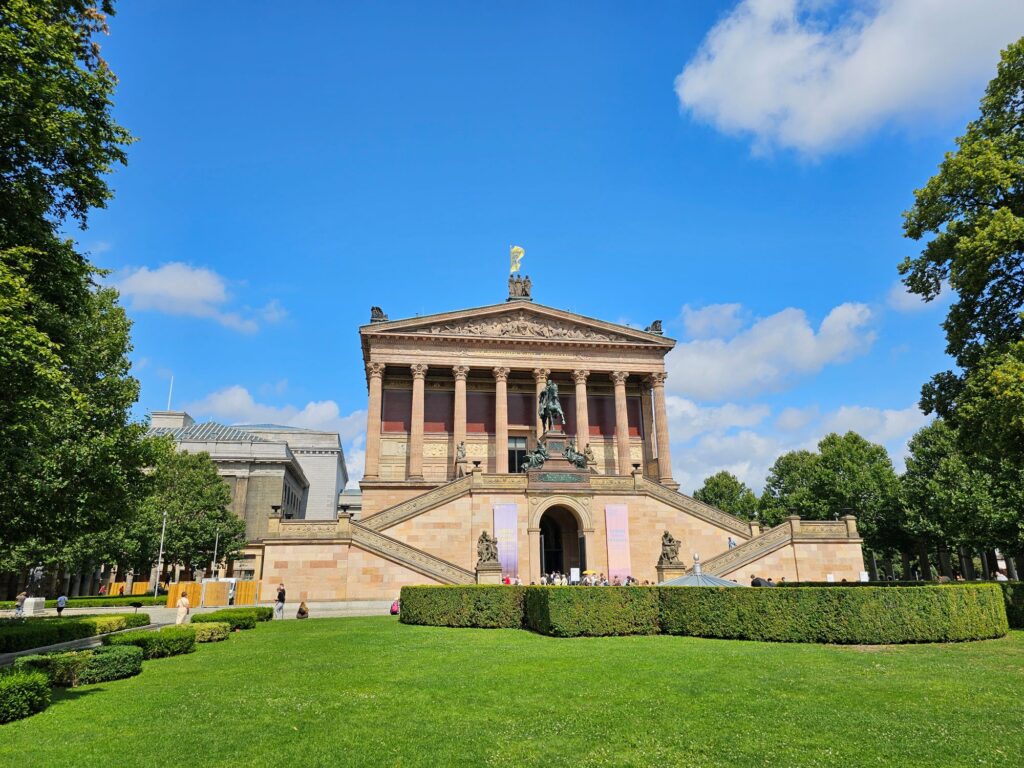
The Alte Nationalgalerie — translated simply as the Old National Gallery — is a 19th-century art museum located on Berlin’s UNESCO World Heritage-listed Museum Island (Museumsinsel), in the heart of the city. It is one of five major museums on the island, alongside the Neues Museum, Altes Museum, Bode Museum, and Pergamon Museum, and together they form one of the world’s most concentrated collections of world-class art and cultural heritage.
The gallery houses approximately 1,800 paintings and 1,500 sculptures, of which around 500 are on permanent display at any given time. The collection covers European art from roughly the French Revolution to the outbreak of the First World War — a span of about 125 years that encompassed Neoclassicism, Romanticism, Biedermeier, Realism, Impressionism, and the early rumblings of Modernism. The emphasis is on German artists, but the collection includes major works from across Europe, including some of the finest French Impressionist paintings held in any German museum.
The gallery was established on the basis of a remarkable gift: in 1861, Berlin banker Johann Heinrich Wilhelm Wagener bequeathed 262 works to the Prussian state, including early paintings by Caspar David Friedrich and Karl Friedrich Schinkel that would become the nucleus of what are today two of the museum’s most significant collections. By the time the building opened in 1876, the holdings had grown considerably, and the Nationalgalerie’s acquisition policy — particularly under director Hugo von Tschudi, who in 1896 made the Nationalgalerie one of the first museums in the world to purchase Impressionist paintings — ensured that the collection kept pace with the most exciting art movements of its time.
The Building: A Temple of Art in Every Sense
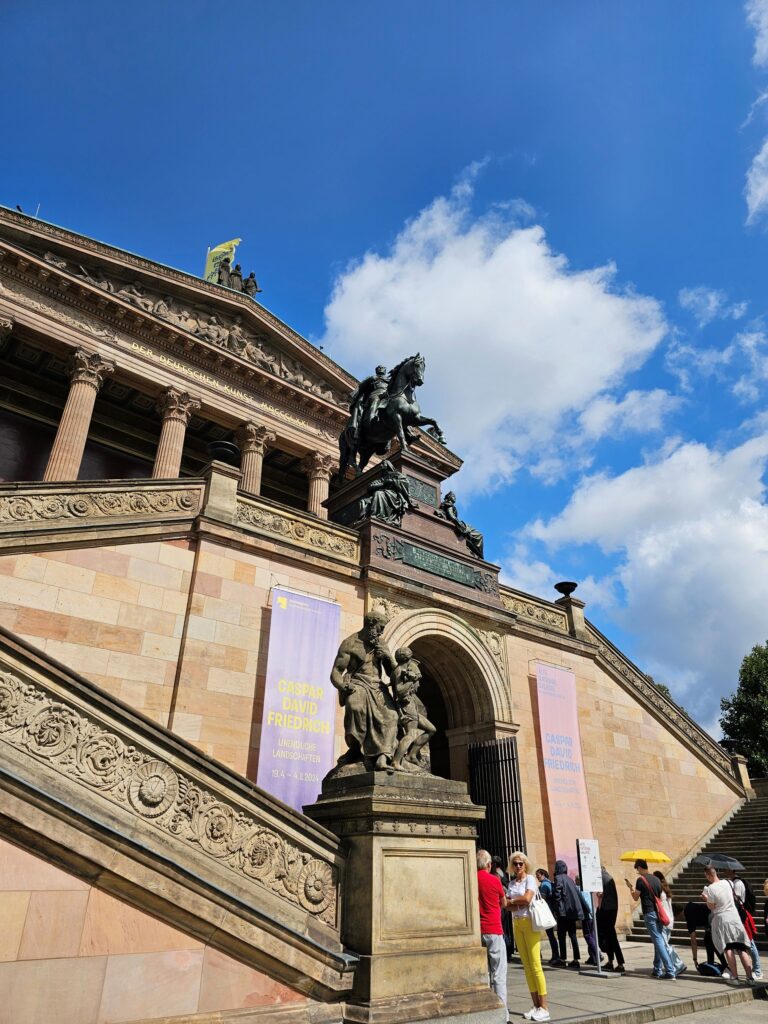
Before you ever see a single painting, the Alte Nationalgalerie makes a statement. The building is one of the finest examples of 19th-century museum architecture in Europe, and standing before it for the first time is a genuinely arresting experience. It was conceived by King Frederick William IV himself, who sketched the original concept in 1841 with the explicit intention of creating a “temple of art” — a secular shrine to German cultural achievement. The design was developed by architect Friedrich August Stüler (a student of Schinkel) and completed after his death by Johann Heinrich Strack, with construction running from 1867 to 1876.
The result is a structure that combines the vocabulary of an ancient Greek or Roman temple with elements of a church and the ceremonial grandeur of a theatre. A wide flight of external stairs ascends to a deep portico supported by Corinthian columns. Above the entrance, a Latin inscription reads: “DER DEUTSCHEN KUNST MDCCCLXXI” — “To German Art, 1871,” the year of German unification, which the museum was explicitly designed to celebrate and embody. At the base of the stairs, a bronze equestrian statue of Friedrich Wilhelm IV surveys the approach from horseback, setting a tone of monumental self-seriousness that the building earns rather than merely claims.
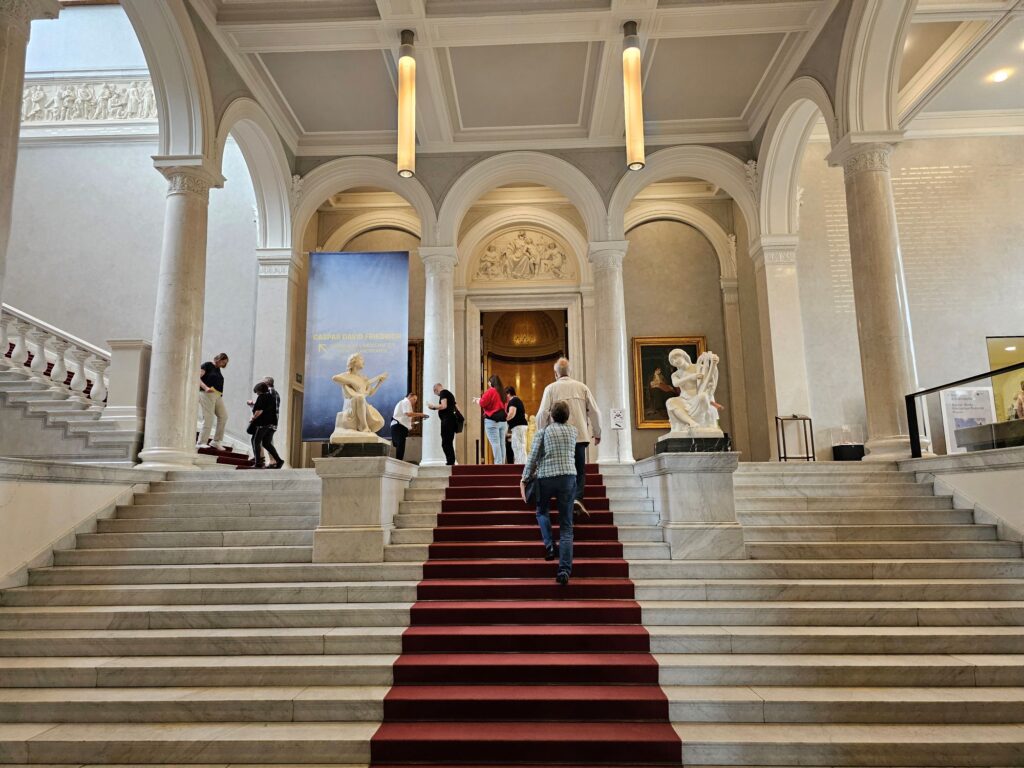
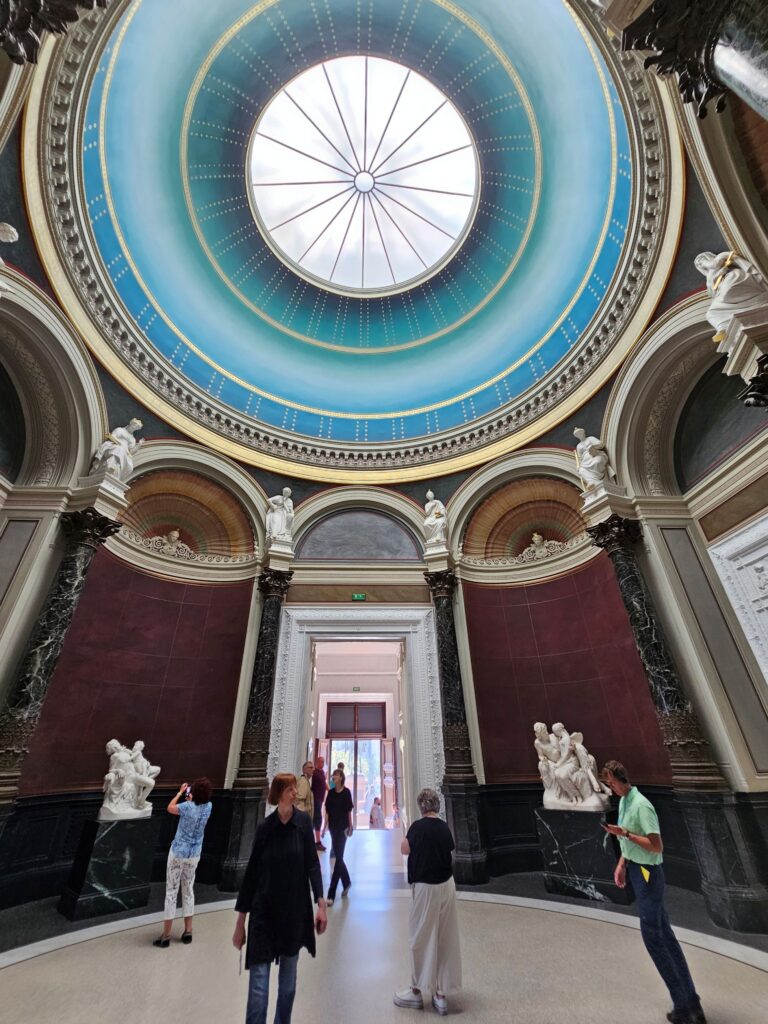
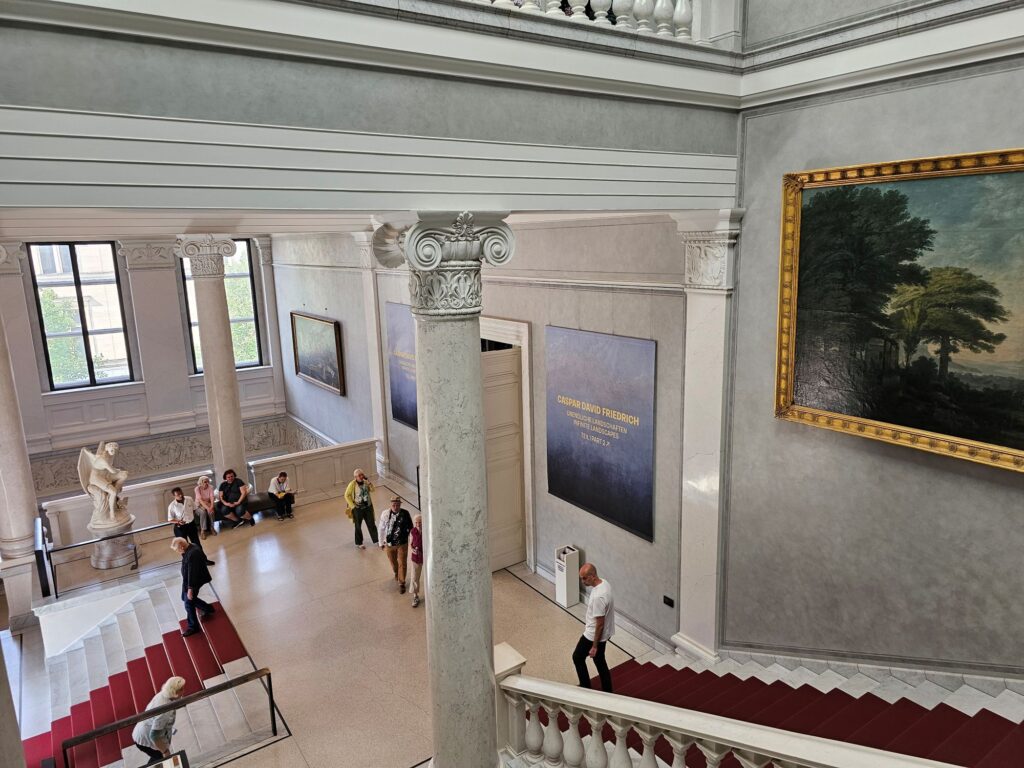
The interior continues the Gesamtkunstwerk — the total artwork — that defines the best 19th-century museum buildings. The entrance foyer and main stairwell are surrounded by a frieze painted by Otto Geyer evoking the museum as a shrine of the German cultural nation. The rooms are high-ceilinged and generously proportioned, with natural light where possible and a spatial logic that feels considered and calm. The building survived damage during World War II but — remarkably — reopened as early as 1949, before many of the island’s other institutions. It underwent significant renovation in the early 2000s, reopening fully in 2001, and today it presents its collection in conditions that do justice to both the art and the architecture.
The Collection: Three Floors, One Extraordinary Century
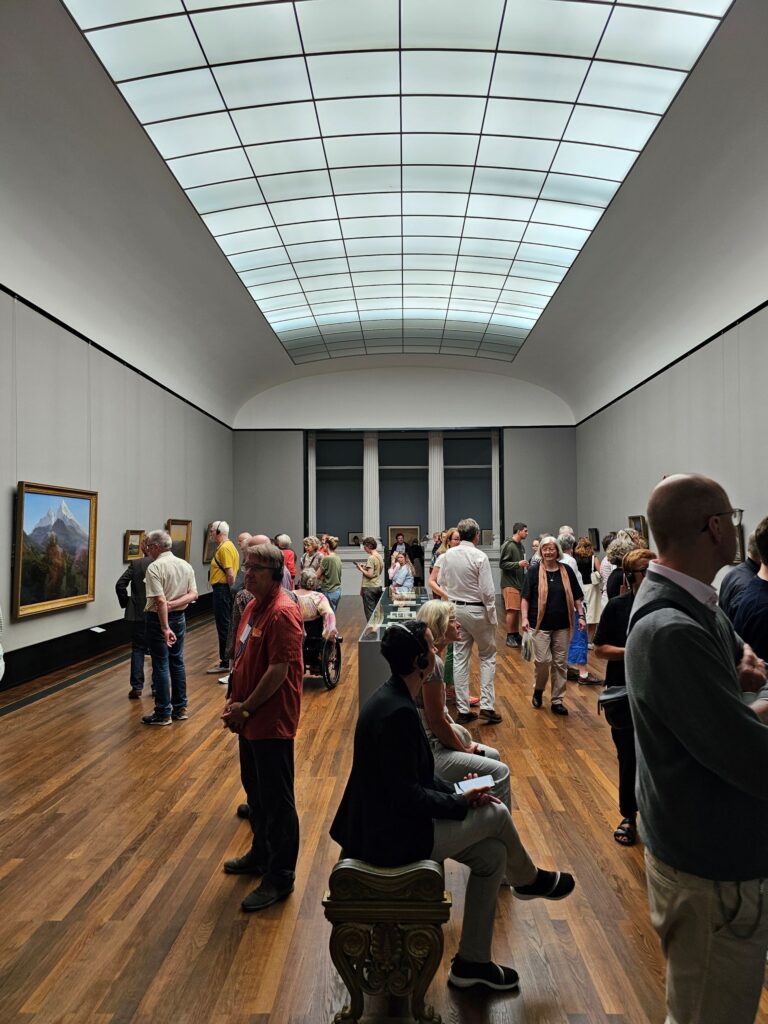
The permanent exhibition is spread across three floors and is best experienced in the direction the museum intends: start at the top and work your way down, moving chronologically from the earliest works to the most modern. This is not arbitrary — the progression mirrors the actual development of European art across the 19th century, and arriving at the Impressionists on the second floor after the contemplative grandeur of the Romantics upstairs produces a genuine sense of historical journey.
Third Floor: Romanticism and the Age of Goethe
The top floor is where most visitors spend the most time, and for good reason. It covers the first half of the 19th century — the period German art historians call the Goethezeit, the Age of Goethe — and it is anchored by what is arguably the greatest collection of German Romantic painting held anywhere in the world.
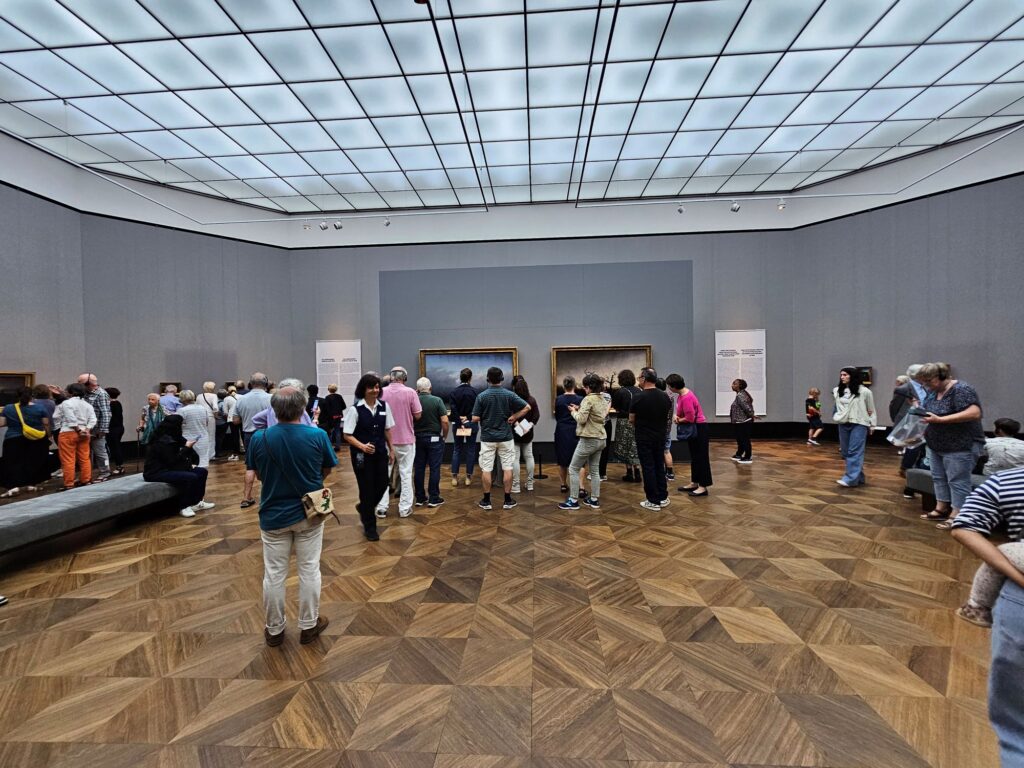
The undisputed centrepiece is the work of Caspar David Friedrich, the painter from Greifswald who transformed landscape painting from a genre of pleasant scenery into a vehicle for philosophical and spiritual inquiry. Two dedicated rooms on the upper floor showcase his work across all phases of his career, and the highlights are two paintings that hang side by side and have done so, in various configurations, since they were first exhibited together in 1810: Mönch am Meer (Monk by the Sea) and Abtei im Eichwald (Abbey Among Oak Trees).
Monk by the Sea is the more famous and the more unsettling. It shows a solitary figure — tiny, black-coated, barely visible — standing at the edge of an enormous, featureless seascape: grey-green water, a vast dark sky, a narrow strip of pale sand. There is no middle ground, no horizon in the conventional sense, no narrative, nothing to hold onto. The figure does not turn to face you. You are not invited in; you are positioned alongside the figure, confronted with exactly what it confronts. When it was first exhibited, Heinrich von Kleist wrote that looking at it was like having your eyelids cut away. That description, more than two centuries old, still holds.
Abbey Among Oak Trees, hanging beside it, offers a different kind of emptiness: a winter procession of monks carrying a coffin through the ruins of a Gothic abbey, leafless oaks rising like dark veins against a pale sky. Together, the two paintings are among the most powerful works in any European museum, and standing in front of them in the quiet of a Tuesday morning is one of those experiences that justifies the entire trip.
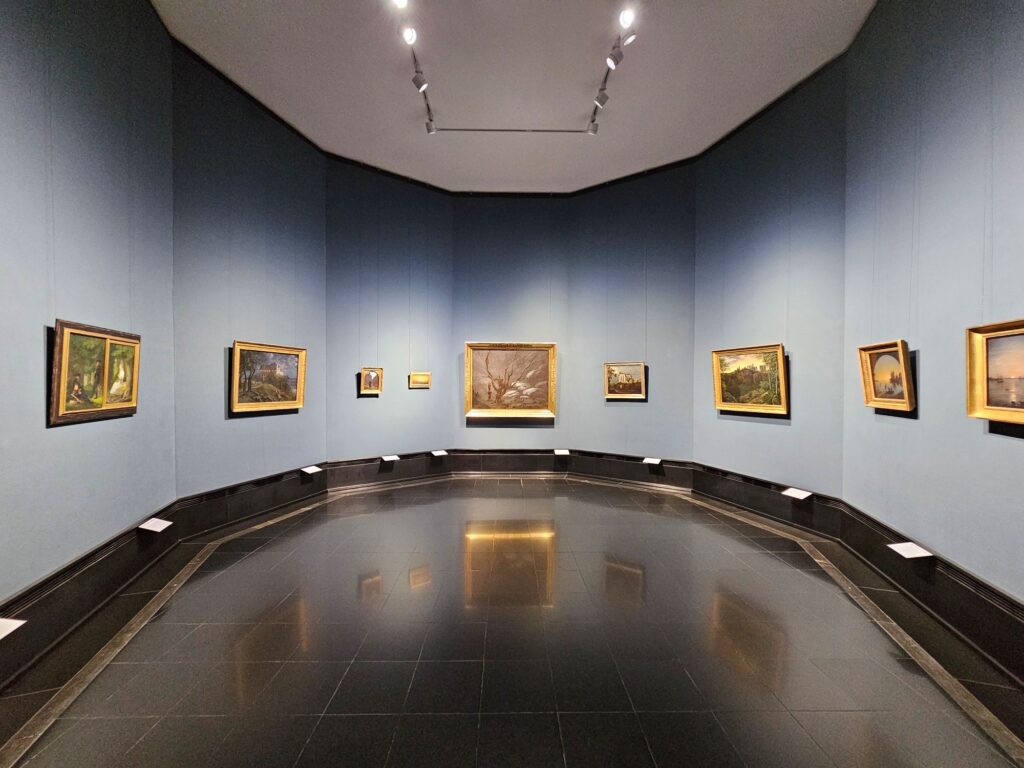
Elsewhere on the third floor, a dedicated room covers the visionary architectural landscapes of Karl Friedrich Schinkel — better known as the man who designed Neoclassical Berlin’s greatest buildings, but here revealed as a painter of remarkable imagination, whose early Gothic fantasies anticipate the nationalistic neo-medievalism that would dominate German art later in the century. The vibrant, unconventional canvases of Carl Blechen feel almost ahead of their time. Works by the Nazarenes — German painters who worked in Rome and sought to revive the spiritual intensity of early Renaissance religious painting — are present in the form of the Casa Bartholdy frescoes, a rare and important group of works that survived the journey from Rome. The Biedermeier section, with its meticulous Berlin cityscapes and genre scenes of domestic life, provides a fascinating counterpoint to the grandeur of the Romantics — the same era seen through a quieter, more intimate lens.
Second Floor: Impressionism, Realism, and the French Connection
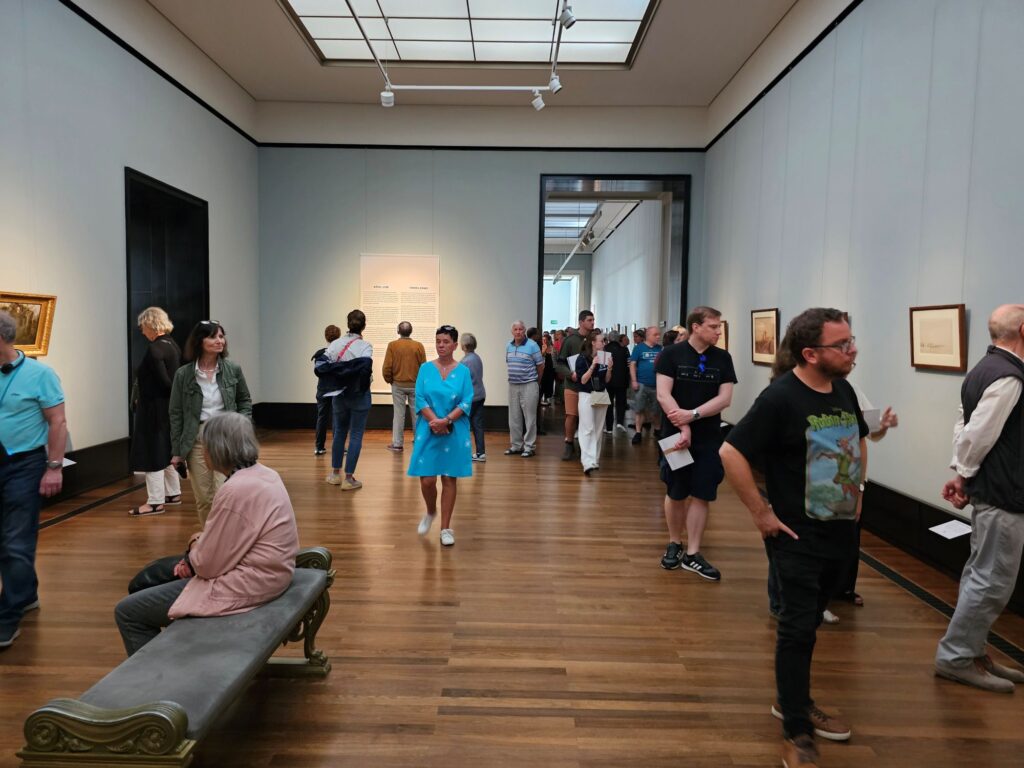
The middle floor is where the collection broadens outward from Germany to engage with the most important developments in European art during the second half of the 19th century. It also contains what many visitors consider the single most thrilling room in the museum: the Impressionist gallery, which the Alte Nationalgalerie assembled with unusual courage and foresight.
Hugo von Tschudi, the gallery’s director from 1896, was one of the early champions of Impressionism in Germany at a time when the style was still genuinely controversial — the Kaiser himself expressed displeasure at Tschudi’s acquisitions, and the dispute eventually cost Tschudi his position. But the works he secured for the collection have outlasted the controversy by more than a century. Édouard Manet’s In the Conservatory (1878-79) is perhaps the jewel: a large, coolly observed double portrait of a bourgeois couple in a glass house full of tropical plants, the two figures positioned close together but separated by a bench and an atmospheric distance that feels contemporary, even now. It was one of the first Impressionist works purchased by a German public museum.
The floor also includes significant works by Claude Monet, Auguste Renoir, Edgar Degas, Paul Cézanne, and Auguste Rodin, whose sculptures are distributed through the gallery with particular effect. The presence of Rodin — including a cast of The Thinker — connects the Impressionist paintings to the broader sculptural revolution happening in parallel, and the conversation between the two media in these rooms is one of the pleasures of the floor.
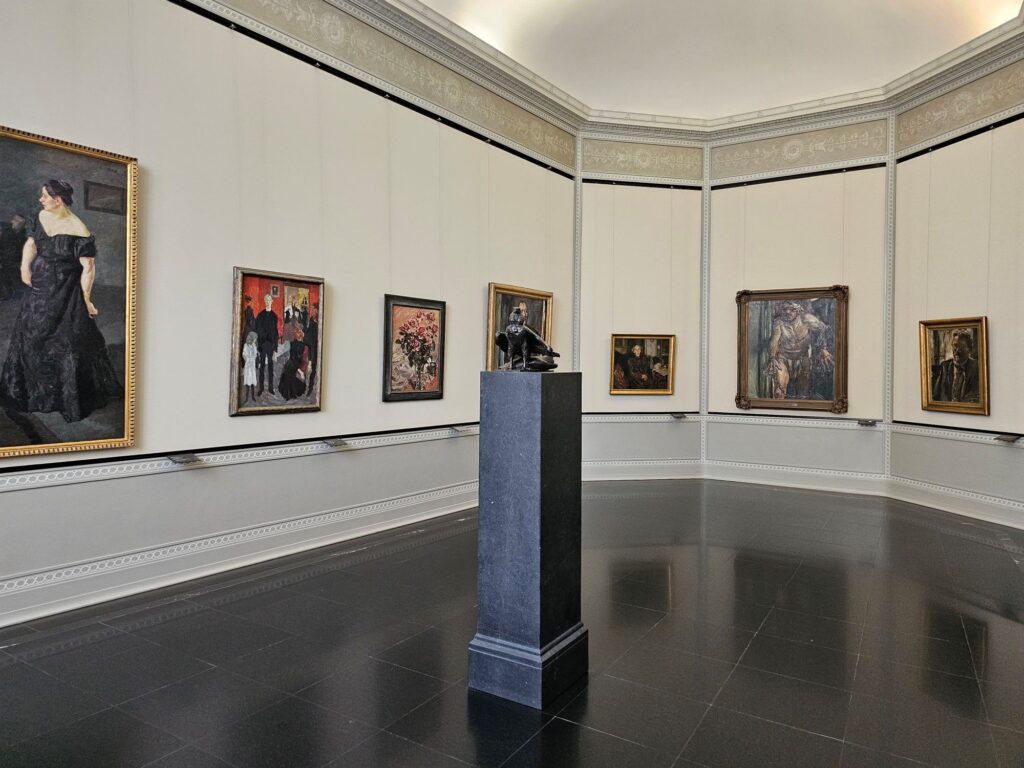
German Impressionism is represented by Max Liebermann, whose quiet scenes of everyday life form a bridge between the French avant-garde and the Berlin context in which he worked, and Lovis Corinth, whose turbulent late work — particularly The Blind Samson — points unmistakably toward the expressionism that would follow. Adolph von Menzel is presented in depth on this floor as well, including his celebrated Das Eisenwalzwerk (The Iron Rolling Mill) — a large, technically extraordinary canvas depicting industrial labour in mid-19th century Berlin that was radical in its subject matter and ahead of its time in its visual treatment of sweat, heat, and physical exhaustion. It is one of the most important paintings in the museum and one of the few works that physically stops visitors in the doorway.
First Floor: Neoclassicism and Sculpture
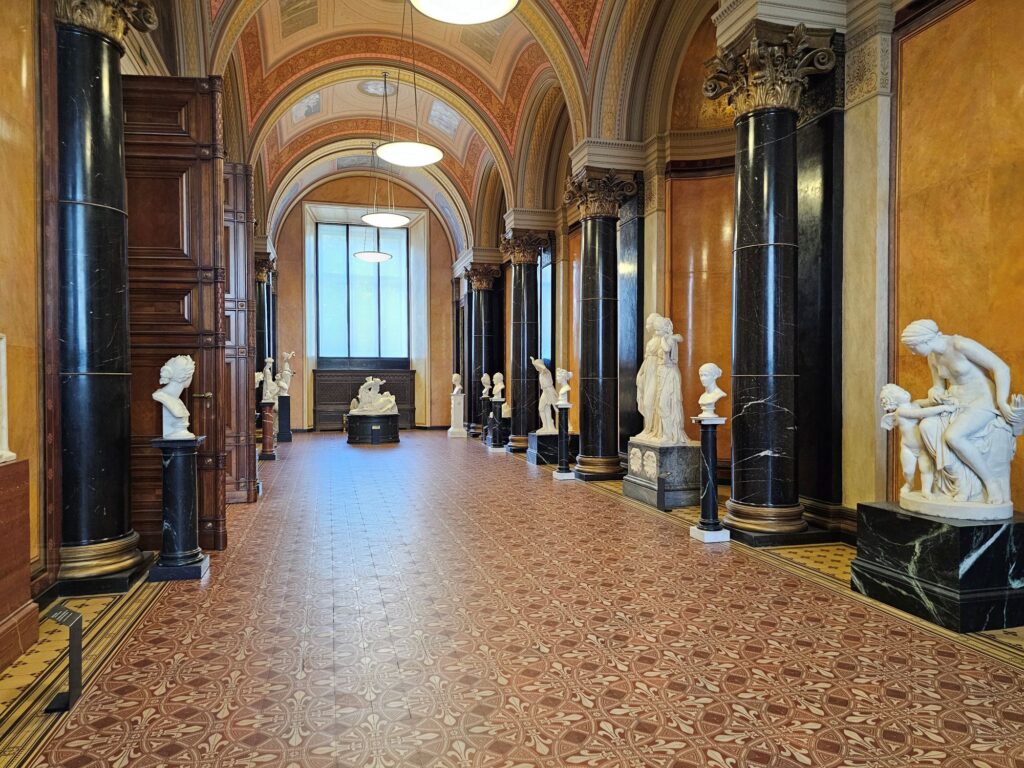
The ground floor presents the earliest phase of the museum’s chronological scope — Neoclassical painting and sculpture from the late 18th and early 19th centuries — alongside what is arguably the finest collection of 19th-century German sculpture in any single institution.
The sculpture highlight is Johann Gottfried Schadow’s Double Statue of the Princesses Luise and Friederike of Prussia (1795-1797), a marble group of two young sisters — the older of whom would later become the beloved Queen Luise — depicted in a moment of casual intimacy, leaning toward each other with a naturalness and warmth that was genuinely revolutionary for sculpture of the period. It remains one of the most admired works in the museum and is widely regarded as a masterpiece of German Neoclassicism. Also present are significant works by Christian Daniel Rauch, Bertel Thorvaldsen, and Antonio Canova, placing the German collection in European context.
The painting collection on the first floor includes realist works by John Constable and Gustave Courbet, which feel almost modest in this company but repay close attention, and works from the Barbizon school that demonstrate the internationalism of 19th-century collecting at its best.
Ticket Options: What to Buy and When
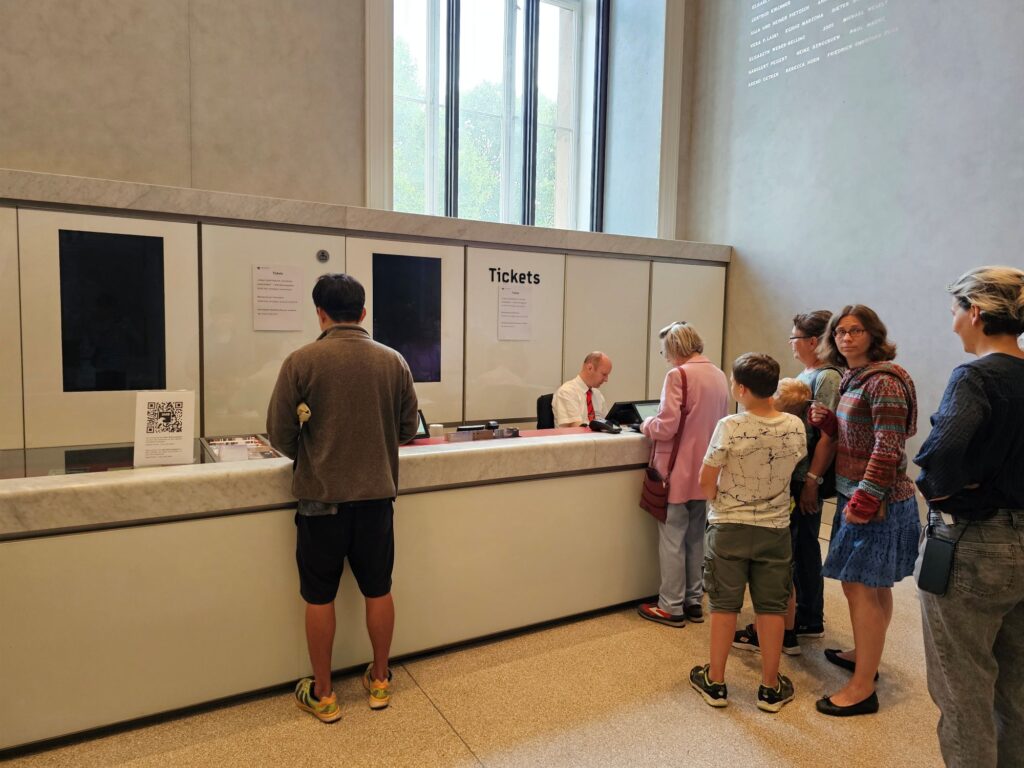
The Alte Nationalgalerie offers several ticket configurations, and choosing the right one depends significantly on how many other Museum Island institutions you plan to visit.
Single Museum Ticket
As of 2026, the single-entry ticket for the Alte Nationalgalerie is priced at €14 per adult. Concessions (students, seniors, and those with relevant documentation) are typically half price. Admission is free for children under 18.
Museum Island Ticket (Museumsinsel-Ticket)
The Museum Island Ticket is €24 and gives unlimited admission on the same day to the Alte Nationalgalerie, Altes Museum, Bode Museum, Neues Museum, and Pergamon Das Panorama. This is excellent value for anyone planning to visit two or more of the island’s museums in a single day.
Museum Pass Berlin
The Museum Pass Berlin is €32 and gives admission to 30 top Berlin museums on three consecutive days. For visitors spending several days in Berlin with a genuine interest in the city’s museum landscape, this is the most comprehensive and economical option.
The Scharf Collection (Current Special Exhibition)
From 24 October 2025 to 15 February 2026, the Alte Nationalgalerie is hosting The Scharf Collection, a major special exhibition featuring works by Goya, Monet, Cézanne, Bonnard, and others from the private collection of Ulla and Heiner Pietzsch. The combined ticket for the permanent collection and The Scharf Collection is €16 (concessions €8). Holders of the Museum Island Ticket, Museum Pass Berlin, and WelcomeCard All Inclusive must pay a surcharge of €6 (concessions €3) to access the special exhibition.
Note that during The Scharf Collection period (through February 2026), the 2nd exhibition floor of the permanent collection will be partially affected by installation requirements. Check the official website for the most current floor plan and availability before visiting.
Booking Online
Online tickets are available through the official SMB website (smb.museum) and third-party platforms including GetYourGuide and Tiqets. Booking online is strongly recommended — not only does it allow you to skip the ticket queue, but during busy periods and special exhibitions, online booking is essential. Time-slot reservations are a separate process from ticket purchase; the two transactions are independent, meaning a missed time slot does not invalidate your ticket.
Groups
All museum visits for groups of ten or more people must be booked at least two weeks in advance. There is a booking fee of €10 per group in addition to admission.
Opening Hours
| Day | Hours |
|---|---|
| Tuesday | 10:00 AM – 6:00 PM |
| Wednesday | 10:00 AM – 6:00 PM |
| Thursday | 10:00 AM – 6:00 PM |
| Friday | 10:00 AM – 6:00 PM |
| Saturday | 10:00 AM – 6:00 PM |
| Sunday | 10:00 AM – 6:00 PM |
| Monday | Closed |
Last admission is 30 minutes before closing (5:30 PM). The museum is open on most public holidays, including Mondays that fall on a public holiday — in those cases, the following Tuesday is closed instead. The museum closes on 24 and 31 December.
Essential Visitor Information
Address
Bodestraße 1-3, 10178 Berlin (Also signposted as: Museumsinsel, Mitte, Berlin)
Phone
+49 30 266 424 242
Official Website
smb.museum/en/museums-institutions/alte-nationalgalerie
Admission Summary
| Ticket Type | Adult | Concession |
|---|---|---|
| Single Museum (Permanent Collection) | €14 | €7 |
| Scharf Collection + Permanent Collection | €16 | €8 |
| Surcharge for special exhibition (pass holders) | €6 | €3 |
| Museum Island Ticket (same day, all 5 museums) | €24 | €12 |
| Museum Pass Berlin (3 days, 30+ museums) | €32 | €16 |
| Children under 18 | Free | — |
Photography
Photography for personal use is permitted throughout the permanent collection. Flash photography and tripods are generally not allowed. Check current rules for any active special exhibitions, as policies may differ.
Accessibility
The Alte Nationalgalerie is wheelchair accessible, with lift access to all floors. Audio guide devices are available at the entrance for an additional fee and are available in multiple languages including English and German.
Coin Lockers and Bag Storage
Lockers are available at the entrance. Large bags and backpacks must be stored. The lockers take a coin deposit (typically €1 or €2) that is refunded on retrieval.
Café
There is no café directly inside the Alte Nationalgalerie. However, there are cafés in the nearby Altes Museum and in the Kolonnadenhof (Colonnade Courtyard) outside during warmer months.
Average Visit Duration
Most visitors spend between 1.5 and 2.5 hours, depending on pace and interest. A focused visit covering the key highlights — the Friedrich rooms, the Impressionist floor, and the sculpture hall — takes around 90 minutes. Art lovers using the audio guide in depth should allow 2.5 to 3 hours.
How to Get to the Alte Nationalgalerie
Museum Island sits in the heart of Berlin’s Mitte district, surrounded by the Spree River on two sides and easily accessible from the city centre by multiple forms of public transport.
By U-Bahn (Underground)
Museumsinsel Station on the U5 line is the most direct underground connection, placing you on the island itself. From the station, the Alte Nationalgalerie is a 5-minute walk.
By S-Bahn (City Rail)
Hackescher Markt Station (S3, S5, S7, S9) is approximately a 6-minute walk from the museum. Friedrichstraße Station (S1, S2, S3, S5, S7, S9) is approximately 13 minutes on foot, but is one of Berlin’s major transport hubs and useful if you’re connecting from many parts of the city.
By Tram
The tram lines stopping at Am Kupfergraben (M1, 12) are the closest, placing you directly beside the museum buildings within a 3-minute walk. Hackescher Markt (M4, M5, M6) is the next closest stop, approximately 6 minutes on foot.
By Bus
Bus stops Staatsoper and Lustgarten are served by several routes and are within a 7-minute walk of the entrance. Route 100 from Alexanderplatz or the Zoo area is a classic Berlin bus route that passes through this part of the city.
On Foot
From Alexanderplatz, the Alte Nationalgalerie is approximately a 15-minute walk west along the Spree. From Unter den Linden and the Brandenburg Gate area, it is approximately a 20-minute walk east. The walk along the river is pleasant and passes several notable buildings.
By Car
There is no on-site parking at the Alte Nationalgalerie. Several public car parks are located in the surrounding Mitte neighbourhood, but given the density of public transport options, driving is not the recommended approach.
Museum Island: Planning Your Full Day
The Alte Nationalgalerie does not exist in isolation — it is one of five world-class museums within walking distance of each other on a small island, and the question of how to combine them is one that every Berlin visitor has to answer.
The Neues Museum is the most popular on the island, housing the Egyptian collection including the bust of Queen Nefertiti — book well in advance, as timed entry slots fill up weeks ahead during peak season. The Pergamon Museum‘s permanent galleries are undergoing major reconstruction and are closed until 2027, though the Pergamon Panorama Exhibition (a large-scale 360-degree panoramic painting by Yadegar Asisi depicting ancient Pergamon) remains open separately. The Altes Museum focuses on Greek and Roman antiquities. The Bode Museum houses sculpture and Byzantine art.
A practical strategy for a full Museum Island day: arrive at the Alte Nationalgalerie when it opens at 10:00 AM, when the Friedrich rooms are at their quietest and the morning light in the upper galleries is at its best. Spend 2 hours here, then move to whichever other museum interests you most. The Museum Island Ticket (€24) makes it financially logical to visit at least two institutions on the same day.
Tips for Getting the Most Out of Your Visit
Start at the top floor and work down. The museum is designed to be experienced chronologically, and the emotional arc from the contemplative Romantics on the third floor to the vivid Impressionists on the second is significantly more powerful when experienced in the intended sequence. Going in the other direction fragments the narrative.
Visit on a weekday morning. The Alte Nationalgalerie is considerably less crowded than the Neues Museum or the former Pergamon, and a Tuesday or Wednesday morning visit can feel almost meditative. Weekends, particularly Saturday midday, are the busiest. Arriving at opening time (10:00 AM) is the most reliable strategy for the quietest experience.
Spend time with the Friedrich paintings even if you think you know them. Reproductions do not prepare you for the scale or the silence of Monk by the Sea in person. The painting is smaller than most people expect, which makes its emotional vastness more rather than less extraordinary. Give it ten minutes. Stand still. Let it work.
The sculpture on the first floor is frequently overlooked. Most visitors are focused on the paintings and move through the sculpture hall more quickly than it deserves. Schadow’s Princesses is one of the finest sculptures in Berlin and is worth a long, slow look from multiple angles.
Book the Museum Island Ticket online in advance. The online purchase allows you to go straight to the entrance without queuing at the ticket desk, and the savings over two or three separate museum admissions are significant. During major special exhibitions, time-slot reservations may be required — check the official website before your visit.
In summer, plan for warmth. The Alte Nationalgalerie is a historic building with variable climate control. The upper floors can become warm on hot summer days — comfortable, light clothing and a water bottle are practical considerations.
The Kolonnadenhof (Colonnade Courtyard) outside the museum is worth 15 minutes on a fine day. The arcaded courtyard connecting the island’s museums is a beautiful space in good weather, and the outdoor café that operates there in warmer months is a pleasant place to pause between galleries.
Why the Alte Nationalgalerie Belongs on Every Berlin Itinerary
Berlin has an extraordinary concentration of world-class museums, and the competition for a visitor’s limited time and energy is genuinely fierce. The Pergamon and the Neues Museum tend to dominate the conversation, largely because their headline objects — the Ishtar Gate, the Nefertiti bust — translate easily into the visual language of travel marketing. The Alte Nationalgalerie’s treasures require a slightly longer explanation.
What it offers, ultimately, is a sustained encounter with an entire century of European art in a single building — a building that is itself a masterpiece of 19th-century design, housing a collection assembled with genuine curatorial vision, arranged with care and intelligence, and presented in conditions that allow the works to speak for themselves. The Friedrich paintings alone would justify the visit, but the Impressionist floor, the sculpture hall, the Menzel rooms, the Biedermeier cityscapes, the Constables and the Courbets — the full experience is substantially greater than the sum of its parts.
Two hours in the Alte Nationalgalerie will not leave you overwhelmed or exhausted. It will leave you wanting to come back, having seen more than you expected, and standing slightly differently in your relationship to the 19th century — which is, when you think about it, a remarkable thing for an afternoon in a museum on an island in the middle of Berlin to accomplish.
Quick Reference
| Info | Details |
|---|---|
| Address | Bodestraße 1-3, 10178 Berlin |
| Phone | +49 30 266 424 242 |
| Hours | Tue–Sun 10:00 AM – 6:00 PM (last entry 5:30 PM) |
| Closed | Monday, 24 & 31 December |
| Single Admission | €14 adults / €7 concessions / Free under 18 |
| Museum Island Ticket | €24 adults / €12 concessions |
| Museum Pass Berlin | €32 (3 days, 30+ museums) |
| Nearest U-Bahn | Museumsinsel (U5), 5 min walk |
| Nearest S-Bahn | Hackescher Markt (S3/5/7/9), 6 min walk |
| Nearest Tram | Am Kupfergraben (M1/12), 3 min walk |
| Official Website | smb.museum/en/museums-institutions/alte-nationalgalerie |
Brandenburger Tor, Berlin: A Complete Travel Guide to Germany’s Most Iconic Landmark