
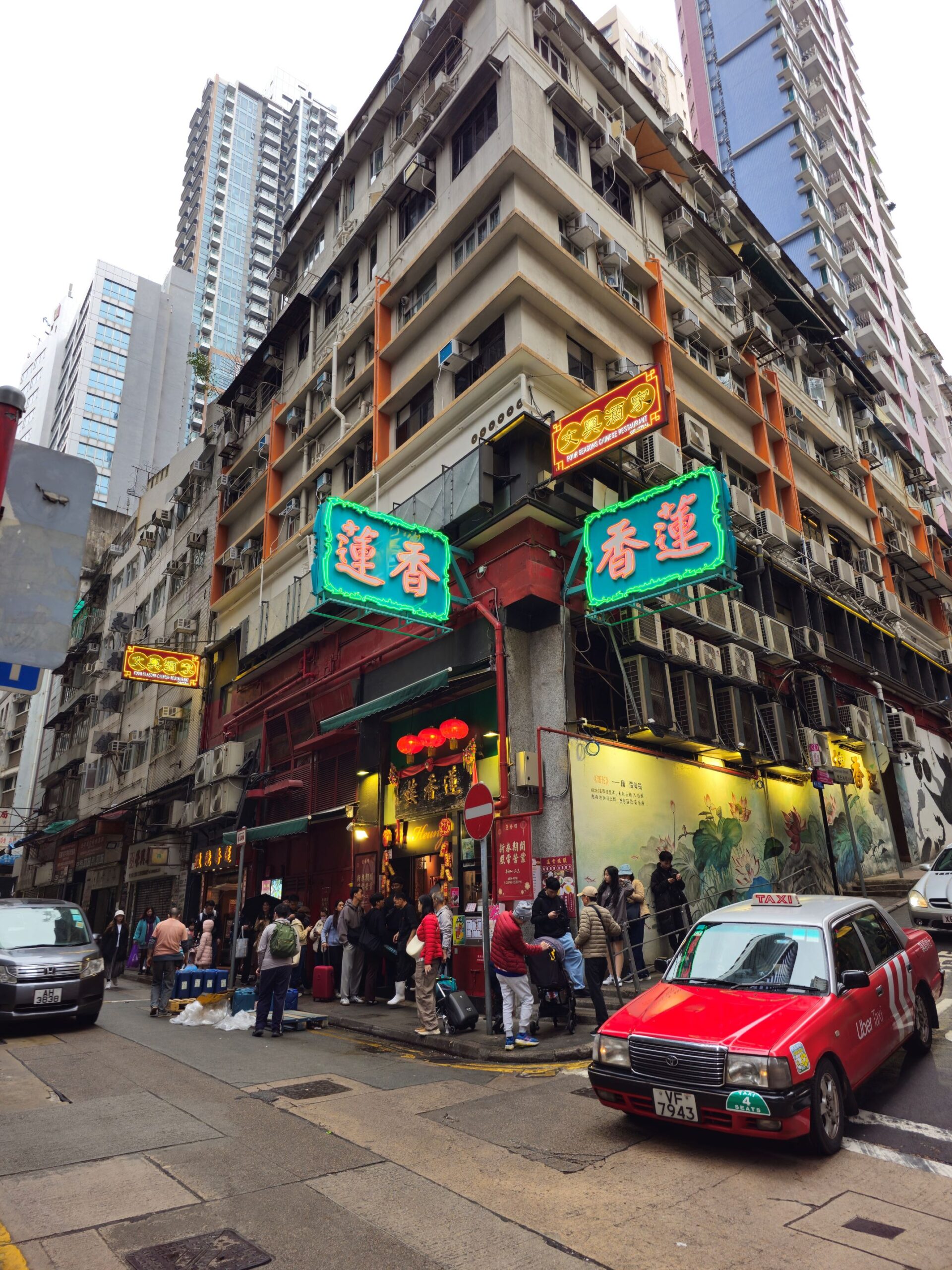
Lin Heung Tea House is not the best dim sum in Hong Kong. It might not even be in the top five by any objective measure of food quality. What it is — and what no other dim sum restaurant in the city can claim to the same degree — is the most authentic surviving example of how Hong Kong has eaten dim sum for nearly a century. I visited for lunch on January 26th, walking from my AKVO Hotel in Central to Sheung Wan in about 15 minutes, and found an experience that I’m still thinking about weeks later — not primarily because of the food, but because of what the food was embedded in.
This review covers Lin Heung Tea House honestly: the history, the experience, the food, and who should make the journey.

Background: A Century of Dim Sum
Lin Heung Tea House (蓮香樓) has been operating on Wellington Street in Sheung Wan since 1926 — nearly a century of continuous service from the same building on the same street, through the Japanese occupation, through the postwar reconstruction, through the handover, through the transformation of Hong Kong into one of the world’s most expensive cities. The restaurant has not changed dramatically in that time, which is either its greatest virtue or its greatest flaw depending on what you’re looking for.
The name translates approximately as “Fragrant Lotus Tea House” — and the restaurant was originally one of several establishments in Hong Kong carrying some version of that name, a common practice among Cantonese tea houses in the early 20th century.
Lin Heung operates on the second floor of a building on Wellington Street — reached via a staircase that sets the atmosphere before you’ve found your table. The staircase is narrow, the walls are old, and the sound of the dining room above is audible before you arrive.

Getting There
From Central MTR (Exit D1): Walk west along Des Voeux Road or Queen’s Road Central approximately 10 minutes to Wellington Street in Sheung Wan. Lin Heung is at 160–164 Wellington Street — the building is identifiable by the queue that typically extends down the staircase during peak service hours.
From AKVO Hotel (Central): A 15-minute walk west through the Central and Sheung Wan streets — the most straightforward route goes along Wellington Street itself, allowing you to see the neighborhood transition from Central’s financial core to Sheung Wan’s more historically layered character.
From Sheung Wan MTR (Exit B): Walk east on Des Voeux Road then south on a connecting street to Wellington Street — approximately 8 minutes.
Arrival and Seating
Lin Heung does not take reservations. The seating process operates on the traditional Hong Kong dim sum model: arrive, assess the queue situation, secure a position on the waiting list or wait at the entrance, and be directed to a table when one becomes available.
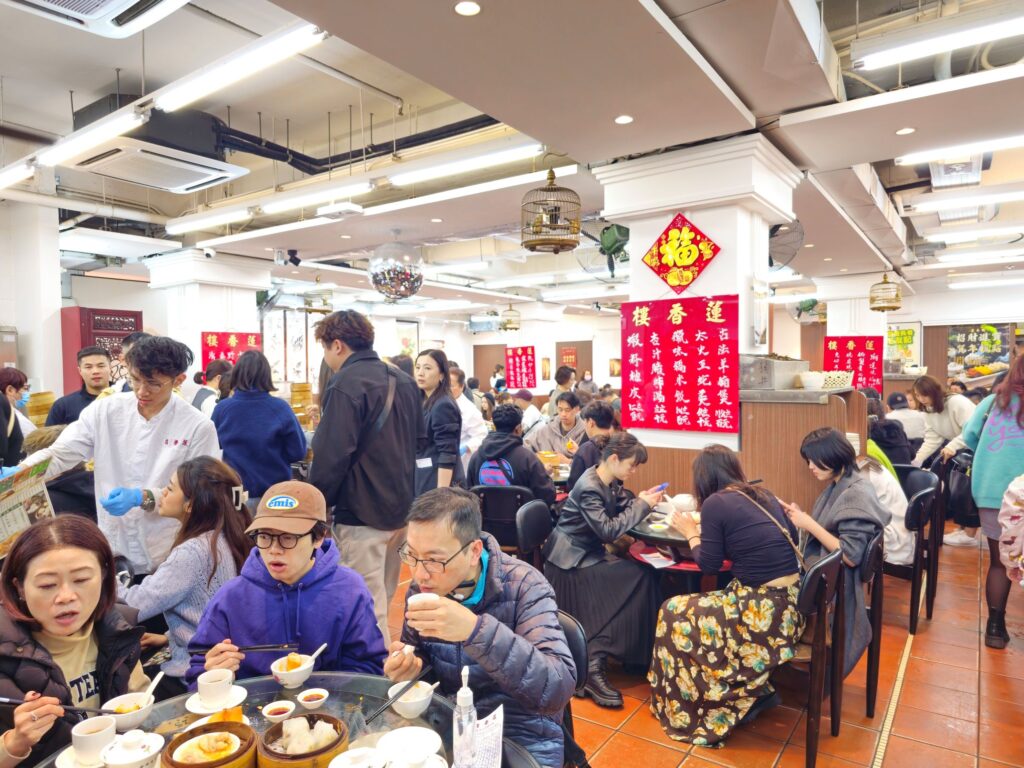
Shared tables are not just expected at Lin Heung — they are standard. In a dining room built around round tables seating 8–10 people, single diners and couples will almost certainly share with strangers. The strangers will be regulars who have been coming here for years; they will not speak to you, and this is completely fine.
I arrived at approximately 12:30pm on a January weekday — the lunchtime service in full operation, tables fully occupied, the trolley service moving continuously through the room. The wait was about 10 minutes before a space appeared at a shared table. Being directed to a specific seat at a specific table — wherever there’s room — is the Lin Heung experience.


The Dining Room
The dining room at Lin Heung Tea House is large, bright, and loud — the particular noise of a Hong Kong dim sum restaurant at full capacity, amplified by high ceilings and hard surfaces. Round tables fill the space with minimal gap between them; the trolley service navigates the gaps between tables with practiced efficiency.
The décor is functional rather than atmospheric — the kind of dining room that looks exactly as it has for decades because it has never needed to be anything other than what it is. No renovation for aesthetic reasons; no design updates for Instagram appeal. The tables are round, the chairs are standard, the lighting is bright. This is where you eat, not where you admire the interior design.
The walls carry some framed historical photographs and calligraphy — small acknowledgments of the restaurant’s age and history that don’t dominate the space. The overall impression is of a room that has been continuously occupied and continuously used for a very long time, which is exactly what it is.

The Trolley Service
The trolley service at Lin Heung is the primary reason to visit — and the element that most clearly differentiates it from every other dim sum experience in Hong Kong.
In most contemporary dim sum restaurants — including excellent ones like One Dim Sum — the trolley service has been partially or fully replaced by written order forms. The form is more efficient and allows diners to request specific dishes rather than waiting for the right cart to appear. Lin Heung has not made this transition. The trolley service here operates as it has for decades: servers push carts through the narrow gaps between tables, and diners flag them down to see what’s available.

How the trolley service works:
The carts carry bamboo steamers stacked in towers — each steamer contains a specific dish, and the server lifts lids on request to show what’s inside. The carts move through the room continuously; different carts carry different dishes, and the availability of specific dishes depends on which cart happens to come past and when.
This creates a dynamic that’s entirely different from ordering off a menu: you flag a cart, you lift lids, you take what looks good or what you recognize. Dishes you didn’t plan to order appear and are ordered on impulse. Dishes you specifically wanted may not appear for 20 minutes, or may not appear at all if the kitchen has run out. The meal is partly determined by the kitchen’s production schedule and the cart’s route through the room rather than entirely by your preferences.
For visitors accustomed to menu-based ordering, this requires an adjustment in approach. The correct posture is receptive rather than directive — flag carts frequently, look at what’s offered, take what looks good, and accept that the meal will be partly a product of chance and timing.
The servers: The trolley servers at Lin Heung are experienced — most have been working this service for years, navigating the room with a speed and precision that makes the continuous flow of carts appear effortless. They work primarily in Cantonese; communication about what’s in the steamers is primarily visual (lid lifting) rather than verbal. The occasional “har gow? siu mai?” exchange in English covers most visitor needs.


The Food
Har Gow (蝦餃)
Lin Heung’s har gow is traditional rather than refined — the wrapper is slightly thicker than at One Dim Sum, the filling is properly prawn-based, and the overall execution is competent without being exceptional. This is the har gow of a restaurant that has been making it the same way for decades — consistent, reliable, and true to the traditional form.
The comparison with One Dim Sum (where the har gow is thinner-wrapped and more precisely executed) is instructive: Lin Heung’s version is the ancestral form from which the more refined versions descend. Both are worth eating; they’re different experiences of the same dish.


Siu Mai (燒賣)
Well-made and generous — the filling is correct, the wrapper holds its shape, and the dish is satisfying in the uncomplicated way that classic dim sum is supposed to be. Lin Heung’s siu mai doesn’t surprise; it delivers what it has always delivered.
Char Siu Bao (叉燒包)
The steamed barbecue pork bun at Lin Heung is one of the restaurant’s better dishes — the bun is fluffy and properly proofed, the char siu filling is well-seasoned and not overly sweet. This is a version of the dish that has been refined over decades of daily production, and the consistency shows.
Lo Mai Gai (糯米雞)
One of Lin Heung’s most reliable dishes — glutinous rice with chicken, mushroom, and Chinese sausage in lotus leaf, steamed to a proper sticky consistency with the lotus fragrance present throughout. Order it if the cart comes past.
Egg Tart (蛋撻)
Lin Heung’s egg tart is a traditional shortcrust version — not the benchmark against Tai Cheong, but a competent and fresh version that benefits from being eaten immediately when the cart delivers it warm.
Pan-Fried Turnip Cake (蘿蔔糕)
A good version of this dim sum staple — crisp exterior, soft interior with the mild sweetness of the radish present without dominating. Worth ordering when the cart comes past.

The Tea
Tea at Lin Heung is not incidental — it’s central to the experience in a way that the name “tea house” implies and that modern dim sum restaurants sometimes forget. The tea arrives immediately on seating; the variety (chrysanthemum, pu-erh, jasmine, po lei) is indicated on a simple menu; and the refill culture operates as it should.
Tea refill signal: Place the teapot lid upside down on the pot to signal a refill request — the server passing with a hot water kettle will refill automatically. This is standard dim sum etiquette at traditional establishments and worth knowing before you arrive.
The pu-erh tea — dark, earthy, and slightly fermented — is the traditional pairing with Cantonese dim sum and the version I ordered. It cuts through the richness of the steamed and fried dishes effectively; the slightly bitter finish of the pu-erh provides the right counterpoint to the buttery and savory flavors of the food.
A small tea service charge (茶位費) is added to the bill — standard at Hong Kong dim sum restaurants, covering the tea and the service of bringing it throughout the meal.


The Regular Customers
The most interesting dimension of the Lin Heung experience — and the element that differentiates it most clearly from any other dim sum restaurant in Hong Kong — is the regular customers.
Lin Heung’s dining room at lunch on a weekday is full of people who have been coming here for years. Retired men who arrive alone and share tables with other regulars they know by sight if not by name. Families who have been eating at these tables for generations. Workers from the surrounding neighborhood who treat Lin Heung as a canteen rather than a restaurant. The occasional table of visitors — identifiable by the slight hesitation in flagging carts and the slightly wider eyes at the room’s intensity.
The regulars are not performing authenticity for visitors. They are simply doing what they do — eating lunch, drinking tea, talking or not talking, occupying tables that they have occupied hundreds of times before. Being present in the same room is access to something that cannot be engineered: a Hong Kong institution operating as it has always operated, for the people it has always served.


Lin Heung vs One Dim Sum: The Honest Comparison
| Lin Heung Tea House | One Dim Sum | |
|---|---|---|
| Food quality | Traditional, competent | ✅ More refined |
| Price | ✅ Cheap | ✅ Cheap |
| Atmosphere | ✅ Most authentic in HK | Local, loud |
| Trolley service | ✅ Full traditional | Partial |
| English accessibility | ⚠️ Limited | ✅ Better |
| Regulars | ✅ Century of them | Local families |
| Best for | Cultural experience | Food quality + value |
The honest summary: One Dim Sum produces better dim sum. Lin Heung provides a more historically significant experience. Both are worth visiting; they serve different purposes and reward different expectations.
For visitors who can only choose one: One Dim Sum if food quality is the primary interest; Lin Heung if cultural authenticity and historical depth are the priority.
For visitors with time for both: visit One Dim Sum first (the food sets a quality baseline), then Lin Heung (the experience reframes what dim sum is in the context of Hong Kong’s history).


Who Should Visit Lin Heung
Visit if:
- The cultural and historical dimension of eating in Hong Kong matters as much as the food quality
- You want to experience traditional trolley service dim sum in its most authentic surviving form
- You’re interested in how Hong Kong has eaten for the past century
- You can approach the experience with patience and receptivity rather than specific dish expectations
Consider alternatives if:
- Food quality is the primary criterion and atmosphere is secondary
- The navigational challenge of a Chinese-only menu and Cantonese-speaking servers feels prohibitive
- You have very limited time and want the most efficient quality dim sum experience

Practical Tips
Timing: The breakfast service (7–10am) and lunch service (10am–2pm) are the peak periods — arrive early for the fullest trolley selection. The restaurant gets progressively busier through the morning and peaks around 11:30am–12:30pm.
Language: The menu and most server communication is in Cantonese. Visual communication — pointing at steamers, lifting lids, indicating quantities with fingers — handles most ordering needs. The dishes themselves are identifiable by sight once you know what you’re looking for.
Shared tables: Unavoidable and standard. Sit where directed, nod to your tablemates, and proceed with the meal.
Trolley strategy: Flag every cart that comes past, regardless of whether you think you want what’s on it. Lift the lids and look. The best dim sum discoveries at Lin Heung come from taking something you didn’t specifically plan to order.
Bill: The bill is calculated from the stamps applied to your table card as dishes are delivered — keep the card visible throughout the meal. A small tea service charge is added automatically.
Cash: Cash is strongly preferred at Lin Heung — bring Hong Kong dollars in small denominations.

Final Thoughts
Lin Heung Tea House is not the place to go if you want the best dim sum in Hong Kong. It is the place to go if you want to understand what dim sum in Hong Kong has always been — the trolley service moving through a loud dining room, the regulars who have been sitting at these tables for decades, the tea arriving automatically and being refilled throughout the meal, the lottery of what the carts bring past your table and the small pleasure of finding something unexpected among the steamers.
A century of continuous operation in the same building on the same street is not just a fact about Lin Heung — it’s the experience. The food is the vehicle; the continuity is the destination.
Go for lunch. Flag every cart. Order the char siu bao when it comes past. And sit for a while after you’ve finished — understanding that every table in this room has been occupied, continuously, for nearly 100 years.
Wonton Noodles in Hong Kong: A Complete Guide
Central Hong Kong Neighborhood Guide: Everything You Need to Know