

I’ll be honest with you: Prague was one of those cities I thought I understood before I arrived. Cobblestone streets, a famous bridge, a castle on a hill — I’d seen the photos. What I wasn’t prepared for was the sheer density of it all. Standing on Charles Bridge at golden hour in July, the city spread out on both sides of the Vltava River, I realized Prague isn’t just photogenic. It’s one of the most complete medieval cities left in Europe, and five days still felt like not quite enough.
Here’s how I’d structure those five days if I were doing it again — built around the way I actually moved through the city, staying in Holešovice and exploring outward from there.

Before You Go: Quick Essentials
Getting around Prague’s public transport system is one of the best in Central Europe — trams, metro, and buses cover the entire city efficiently and cheaply. I relied almost entirely on trams and the metro, with a lot of walking in between, and found that combination handled everything I needed without exception.
Get a multi-day travel pass rather than paying per individual ride. A 24-hour pass covers unlimited trams, metro, and buses and is far better value if you’re moving around the city regularly. Validate your ticket every single time you board — transport inspectors check frequently, and fines are issued on the spot without exception.
Trams Prague’s tram network is the backbone of the city’s public transport and the most useful option for most journeys. Trams run along the surface streets, which means you see the city as you move through it — and in a city as beautiful as Prague, that matters. Lines 22 and 23 are particularly useful for visitors, running from the New Town through Malá Strana and up to Prague Castle. Night trams run through the early hours for late evenings out.
Metro Three metro lines (A, B, C) cover the main hubs and are faster than trams for longer distances across the city. Use the metro to get somewhere quickly; use trams when you want to enjoy the journey. The metro is clean, frequent, and easy to navigate even without Czech.
Walking Prague’s Old Town and Malá Strana are extremely walkable once you’re in them — and many of the best moments in Prague happen when you put the map away and wander. The city rewards exploration more than most. Wear comfortable shoes from day one: Prague’s cobblestones are beautiful and hard on feet over long days.

Weather in Summer June through August in Prague is warm and sunny — typically 25–30°C, occasionally hotter during heat waves. It’s also peak tourist season, which means the major sights get genuinely crowded by mid-morning. Charles Bridge can feel like a rush-hour commute by 10am in July. The single most effective strategy for summer Prague: start early. The city before 8am is a completely different experience — quieter, softer light, and far more atmospheric than anything you’ll find at midday.
Practical tips before day one
- Czech koruna (CZK) is the currency — Prague has not adopted the euro despite being in the EU
- Most restaurants and shops accept cards, but carry some cash for smaller places, markets, and public toilets
- Download the PID Lítačka app for public transport — it covers routes, real-time departures, and ticket purchase all in one place
- Prague’s tap water is safe to drink — bring a reusable bottle
- Most signs in tourist areas are in Czech and English; learning a few Czech phrases (děkuji = thank you, prosím = please) goes a long way with locals

A Note on Staying in Holešovice
Most first-time visitors stay in or around Old Town, and it’s easy to see why — you’re walking distance from everything. But Holešovice, the neighborhood just north of the center across the river, offers something genuinely different: a quieter, more residential Prague that feels less like a tourist attraction and more like a real city neighborhood in the middle of its own slow transformation.
It’s extremely well-connected — Vltavská metro station puts you in the center in about 10 minutes, and multiple tram lines run directly to Old Town and Malá Strana. The area around the Holešovice market hall (Tržnice), the DOX Centre for Contemporary Art, and the emerging restaurant and bar scene gives you access to a creative, local atmosphere that the Old Town simply doesn’t have at any price point.
If you’re doing five days and want a mix of tourist Prague and real Prague, Holešovice is a genuinely good base — and usually better value than staying inside the tourist center.
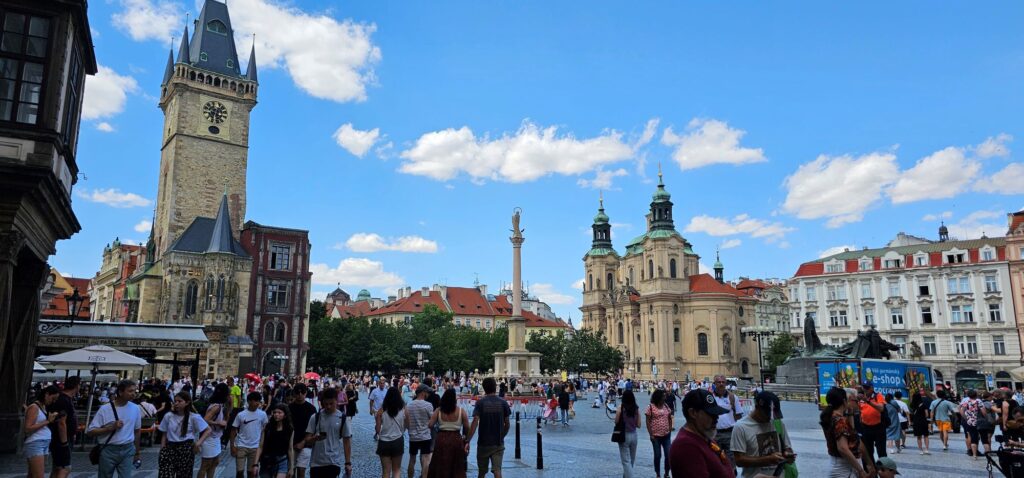
Day 1 — Old Town: Getting Your Bearings
Give your first full day to the Old Town. Don’t rush it — there’s more layered into these streets than most cities manage across their entire historic center.
Old Town Square and the Astronomical Clock
Start at Old Town Square (Staroměstské náměstí). It’s the heart of historic Prague and one of the finest medieval squares in Europe — surrounded by Gothic churches, Baroque palaces, and the colorful facades of buildings that have stood here for centuries. The square has witnessed coronations, executions, and revolutions, and the weight of that history is somehow still present in the stones underfoot.
At one corner of the square stands the Prague Astronomical Clock (Orloj), mounted on the Old Town Hall tower. Built in 1410, it’s one of the oldest functioning astronomical clocks in the world — tracking not just the time but the position of the sun and moon, the zodiac calendar, and the time of sunrise and sunset. Every hour on the hour, a mechanical procession of the Twelve Apostles moves across the upper windows while Death rings a bell below. It’s brief — about 45 seconds — but watching it with the square gathered around you is one of those travel moments that earns its reputation.
Climb the Old Town Hall Tower for a panoramic view over the rooftops and spires of the city. The view from the top — a forest of Gothic towers and terracotta rooftops stretching in every direction — is one of the best vantage points in Prague and well worth the modest entrance fee.
Summer tip: The square gets very crowded from around 10am. If you can be there by 8–8:30am, you’ll have it largely to yourself. The morning light hits the facades beautifully and the atmosphere is incomparably better than midday.
Josefov — The Jewish Quarter
Just northwest of Old Town Square sits Josefov, Prague’s historic Jewish Quarter and one of the best-preserved Jewish historic districts in Central Europe. The quarter contains six synagogues — each architecturally distinct and historically significant — a Jewish Town Hall, and the Old Jewish Cemetery, where graves are layered up to twelve deep due to the limited space available for burial over four centuries.
The cemetery is one of the most quietly affecting places in Prague. Around 12,000 gravestones crowd together at all angles across the uneven ground, the oldest dating to 1439. The sheer density of the stones — the evidence of centuries of community compressed into a small enclosed space — is something that stays with you long after you leave.
Budget at least 2 hours for the quarter, more if you want to explore the synagogues in depth. A combined ticket covers all the main sites and is the best value option.
Evening: Old Town Streets and Dinner
Spend the evening wandering the Old Town streets without a specific agenda. The area around Týn Church and the side streets off the main square reward slow exploration — architectural details you’d walk past quickly in the day become more visible in the evening light, and the crowds thin noticeably after 7pm.
For dinner, look for restaurants with menus written in Czech as well as English — a reliable indicator of places aimed at locals rather than tourists. The streets immediately around Old Town Square tend toward tourist pricing; one or two blocks away, the value improves significantly.
🗓 Local tip for Day 1: The Astronomical Clock procession runs at the top of every hour. Don’t stand in the square waiting for it — time your visit naturally and let it happen as a bonus rather than the main event.

Day 2 — Prague Castle and Malá Strana
Prague Castle
Prague Castle (Pražský hrad) is the largest ancient castle complex in the world — not a single building but an entire hilltop district of palaces, churches, galleries, and gardens covering nearly 70,000 square meters. It has served as the seat of Bohemian kings, Holy Roman Emperors, and Czech presidents for over a thousand years. Allow at least half a day, and consider a full day if you want to explore thoroughly.
The centerpiece is St. Vitus Cathedral — a Gothic masterpiece whose construction began in 1344 and wasn’t completed until 1929. The scale of the interior is extraordinary: the nave soars to 33 meters, and the stained glass windows — including one designed by Art Nouveau master Alfons Mucha — fill the space with extraordinary light on a clear morning. Arrive early, when the morning sun comes through the nave, for the most impressive experience.
Golden Lane (Zlatá ulička) is a narrow street of tiny, brightly colored houses built into the castle walls in the 16th century — originally home to castle guards and later to craftsmen and alchemists. Franz Kafka briefly lived at number 22. The lane is compact and atmospheric, and gets very crowded by mid-morning in summer; again, early arrival is the strategy.
From the castle ramparts and gardens, the views over the red rooftops of Malá Strana and across the river to Old Town are the finest panoramic views in Prague. The South Gardens running below the castle walls are quieter than the main courtyard and offer beautiful views with far fewer people.
Getting there: Tram to Pohořelec or Pražský hrad stop, then a short walk. Alternatively, walk up from Malá Strana through the castle gardens — longer but significantly more scenic, passing through terraced gardens with river views on the way up.

Charles Bridge
Walk down from the castle through Malá Strana and cross Charles Bridge (Karlův most) back toward Old Town. Completed in 1402, the bridge stretches 516 meters across the Vltava on 16 arches and is lined on both sides by 30 Baroque statues of saints — most of them copies, with the originals preserved in the National Museum. For centuries it was the only crossing point over the river in Prague, and the weight of that history is still palpable.
In summer the bridge is extremely crowded during the day — at peak times it can feel more like a slow-moving queue than a walk. But in the early morning (before 7:30am) or late evening it takes on a completely different character: quieter, atmospheric, with street musicians playing to smaller crowds and the city reflected in the river on both sides. If you can manage one early start during your trip, Charles Bridge at dawn is worth every minute of lost sleep.
Malá Strana
Spend the afternoon in Malá Strana — the Lesser Town between the castle hill and the river. It’s quieter and more residential than Old Town, with elegant Baroque architecture, foreign embassies tucked into old palaces, hidden courtyards behind arched gateways, and the beautiful Wallenstein Garden — a formal Baroque garden open free to the public, genuinely lovely on a summer afternoon, and consistently overlooked by visitors focused on the more famous sights.
The streets of Malá Strana reward wandering without a plan. The neighborhood has a slower pace than the tourist center and gives a better sense of what Prague actually feels like to live in.
🗓 Local tip for Day 2: Buy Prague Castle tickets online in advance — the queue at the gate in summer is significant and can cost you an hour. The Circuit B ticket (covering St. Vitus, Old Royal Palace, St. George’s Basilica, and Golden Lane) is the best value for a first visit.

Day 3 — Wenceslas Square, Vinohrady, and Holešovice
Wenceslas Square
Wenceslas Square (Václavské náměstí) is less a square than a grand boulevard — more than 700 meters long, sloping gently upward from the bottom of the New Town to the National Museum at its head. It’s lined with hotels, shops, cinemas, and restaurants, and has been the stage for some of the most significant events in modern Czech history: the Nazi occupation, the Soviet invasion of 1968, and the Velvet Revolution of 1989, when hundreds of thousands gathered here to demand the end of Communist rule.
The National Museum at the top has been extensively renovated and is well worth a visit — the neo-Renaissance building alone is architecturally impressive, and the natural history and history collections inside are substantial. The view back down the square from the museum steps gives you a sense of the boulevard’s full scale.
Walk the length of the square from end to end — it takes about 15 minutes at a relaxed pace — and stop at the Memorial to the Victims of Communism near the equestrian statue of St. Wenceslas at the upper end. The memorial marks the spot where Jan Palach set himself on fire in 1969 in protest at the Soviet occupation. It’s a small but quietly powerful reminder of the history this city has lived through.
Vinohrady
From Wenceslas Square, walk or take a short tram ride east into Vinohrady — one of Prague’s most pleasant and livable neighborhoods. Built largely in the late 19th and early 20th centuries, the area is full of handsome Art Nouveau and neo-Renaissance apartment buildings, tree-lined streets, good independent cafés, and some of the best restaurants in the city at prices that reflect a local rather than tourist clientele.
Náměstí Míru (Peace Square) is the neighborhood’s center — a large square anchored by the neo-Gothic Church of St. Ludmila and surrounded by café terraces that are busy with locals on sunny afternoons. It’s an easy place to spend a few hours doing very little productively.
Vinohrady is consistently recommended by people who live in Prague as the neighborhood they’d choose to stay in. Spending an afternoon here gives you a far better sense of the city’s daily life than anything in the tourist center.
Evening in Holešovice
End the day back in Holešovice. The area around the old Holešovice Market Hall (Tržnice) has been gradually developing into one of Prague’s more interesting food and culture hubs — the market building itself hosts food stalls, bars, and occasional events, and the surrounding streets have a growing concentration of good independent restaurants.
It’s a neighborhood that’s genuinely in the middle of its own story, and spending an evening here feels like seeing Prague at a different angle from the one most visitors get.
🗓 Local tip for Day 3: Vinohrady has some of the best value restaurants in Prague. The streets off Mánesova and Blanická are particularly good — look for places without English-only menus outside.

Day 4 — Day Trip: Český Krumlov
Take a full day for Český Krumlov — a small medieval town in South Bohemia, about 3 hours from Prague by direct bus, and one of the most extraordinarily preserved historic towns in Central Europe. It was designated a UNESCO World Heritage Site in 1992, and standing in the old town for the first time, the designation feels entirely justified.
The town wraps around a tight horseshoe bend in the Vltava River, with a massive castle complex rising above it on a rocky promontory. The Český Krumlov Castle is the second largest in the Czech Republic after Prague Castle — a sprawling complex of courtyards, towers, galleries, and Baroque theater that took centuries to build and has been remarkably well-preserved. The castle tower offers views over the town and river that are among the most photographed in the country, and justifiably so.
Below the castle, the old town is a dense network of cobblestone lanes, colorful Baroque and Renaissance buildings, small squares, and the river running around it on three sides. It’s small enough to cover on foot in a few hours, but the atmosphere — particularly in the early morning before the day-trip crowds arrive from Prague — is extraordinary.
Getting there: Direct buses run from Prague’s Florenc or Na Knížecí bus stations. Book tickets in advance in summer — the route is popular and fills up days ahead. Journey time is approximately 3 hours each way. Trains also run but require a change and take longer.
What to do:
- Walk the old town streets and cross the river on the footbridge for the best view of the castle above
- Visit the castle tower for panoramic views (separate entry ticket, worth it)
- Rent a canoe or rubber ring and float the river loop around the town — one of the most enjoyable ways to see Český Krumlov and very popular in summer
- Eat lunch at one of the riverside restaurants with views of the castle
Timing: Take the earliest bus available (7–8am from Prague) to arrive by mid-morning. The town gets crowded with day-trippers by noon in summer, so the morning hours are significantly better. Aim to head back on a late afternoon bus to give yourself the full day.
🗓 Local tip for Day 4: The canoe rental places on the river get busy fast — if you want to paddle the loop, go to the rental point early in the day. The float takes about 2–3 hours depending on the route you choose.

Day 5 — Day Trip: Pilsen and the Pilsner Urquell Brewery
Use your final day for Pilsen (Plzeň) — the city that gave the world pilsner beer, about 90 minutes west of Prague by train. It’s a substantial city with its own historic center worth exploring, but the main draw for most visitors is the Pilsner Urquell Brewery — the original brewery where pilsner lager was first produced in 1842 and where it has been brewed continuously ever since.
Pilsner Urquell Brewery Tour
The brewery tour is one of the best industrial heritage experiences in Central Europe. The full tour takes you through the historic brewery complex — the malthouses, the copper brew kettles, the lagering cellars — and ends in the underground cellars where the beer is still lagered in wooden barrels, just as it was in 1842. The cellar tour ends with a glass of unfiltered, unpasteurized Pilsner Urquell drawn directly from the barrel — a version of the beer that tastes noticeably different from anything available outside the brewery.
Tours run several times daily and must be booked in advance, especially in summer. The guided tour lasts about 100 minutes and is available in English. It’s one of those experiences that rewards actually paying attention — the history of how pilsner came to dominate global beer culture, told in the place where it started, is genuinely interesting even if beer isn’t normally your focus.
Getting there: Regular trains run from Prague’s Hlavní nádraží (main station) to Pilsen, taking about 1 hour 40 minutes. Trains depart frequently throughout the day and no advance booking is required for the train itself.
Pilsen Old Town
While you’re in Pilsen, the Republic Square (náměstí Republiky) is worth an hour — one of the largest historic squares in the Czech Republic, anchored by the Gothic Cathedral of St. Bartholomew whose tower is the tallest in Bohemia. The square is large, airy, and far less crowded than anything in Prague, with a pleasant café culture around its edges.
The Underground Pilsen tour (separate from the brewery) explores a network of medieval tunnels and cellars beneath the city — an interesting complement to the brewery visit if you have time.
Timing: Take a morning train from Prague, do the brewery tour midday, explore the square in the afternoon, and return to Prague in the early evening. It’s a full but very manageable day.
🗓 Local tip for Day 5: Book the Pilsner Urquell brewery tour online as far in advance as possible in summer — English-language tours sell out days ahead. The tour that ends in the cellars with the unfiltered beer is worth the full ticket price for that final pour alone.

Where to Stay in Prague
Old Town (Staré Město) Maximum convenience — walking distance from everything. More expensive than other areas and noisier, particularly on weekends when the streets around the square stay lively late. Best for visitors who want to be in the middle of the action and don’t mind paying for it.
Malá Strana Beautiful neighborhood with a quieter atmosphere than Old Town. Excellent position for Prague Castle and Charles Bridge. Fewer dining options at the lower end of the price range, but the atmosphere in the evenings is hard to beat.
Vinohrady The best neighborhood for a more local Prague experience. Well-connected by metro and tram, excellent independent restaurant and café scene, quieter evenings, and generally better value than the center. A strong choice for longer stays.
Holešovice Good value, genuinely local neighborhood currently in the middle of its own development. Easy metro and tram connections to the center (10–15 minutes). Best for visitors who want to experience Prague beyond the tourist circuit without sacrificing connectivity.
Nové Město (New Town) Practical and central, with Wenceslas Square at its heart. More affordable than Old Town, well-connected, and a good base for exploring in all directions.

What to Eat and Drink in Prague
Czech cuisine is hearty, meat-focused, and deeply tied to the country’s central European geography. It’s not the most celebrated food culture in Europe, but done well — in the right restaurant, with a proper Czech beer — it’s genuinely satisfying.
Food
- Svíčková na smetaně — Slow-braised beef sirloin in a cream sauce with bread dumplings, a dollop of cranberry, and a slice of lemon. The national dish. Order it at least once, ideally in a traditional Czech restaurant rather than a tourist-facing one.
- Vepřo-knedlo-zelo — Roast pork with bread dumplings and sauerkraut. Simple, filling, and very good when properly made.
- Goulash with bread dumplings — A staple across Czech pubs and restaurants. The quality varies enormously; a good version is deeply satisfying.
- Trdelník — A spiral pastry cooked over an open flame and rolled in sugar and cinnamon, sold at street stalls throughout Old Town. Very tourist-facing but genuinely good when fresh and hot off the spit.
- Chlebíčky — Open-faced sandwiches from Czech deli counters, topped with combinations of egg, ham, cheese, and vegetables. A local lunch staple and excellent value — look for them in supermarket deli sections and dedicated chlebíčky shops.
- Smažený sýr — Fried cheese, typically served with tartare sauce and fries. A Czech fast food staple that appears on almost every pub menu.

Beer Czech beer culture is serious, historically significant, and genuinely world-class. The Czech Republic has the highest per-capita beer consumption in the world, and the country produces some of the finest lagers available anywhere.
- Pilsner Urquell — The original pilsner, brewed in Pilsen since 1842. The version you’ll drink in Prague is good; the unfiltered version in the Pilsen brewery cellars is in a different category.
- Kozel — A widely available Czech lager with both light and dark versions. The dark (tmavý) Kozel is excellent value and consistently good.
- Budvar (Budweiser Budvar) — The original Czech Budweiser, bearing no relation to the American brand. A clean, well-made lager worth trying.
- Local craft beer — Prague has developed a solid craft beer scene over the past decade. Areas like Vinohrady and Holešovice have good craft beer bars worth exploring.
The standard order in a Czech pub is simple: sit down, and a beer will likely appear in front of you shortly. If you don’t want another, place a coaster on top of your glass.

Practical Tips Recap
- Prague Castle tickets: Book online in advance — summer queues at the gate are significant
- Transport validation: Validate your ticket every time you board — inspectors check regularly
- Czech koruna: Exchange at a bank or use ATMs; avoid street exchange booths which offer poor rates
- Český Krumlov buses: Book in advance — summer services fill up days ahead
- Pilsner Urquell tour: Book online as far ahead as possible for English-language tours
- Shoes: Cobblestones are everywhere and hard on feet — wear comfortable walking shoes from day one
- Crowds: Major sights are significantly less crowded before 9am and after 6pm — plan accordingly
- Czech phrases: Děkuji (thank you) and Prosím (please/you’re welcome) are appreciated and go a long way
Final Thoughts
Five days in Prague is enough to understand why it consistently ranks among Europe’s most visited cities — and also enough to get past the postcard version and find the real city underneath. The castle and Charles Bridge are genuinely as impressive as their reputation suggests. But Prague also rewards the slower moments: the early morning walk across an empty bridge, the afternoon in a Vinohrady café, the evening wander through Holešovice. The city has layers, and five days gives you just enough time to start finding them.
Stay somewhere local. Take the trams. Go to Charles Bridge before breakfast. Drink the beer where it was invented. And leave yourself at least one afternoon with no particular plan — Prague will fill it.
Prague Václav Havel Airport Terminal 2 Guide: Shopping, Duty Free & Travel Tips