
Most Hong Kong itineraries are built around the harbor view, the Peak, and the temple circuit. The Mong Kok Flower Market and Bird Garden belong to a different category — experiences that have nothing to do with the tourist circuit and everything to do with how the city actually lives. I visited on the afternoon of my second day in Hong Kong, walking from One Dim Sum after lunch and arriving at the flower market as the afternoon trade was in full flow. It was one of the most genuinely local experiences of the entire trip.
This guide covers both the Flower Market and the Bird Garden — what they are, how to visit them, what to expect, and why they belong in any Hong Kong itinerary that goes beyond the standard highlights.

The Flower Market
What Is It?
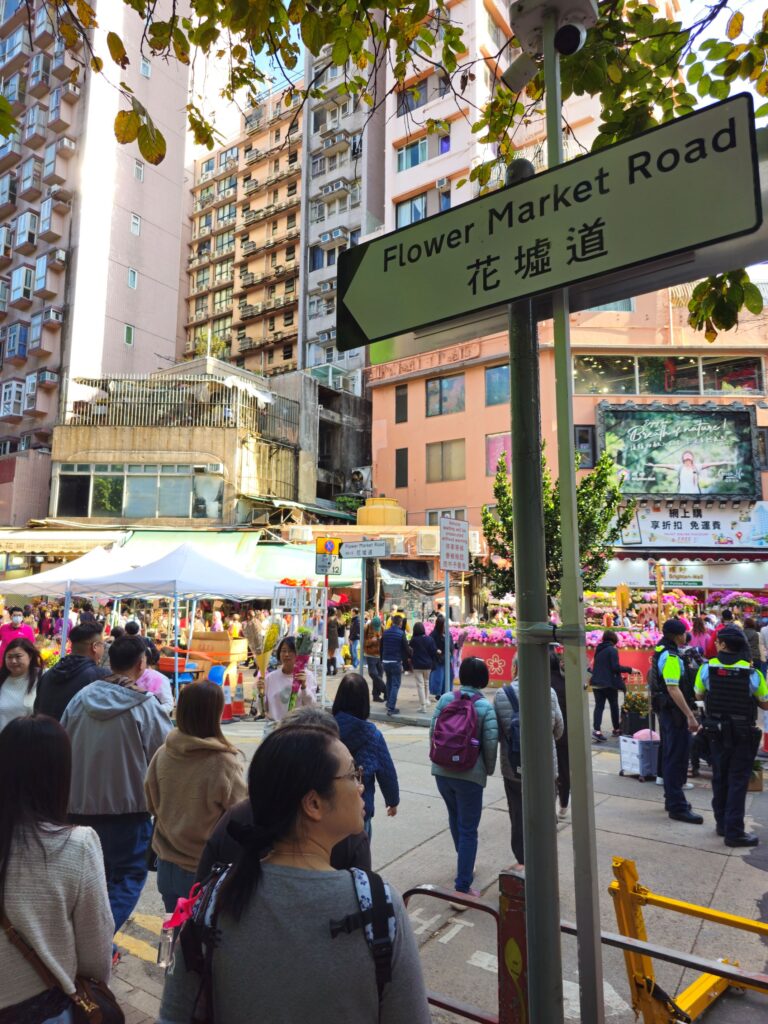
The Mong Kok Flower Market (旺角花墟) is a street of wholesale and retail flower vendors concentrated on Flower Market Road (花墟道) — a dedicated street in the Mong Kok neighborhood running parallel to Prince Edward Road West. The market operates daily, with wholesalers trading from the early morning hours and retail vendors operating through the afternoon and evening.
The market has been in this location for decades and serves both the commercial flower trade (hotels, restaurants, event venues) and individual retail customers buying flowers for their homes, for gifts, and for the religious offerings that are a regular part of Hong Kong’s domestic and temple life.
Getting There
From Prince Edward MTR station (Exit A): Walk south on Tung Choi Street and turn right onto Flower Market Road — approximately 5 minutes from the MTR exit. This is the most direct approach.
From One Dim Sum: After lunch at One Dim Sum near Prince Edward station, the flower market is a natural next stop — a 10-minute walk south and west through the neighborhood streets.
From Mong Kok MTR station (Exit B2): Walk north on Tung Choi Street to Flower Market Road — approximately 8–10 minutes.

What to Expect
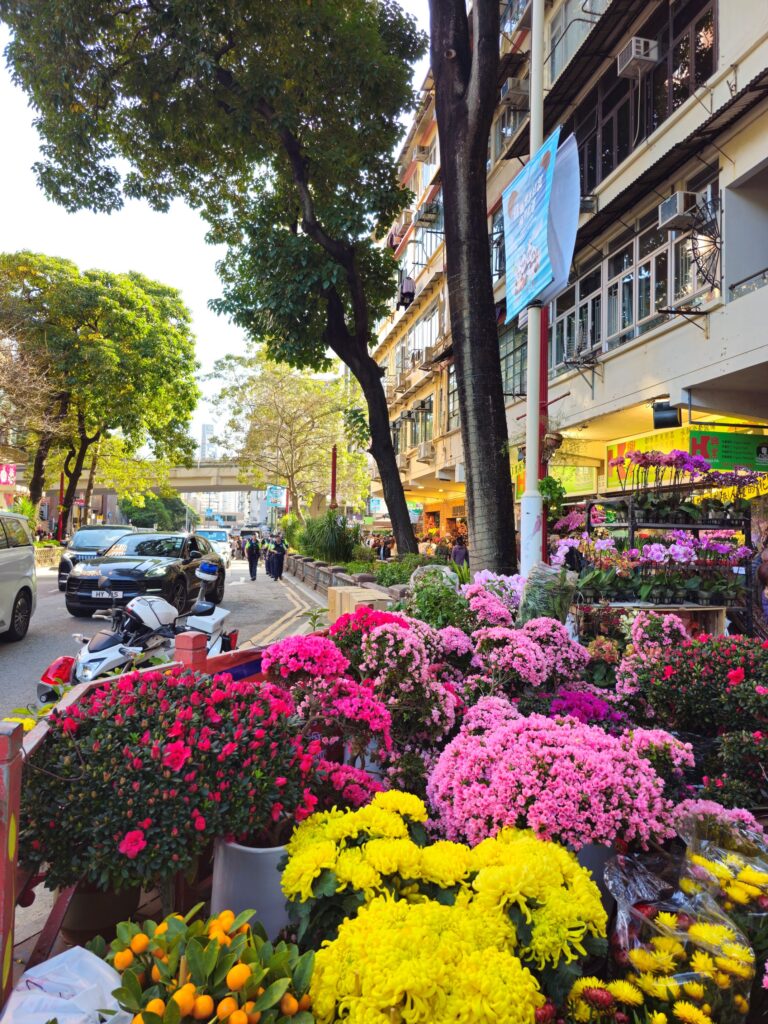
Flower Market Road is a relatively narrow street lined on both sides with open-fronted flower shops and pavement stalls — vendors arranging fresh stock, buckets of cut flowers at pavement level, potted plants stacked to ceiling height, and the particular compressed visual quality of a specialist market street at full operation.
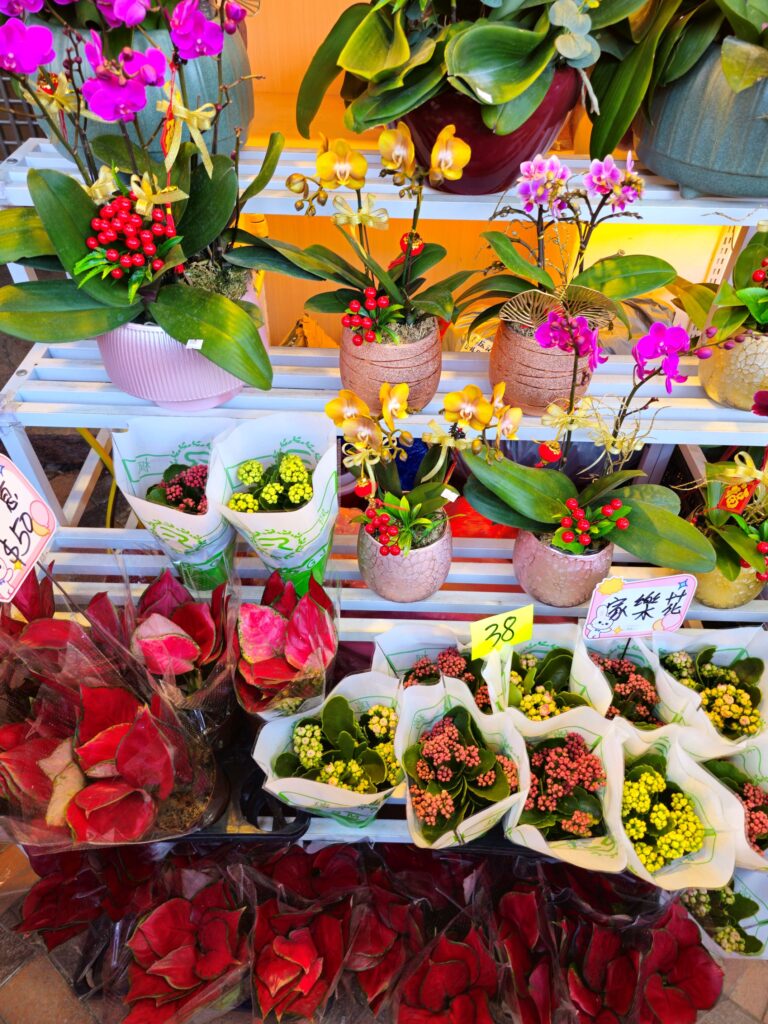
The variety is the first thing that registers. Not just the standard Western cut flowers (though roses, chrysanthemums, and carnations are well-represented) but tropical varieties specific to Hong Kong’s subtropical climate: bird of paradise (天堂鳥), anthurium (火鶴), heliconia, protea, and various orchid species that are particularly associated with Hong Kong’s Chinese New Year flower culture.
Potted plants are as significant as cut flowers in the market — orchids, succulents, and the various bonsai-adjacent miniature tree forms that are popular in Hong Kong’s apartment culture, where outdoor space is limited and indoor plants fill the gap.
January: Chinese New Year Preparation
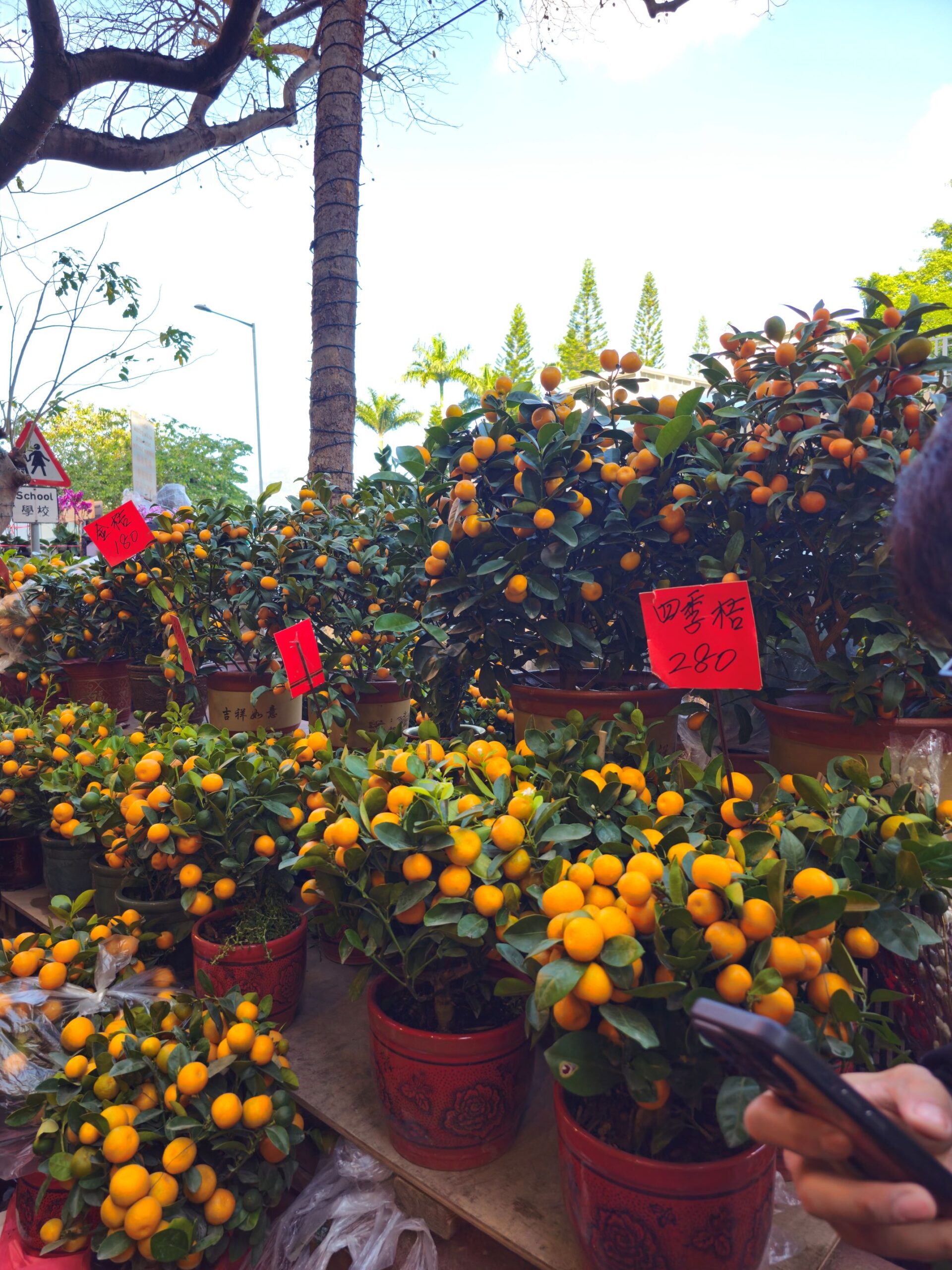
My January visit coincided with the pre-Chinese New Year period — and the flower market during this time is a version of itself that exists only in the weeks before the festival.
Peach blossom (桃花) is the defining plant of the Chinese New Year flower season — branches of cherry-like blossoms associated with luck, prosperity, and new beginnings that fill Hong Kong homes and businesses during the festival period. In January, peach blossom branches in various stages of bloom occupy significant sections of the flower market, and the particular visual and olfactory character of the market shifts accordingly.
Kumquat trees (金桔) — small citrus trees bearing abundant golden fruit, symbolizing gold and prosperity — are another Chinese New Year staple that fills the market in January. The trees are bought for home display during the New Year period and then (ideally) eaten or composted after the festival.
Narcissus (水仙) bulbs, carefully cultivated to bloom for New Year, and pussy willow (銀柳) branches round out the New Year flower palette — giving the January flower market a specific seasonal character that the same market in July or October doesn’t have.
For visitors arriving in Hong Kong in the weeks before Chinese New Year, the flower market during this period is one of the most atmospheric and specifically seasonal experiences available — worth prioritizing over other activities if the timing aligns.
How to Browse
The flower market rewards slow walking rather than purposeful navigation. Most vendors welcome browsing without purchase obligation — the commercial dynamic is primarily wholesale and regular retail customer facing, and casual visitors are neither pursued nor ignored.
If you want to buy: Cut flowers are sold by the stem or in bunches at prices that reflect wholesale proximity — significantly cheaper than florist shops in the tourist areas. For visitors staying in hotel rooms, a small bunch of flowers is a practical purchase that improves the room considerably.
Photography: The flower market is highly photographic — the density of color, the arrangement of flowers at various heights, and the particular light of an open-fronted market street give strong images. Morning visits have the freshest stock; afternoon visits have the most active trading atmosphere.
The Bird Garden
What Is It?
The Yuen Po Street Bird Garden (園圃街雀鳥花園) — universally known as the Bird Garden — is a covered arcade of bird vendors, cage makers, and accessory sellers on Yuen Po Street, immediately adjacent to the Flower Market. The garden was relocated to its current purpose-built facility in 1997 and has been operating in this form since then.
The Bird Garden represents a traditional Cantonese cultural practice — the keeping of song birds as companions and the social ritual of bringing them to public spaces to sing together — that has deep roots in Hong Kong and the broader Cantonese cultural world. It is a functioning commercial and social space rather than a heritage attraction, and visiting it with that understanding produces a more genuine experience.
Getting There
From the Flower Market, the Bird Garden is a 2-minute walk — turn onto Yuen Po Street from Flower Market Road and the covered arcade entrance is immediately visible. The two locations are essentially adjacent and should be visited together rather than separately.
The Physical Space
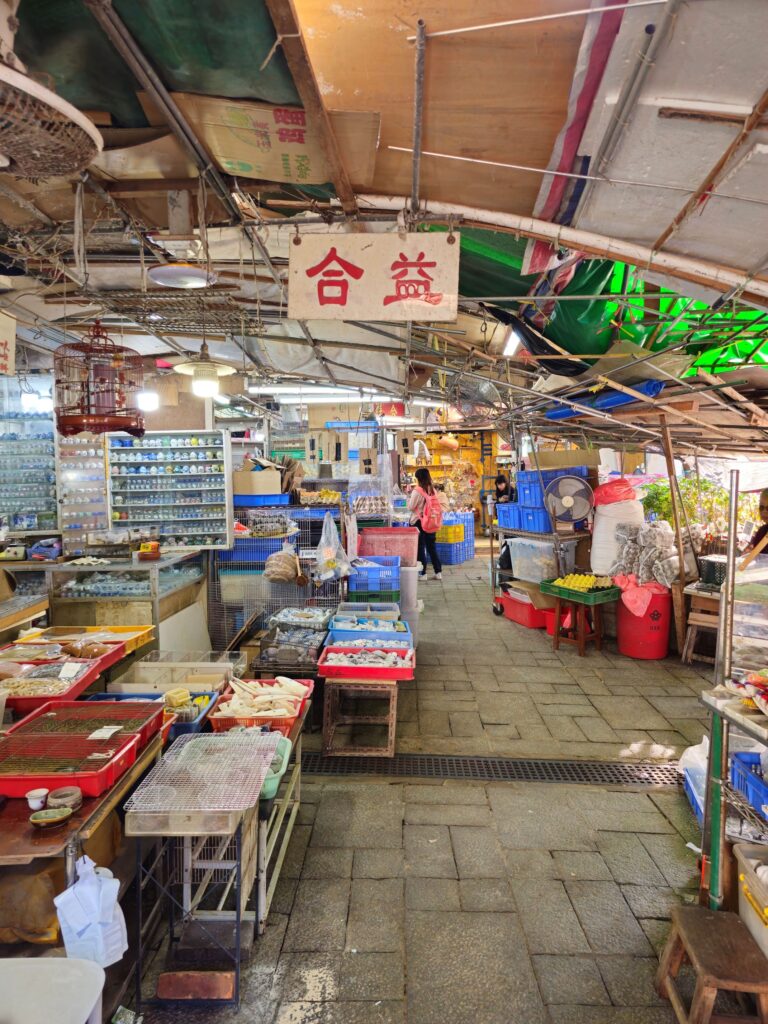
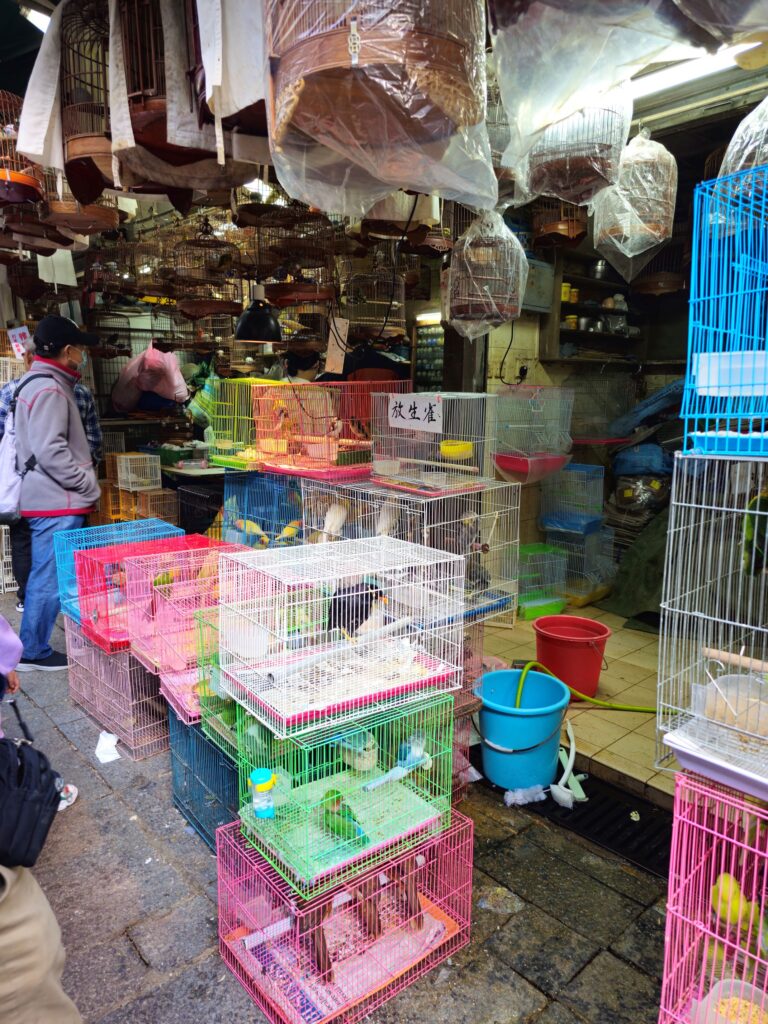
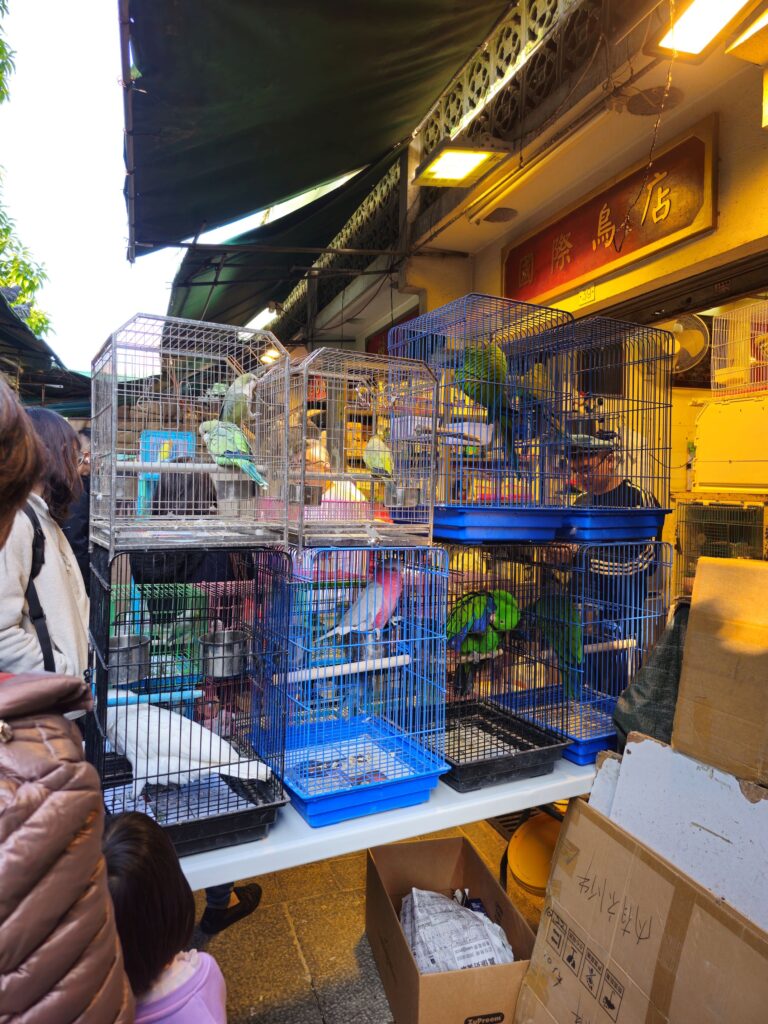
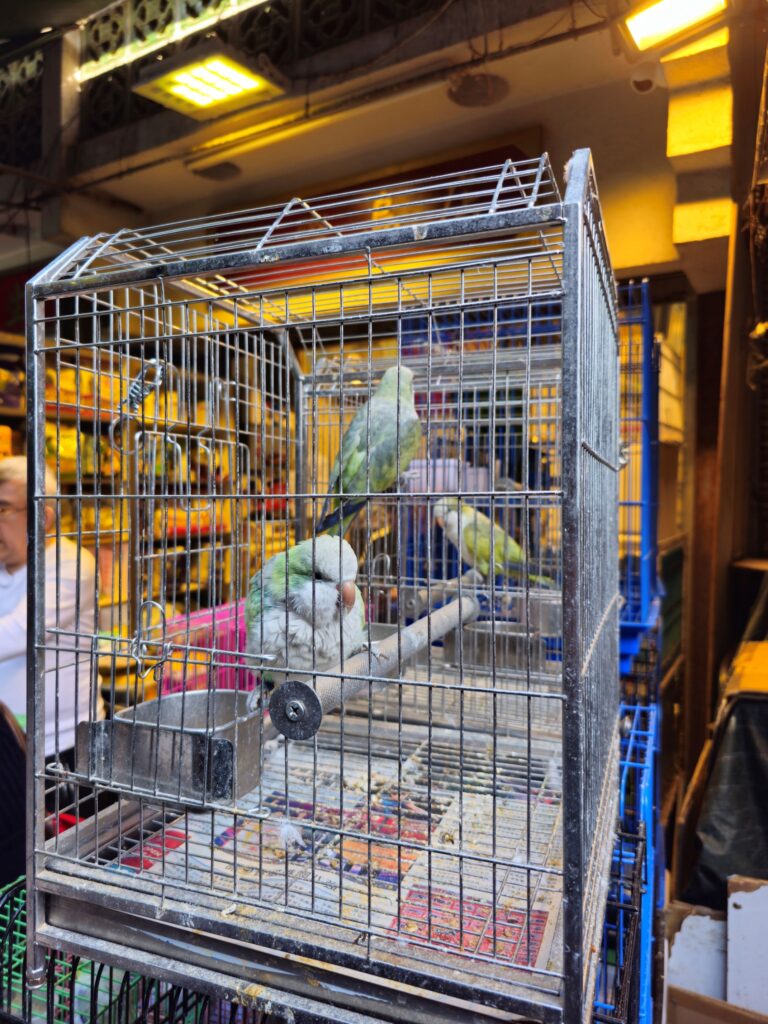
The Bird Garden is a purpose-built covered arcade — a series of interconnected pathways under a roof, with vendors’ spaces arranged along the sides and open central areas where birds in hanging cages can be observed. The arcade has a particular atmosphere: the sound of multiple bird species singing simultaneously, the smell of fresh bird feed and the wood of the cages, and the visual texture of dozens of elaborately carved cages hanging at various heights.
The vendors sell:
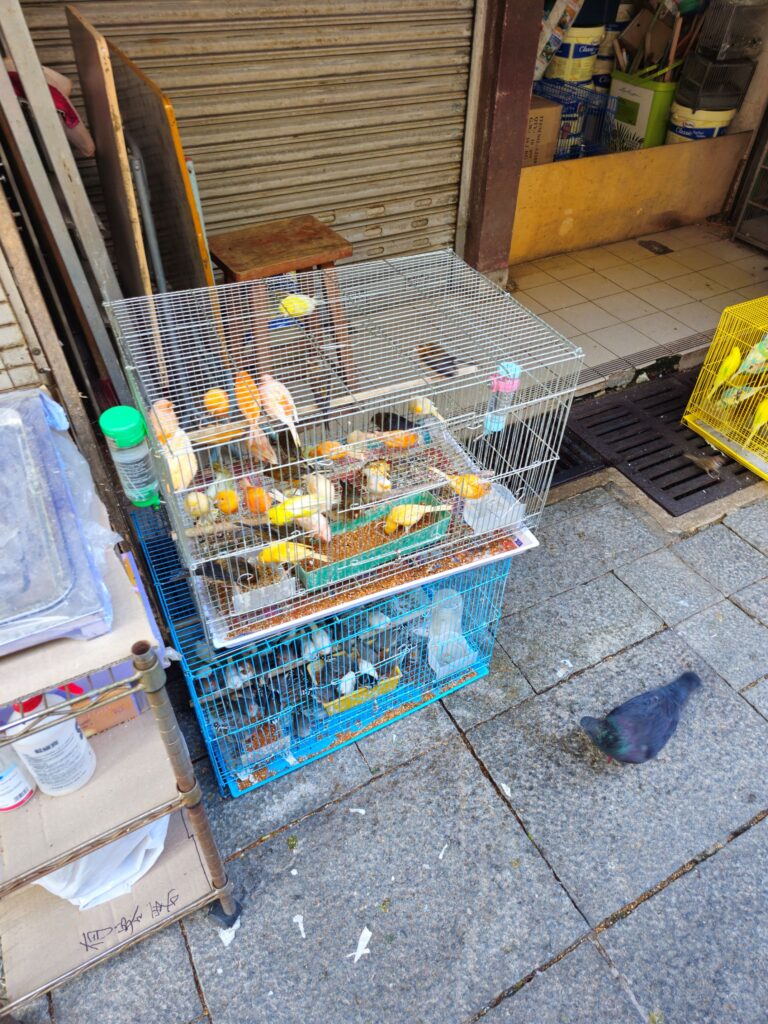
- Song birds: Various species valued for their singing ability — Java sparrows (文鳥), white-eyes (繡眼鳥), mynahs (八哥), various finches and buntings
- Cages: From simple functional bamboo cages to elaborately carved wooden masterpieces that are themselves significant craft objects, with prices ranging from a few hundred to several thousand Hong Kong dollars
- Feeding accessories: Porcelain feeding cups (often decorated), water dishes, and the various small implements of serious bird keeping
- Live food: Crickets, mealworms, and other live insects sold as bird feed — a significant commercial component of the market
The Social Dimension
The most affecting aspect of the Bird Garden is not the commercial activity but the social ritual that happens alongside it. In the morning hours particularly, regular visitors arrive with their birds — hung on the exterior hooks provided along the arcade’s perimeter — to let them sing in the company of other birds and in the company of other bird keepers.
The practice of walking birds (遛鳥) — taking a caged bird to a garden or bird gathering point to sing and socialize — is a Cantonese tradition with roots extending back centuries. In contemporary Hong Kong, where the pace of life is relentless and outdoor space is limited, the Bird Garden provides a specific slow-paced social space that operates outside the city’s normal rhythms.
Elderly men (the practice skews heavily male and toward older generations, though not exclusively) arriving with ornate cages, exchanging views on their birds’ singing ability, comparing acquisitions, and spending an unhurried morning in the garden — this is the Bird Garden at its most authentic and most worth seeing. It happens primarily in the morning hours; afternoon visits see less of this social dimension.
January Visit Considerations
My January visit was in the afternoon — after the morning social period when the bird keepers gather. The market was active commercially but the social dimension was less visible than it would have been at 8–9am. For visitors specifically interested in the cultural practice of bird walking, an earlier visit gives a more complete picture.
In January, as with the Flower Market, the Bird Garden has some Chinese New Year specific character — certain birds associated with auspicious sound and symbolism see increased demand in the pre-festival period.
Visiting Respectfully
The Bird Garden is a working commercial and social space rather than a tourist attraction, and the same principles of respectful visiting that apply to the Monster Building apply here:
Keep noise low. The garden amplifies sound — the birds are sensitive to disturbance and the regular visitors are there for a specific social and cultural purpose that loud tourist behavior disrupts.
Don’t touch the cages or birds. The cages are valuable objects (some are worth thousands of dollars) and the birds are the personal companions of their keepers. Touching either without invitation is inappropriate.
Photography: Photography of the birds and cages is generally fine and expected. Photography of individual bird keepers should be done with awareness and sensitivity — these are not performance subjects.
Duration: 15–20 minutes is appropriate for a respectful visit that takes in the full arcade without overstaying. The Bird Garden is a stop on a broader Mong Kok itinerary rather than a destination requiring extended time.
Combining Both: The Natural Circuit
The Flower Market and Bird Garden together form a natural 45-minute to 1-hour circuit from Prince Edward MTR station — the most efficient way to experience both without unnecessary backtracking.
The recommended sequence:
Prince Edward MTR (Exit A)
        ↓
Walk south to Flower Market Road
        ↓
Flower Market (north end to south end)
~20–25 minutes
        ↓
Turn onto Yuen Po Street
        ↓
Bird Garden
~15–20 minutes
        ↓
Walk south to Fa Yuen Street
        ↓
Fa Yuen Street Market (sneaker section)
~15 minutes
        ↓
Continue south on Tung Choi Street
        ↓
Ladies Market (if desired)
~30 minutes
        ↓
MTR from Mong Kok station back to
Tsim Sha Tsui or Central
This sequence — Flower Market, Bird Garden, Fa Yuen Street, and optionally Ladies Market — covers the full range of the Mong Kok market experience in a logical geographic order, moving generally south from Prince Edward toward the Mong Kok MTR station.
Best Time to Visit
Morning (8–11am)
The best time for both the Flower Market and the Bird Garden. The flower market at its freshest — new stock arrived, vendors arranging displays, wholesale trade active alongside retail. The Bird Garden at its most socially alive — bird keepers arriving with their birds, the social ritual in full operation.
For visitors willing to adjust their schedule, a morning visit to the Flower Market and Bird Garden before the One Dim Sum lunch is the ideal sequence — arriving at the market first thing, when both are at their most atmospheric, then rewarding the morning walk with dim sum.
Afternoon (2–5pm)
The version I experienced in January — flower market in active retail mode, Bird Garden commercially active but with less of the morning social dimension. Still excellent, particularly for the Flower Market’s visual character.
Pre-Chinese New Year (January–February)
The most distinctive seasonal version — peach blossoms, kumquat trees, and the full New Year preparation atmosphere. If your visit falls in January, this is the version worth prioritizing.
What Makes These Markets Genuinely Local
The Flower Market and Bird Garden represent something that’s becoming less common in Hong Kong’s increasingly tourist-oriented city center: spaces that exist primarily for the city’s residents rather than for visitors, operating according to their own logic and schedule regardless of whether anyone from outside is watching.
The flower market serves the hotels, restaurants, temples, and households of Hong Kong’s daily life. The Bird Garden serves a community of practitioners whose hobby and social life centers on bird keeping — a tradition carried from mainland China and refined in Hong Kong’s specific urban context over generations.
Visiting these spaces as a tourist is entirely welcome and entirely beside the point simultaneously. The market and the garden operate whether or not visitors are present. The vendors are focused on their trade; the bird keepers are focused on their birds. The visitor’s role is observer rather than participant — which, done with appropriate awareness, is a completely valid way to experience the most authentic dimensions of a city’s life.

Practical Tips
Getting there: Prince Edward MTR station (Exit A) is the most convenient access point — 5 minutes to the Flower Market entrance
Timing: Morning for social Bird Garden atmosphere and freshest flowers; afternoon for active retail flower market
January visit: Pre-Chinese New Year atmosphere is distinctive — peach blossoms and kumquat trees specific to this period
Photography: Both locations are highly photographic — wide shots of the flower market street, close-up details of individual flowers and cages
Bird Garden etiquette: Quiet, respectful, no touching of cages or birds
Combining with One Dim Sum: The natural sequence is One Dim Sum lunch at Prince Edward followed by Flower Market and Bird Garden in the afternoon
Duration: Allow 45 minutes to 1 hour for both locations together
Cash: Most flower vendors accept Octopus card for retail purchases; bird accessory vendors may prefer cash
Final Thoughts
The Mong Kok Flower Market and Bird Garden are the kind of Hong Kong experiences that don’t photograph as dramatically as Victoria Peak or translate as easily into travel recommendations as the Symphony of Lights — but they give something that those experiences don’t: a window into how the city lives outside the tourist circuit, slowly and on its own terms.
The flowers are extraordinarily beautiful. The birds are extraordinary performers. And the people who keep the market and the garden alive — the vendors who’ve been trading here for decades, the bird keepers who arrive every morning with their companions — are Hong Kong in a form that the harbor view doesn’t show.
Go in the morning if you can. Walk slowly. And in January, look for the peach blossoms.
Temple Street Night Market: Complete Guide to Hong Kong’s Most Atmospheric Market
Mong Kok Travel Guide: Hong Kong’s Most Intense Neighborhood