

If you’re visiting Hong Kong for the first time and wondering where to base yourself, the answer for most people is Tsim Sha Tsui. I stayed here for the first two nights of my January trip — at the YMCA Salisbury Hotel, steps from the harbor — and the neighborhood delivered everything a first-time visitor needs: the most iconic view in Hong Kong right outside the door, excellent transport connections to the rest of the city, and enough to see and do within walking distance that you could spend two full days without ever leaving.
This guide covers everything worth knowing about Tsim Sha Tsui — what to see, where to eat, how to get around, and why it remains the best base for a first Hong Kong visit.

Where Is Tsim Sha Tsui?
Tsim Sha Tsui (尖沙咀, often abbreviated TST) occupies the southern tip of the Kowloon Peninsula — the mainland side of Hong Kong, directly across Victoria Harbour from Hong Kong Island. The neighborhood sits at the confluence of the MTR network, the Star Ferry terminal, and the harbor promenade, which gives it a connectivity that no other neighborhood in Hong Kong quite matches.
The distinction between Kowloon side and Hong Kong Island side is the first geographic concept worth understanding in Hong Kong. Tsim Sha Tsui is Kowloon — older, denser, slightly more working-class in character than the gleaming towers of Central across the water, and home to the harbor view that most people picture when they think of Hong Kong.
The neighborhood is compact and highly walkable — most major sights are within 20 minutes on foot of the Star Ferry pier, and the street-level experience of walking through TST gives a better sense of Hong Kong’s daily life than any single attraction can.

Getting to Tsim Sha Tsui
From the Airport
The most practical option from Hong Kong International Airport for visitors heading to Tsim Sha Tsui is the A25 bus — a direct service running from the airport through the city, stopping at multiple points along Nathan Road and near the major hotels in the neighborhood. The journey takes approximately 45–60 minutes depending on traffic and costs a fraction of a taxi fare. I took this bus on arrival in January with luggage and found it efficient and straightforward — stops are announced in English, the luggage storage area under the bus handles standard travel bags, and the route deposits you directly in the heart of the neighborhood.
The Airport Express train to Kowloon Station followed by a short taxi or MTR connection is faster but involves more steps and a higher cost. For most visitors with manageable luggage, the A25 represents the best balance of cost, convenience, and directness.
Taxis from the airport to Tsim Sha Tsui are metered and available at the designated taxi rank outside the arrivals hall — the journey runs through the cross-harbor tunnel and takes 30–45 minutes. More expensive than the bus but door-to-door and appropriate when arriving late at night or with heavy luggage.
From Elsewhere in Hong Kong
The MTR Tsim Sha Tsui station (Tsuen Wan Line) and East Tsim Sha Tsui station (East Rail Line) connect the neighborhood to the entire MTR network with fast, frequent service. From Hong Kong Station on the Island, the journey takes under 10 minutes via the cross-harbor tunnel.
The Star Ferry from Central Pier 7 takes about 10 minutes and is the most atmospheric way to arrive — crossing the harbor with the Tsim Sha Tsui skyline growing ahead of you and Hong Kong Island receding behind is one of the genuine pleasures of moving around the city. The upper deck always.
Where to Stay in Tsim Sha Tsui
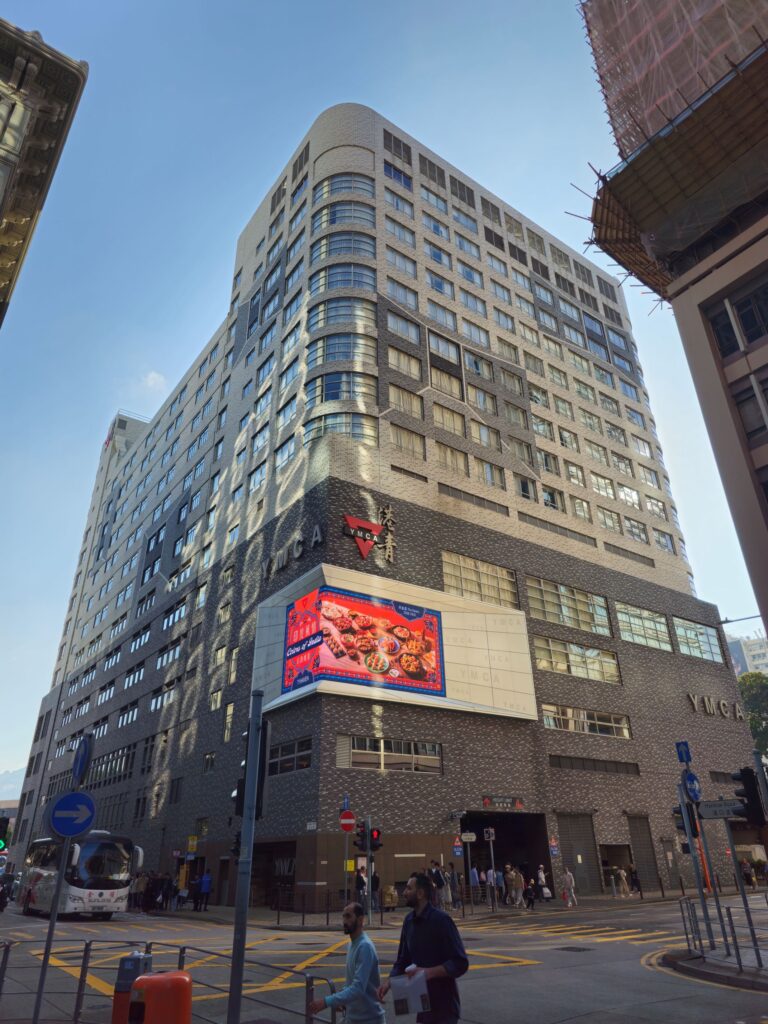
YMCA Salisbury Hotel
The YMCA Salisbury Hotel deserves particular attention because its location is genuinely exceptional and consistently underappreciated by visitors who overlook it in favor of more recognizable hotel brands. The property sits directly on Salisbury Road facing the harbor — two minutes’ walk from the Star Ferry pier, directly adjacent to the Hong Kong Cultural Centre, and with the Avenue of Stars promenade immediately outside the front entrance.
For a hotel at this price point, the harbor access is unmatched anywhere in Tsim Sha Tsui. Rooms are clean, well-maintained, and functional rather than luxurious — this is a YMCA property, and the value proposition is location rather than amenities. Waking up and walking to the harbor promenade in two minutes, or reaching the MTR in five, structures the entire Tsim Sha Tsui experience around maximum convenience.
The hotel has multiple room categories including harbor-view options that offer a direct view of the Symphony of Lights from the window — worth the premium for at least one night if the budget allows.
Best for: First-time visitors who want maximum location advantage at a reasonable price point. Families, solo travelers, and couples all work well here. The YMCA association means facilities are clean and well-run, and the staff are experienced with international visitors.
Booking note: Reserve well in advance for peak season, Golden Week, and the Chinese New Year period — the location means it fills quickly, and last-minute availability at this address is rare.
The Peninsula Hong Kong
At the opposite end of the price spectrum, The Peninsula Hong Kong on Salisbury Road is one of the great historic hotels in Asia — opened in 1928 and still considered one of the finest addresses in the city. The famous fleet of Rolls-Royce hotel cars, afternoon tea in the lobby (a Hong Kong institution in its own right), and the rooftop Felix restaurant and bar are the Peninsula’s signature experiences. Staying here is a statement; having afternoon tea in the lobby is accessible to anyone regardless of whether they’re a guest.
Mid-Range Options
The stretch of Nathan Road running north from the harbor and the streets running off it have the highest concentration of mid-range hotels in Hong Kong — a wide range of options at various price points, most within a 10–15 minute walk of the harbor promenade. When evaluating options in this area, proximity to the MTR and the harbor is worth prioritizing over room size — Hong Kong hotel rooms are universally compact, and location drives the quality of the experience far more than room dimensions.

What to See and Do in Tsim Sha Tsui
Victoria Harbour Promenade and Avenue of Stars
The Tsim Sha Tsui Promenade running along the harbor from the Star Ferry pier eastward past the Cultural Centre is the neighborhood’s defining feature — and one of the finest urban waterfronts in the world. The walk takes about 20–25 minutes end to end at a relaxed pace, with the Hong Kong Island skyline filling the view across the water the entire length.
What makes this promenade exceptional is the skyline it faces. The Central and Wan Chai waterfront — a continuous wall of towers of varying heights, rising from the water’s edge and climbing the hillside behind — is one of the most dramatic urban skylines on earth. The density is the defining characteristic: buildings pressed together with no gaps, climbing higher as they go, creating a vertical intensity that photographs consistently underrepresent. Standing in front of it for the first time, it’s genuinely more impressive than expected.
The Avenue of Stars (星光大道) runs along the promenade celebrating Hong Kong’s film industry — bronze handprints of Hong Kong cinema legends, interactive installations, and the Bruce Lee statue that’s become one of the neighborhood’s most photographed landmarks. The avenue was renovated in 2019 and the improved viewing platforms give particularly good angles on the skyline.
Walk the promenade at multiple times of day. Morning offers clean light and relative quiet — joggers, fishermen, and the occasional tai chi practitioner. Evening brings the promenade to life as visitors and locals gather for the harbor view and the Symphony of Lights at 8pm. Late night, after the show crowd disperses, the promenade takes on a calmer character with the illuminated skyline reflecting on the water.

Symphony of Lights
Every evening at 8pm, the Symphony of Lights (幻彩詠香江) transforms the harbor into a free light and laser show — buildings on both sides of the water coordinating in a display of colored lights, searchlights, and lasers running for approximately 15 minutes. It is the most-watched free show in Hong Kong and remains one of the city’s most impressive experiences despite being a fixture of the tourist circuit.
Position yourself on the promenade by 7:45pm. The section near the Avenue of Stars viewing platforms gives the widest unobstructed sightline. The experience peaks in the middle section of the show when the laser beams sweep across the full width of the harbor and multiple buildings on both shores are illuminated simultaneously — the scale of it, viewed from water level, is genuinely dramatic.
The crowd that gathers for the show is itself worth observing: visitors from across Asia and beyond, locals who’ve seen it dozens of times but stop anyway, families, couples, tour groups — all facing the same direction, going quiet together at 8pm as the music begins. It’s one of those collective urban experiences that feels specific to Hong Kong.

Hong Kong Museum of Art
The Hong Kong Museum of Art (香港藝術館) sits directly on the waterfront adjacent to the Cultural Centre — a modern building reopened after extensive renovation in 2019, with harbor views from its upper floors and a permanent collection that’s considerably better than its understated reputation among visitors suggests.
The collection covers Chinese ink painting, calligraphy, ceramics, and decorative arts with real depth — centuries of Chinese artistic tradition presented with clear context and good curation. The contemporary Hong Kong art section on the upper floors is the most interesting for visitors seeking insight into the city’s cultural identity: works that engage with Hong Kong’s specific position — Chinese and international, colonial and post-colonial, anxious and confident — in ways that reward attention.
Free admission for the permanent collection makes it one of the best value cultural stops in Tsim Sha Tsui. Budget 2 hours minimum for a proper visit rather than a walk-through. The museum café on the harbor side serves decent coffee with a view that justifies the visit independently.
The museum’s position — a five-minute walk from the Star Ferry pier along the promenade — makes it a natural component of any harbor walk rather than a separate destination requiring specific motivation to reach.

Kowloon Park
Kowloon Park (九龍公園) occupies a significant block of land between Nathan Road and Austin Road — a large public park that provides the most accessible green space in Tsim Sha Tsui and a genuine contrast to the urban density outside its gates. The park contains formal gardens, a flamingo lake, an aviary, sculpture walks, and an outdoor swimming pool complex that locals use year-round.
The Hong Kong Avenue of Comic Stars within the park celebrates the city’s manga and comic culture with bronze statues of beloved characters alongside a martial arts garden and Chinese garden section. The park’s elevated sections offer views over the surrounding neighborhood that give a useful sense of Kowloon’s density from above.
For visitors staying in Tsim Sha Tsui, Kowloon Park functions best as a morning walk destination — the park is at its most local and atmospheric before 9am, when tai chi practitioners occupy the open spaces and the flamingo lake has few visitors. The park entrance on Nathan Road is well-signposted and takes about 10 minutes to walk from the harbor promenade.

Temple Street Night Market
Temple Street Night Market (廟街夜市) begins setting up from around 5–6pm and runs until late, stretching several blocks through the Yau Ma Tei neighborhood north of Tsim Sha Tsui proper — about 15 minutes’ walk or one MTR stop from the harbor area. The market sells the full Hong Kong street market range — jade jewelry, watches, electronics accessories, clothing, and souvenirs — alongside street food stalls and the fortune tellers and occasional Cantonese opera performers that give Temple Street its particular character.
The market rewards arriving in the early evening (5:30–6:30pm) when the stalls are setting up and the atmosphere is building but the density hasn’t yet reached its peak. Later evening (8–10pm) is the most atmospheric but also the most crowded. The street food quality at Temple Street is decent rather than exceptional — the market’s value is the experience and atmosphere rather than the gastronomy.
Bargaining is expected across all market purchases. The opening price from any vendor is a starting point for negotiation rather than a fixed offer — polite counter-offering is the correct approach, and most vendors are experienced and good-natured about the process.

Mong Kok: The Neighborhood Just North
While not technically Tsim Sha Tsui, Mong Kok (旺角) — a 15-minute walk or two MTR stops north — is worth including in any Tsim Sha Tsui-based itinerary because it represents a different and equally essential side of Kowloon.
Mong Kok is one of the most densely populated urban areas on earth — the streets have an intensity that even other parts of Hong Kong don’t quite match. It’s also home to several of Hong Kong’s most distinctive markets, clustered within a few blocks of each other.
Flower Market (花墟道)
The Flower Market on Flower Market Road (花墟道) is one of Hong Kong’s most photogenic and least touristy market experiences — a street of wholesale and retail flower vendors selling fresh cut flowers, potted plants, and seasonal arrangements at prices that reflect local rather than tourist economics. The market operates daily and peaks in the early morning when the wholesale trade is active. Visiting in the morning, when the stalls are at their freshest and most colorful, gives the best experience.
In the lead-up to Chinese New Year, the flower market transforms — seasonal flowers including peach blossoms, narcissus, and kumquat trees fill the street and the atmosphere becomes festive in a way that’s specific to this period.

Bird Garden (雀鳥花園)
Adjacent to the Flower Market, the Yuen Po Street Bird Garden is a traditional Chinese bird garden — a covered arcade of stalls selling song birds, elaborate carved wooden cages, live crickets and mealworms for feeding, and the accessories of a bird-keeping culture that has been part of Hong Kong’s social fabric for generations. Elderly men bring their birds in the morning to let them sing in the company of other birds — a social ritual as much as an avian one.
It’s a genuine slice of traditional Hong Kong life that exists completely outside the tourist circuit and rewards a slow, respectful visit.
Fa Yuen Street Market
Fa Yuen Street (花園街) — known informally as the sneaker street of Hong Kong — is a long market street with a split personality: the lower section specializes in sportswear and athletic footwear at competitive prices, while the upper section transitions into a traditional wet market selling fresh produce, meat, and everyday goods to local residents. The contrast between the two sections within a few hundred meters is a good illustration of how Hong Kong neighborhoods layer their functions.

Where to Eat in Tsim Sha Tsui and Nearby
Australian Dairy Company (澳洲牛奶公司)
The Australian Dairy Company in Jordan — a short walk north of Tsim Sha Tsui — is one of Hong Kong’s most famous cha chaan tengs and the most convenient breakfast option for visitors staying in the neighborhood. The scrambled egg toast, steamed egg pudding, and silk stocking milk tea are the essential orders. Arrive early, expect a queue that moves faster than it looks, share a table without complaint, eat quickly and with purpose — this is the correct approach, and understanding it before you arrive makes the experience considerably more enjoyable.
The restaurant operates at a pace that reflects Hong Kong’s general relationship with time: efficient, purposeful, and entirely comfortable with the idea that a table is for eating at rather than lingering over. Embrace it.

One Dim Sum (一點心)
One Dim Sum near Prince Edward station — two MTR stops north of Tsim Sha Tsui — is worth the short journey for the best value dim sum in this part of Hong Kong. The restaurant is loud, packed with locals, and operates a no-reservations policy that means arriving at opening is the correct strategy. The har gow, siu mai, cheung fun, and lo mai gai are the essential orders; point at whatever comes past on the cart that looks good and you won’t go wrong.

Outdark (Tsim Sha Tsui Branch)
Outdark provides a useful evening alternative when Cantonese food fatigue sets in — Korean-influenced dishes including their signature Korean fried chicken and spicy tofu udon noodles, served in a comfortable setting convenient to the Tsim Sha Tsui hotel area. A good choice for a late dinner after the Symphony of Lights when the desire for something familiar outweighs the motivation to seek out another Cantonese option.

Shopping in Tsim Sha Tsui
Tsim Sha Tsui has a significant shopping dimension that visitors sometimes overlook in favor of the harbor attractions.
Nathan Road — the main commercial artery running north from the harbor — is lined with electronics shops, jewelry stores, and fashion retailers at every price point. The tourist premium on Nathan Road is real; comparison shopping and polite negotiation are appropriate for significant purchases.
Harbour City — the large mall adjacent to the Ocean Terminal on the western side of the neighborhood — is one of Hong Kong’s largest shopping complexes, with international brands across fashion, cosmetics, and lifestyle goods. Useful for air-conditioned browsing on hot afternoons and for accessing brands not available or more expensive elsewhere.
K11 Musea — a newer art-retail hybrid complex on the eastern waterfront — combines high-end retail with gallery spaces and public art installations in an architecturally interesting building. Worth visiting for the building and the harbor views from its outdoor terrace as much as the retail offering.

A Recommended Two-Day Tsim Sha Tsui Itinerary
Based on the actual January experience, here’s how two days in Tsim Sha Tsui work best:
Day 1
Morning:    Arrive, check in, walk the promenade
            Avenue of Stars, harbor view
Midday:     Hong Kong Museum of Art
            (free, air-conditioned, excellent)
Afternoon:  Kowloon Park walk
            Nathan Road browsing
Evening:    Temple Street Night Market (from 6pm)
            Back to promenade for 8pm
            Symphony of Lights
Day 2
Early morning: Australian Dairy Company breakfast
               (arrive before 8am)
Morning:        MTR to Prince Edward
                One Dim Sum lunch
                Mong Kok Flower Market
                Bird Garden
                Fa Yuen Street
Afternoon:      Return to TST
                Harbour City or K11 browsing
Evening:        Dinner at Outdark or local restaurant
                Final harbor walk
Tsim Sha Tsui vs Hong Kong Island: Which Side to Stay?
This is the most common accommodation question for first-time visitors, and the honest answer depends on priorities.
Stay in Tsim Sha Tsui if:
- The harbor view and the promenade experience are priorities
- You want the most convenient and well-connected base for a first visit
- Budget is a consideration — Kowloon side consistently offers better value per room
- You want to experience a more working-class, local dimension of Hong Kong alongside the tourist circuit
Stay on Hong Kong Island (Central/Wan Chai) if:
- Victoria Peak, Soho, and the Mid-Levels are your primary focus
- You prefer the more polished, international character of the island
- Proximity to the Central business and dining district matters
The best approach for longer stays: Split the visit as I did — two nights in Tsim Sha Tsui for the Kowloon experience, two nights in Central for the island perspective. The contrast between the two sides of the harbor is itself one of Hong Kong’s most interesting dynamics, and experiencing both gives a much fuller picture of the city than staying on one side throughout.

Practical Tips for Tsim Sha Tsui
- Octopus Card: Essential — get one at the airport on arrival. Covers MTR, Star Ferry, buses, and most convenience stores
- Star Ferry hours: Last ferry from Tsim Sha Tsui to Central runs around 11:30pm — check current schedule if planning a late return
- Symphony of Lights: Free every night at 8pm. No booking, no ticket — just arrive on the promenade before 7:45pm
- A25 bus stop: The return A25 bus to the airport departs from stops along Nathan Road — confirm the stop location with your hotel on arrival
- Nathan Road shopping: Tourist premium is real. For electronics, compare prices across multiple shops before buying
- Weather in January: 15–18°C with occasional harbor breeze — a light jacket for evenings is the right call
- Walking distances: Most Tsim Sha Tsui sights are walkable from the harbor — the neighborhood rewards walking over taking taxis for short distances
Final Thoughts
Tsim Sha Tsui earns its reputation as Hong Kong’s best base for first-time visitors not because it’s the most glamorous neighborhood or the most local — it’s neither — but because it positions you in front of the city’s most iconic experience while connecting you to everything else efficiently. The promenade, the Symphony of Lights, the Star Ferry crossing, the Museum of Art, and the side trip to Mong Kok’s markets are all accessible from a single base without unnecessary transit complexity.
Stay at least two nights. Walk the promenade at night. Take the Star Ferry in both directions. Eat breakfast at Australian Dairy Company early enough to beat the queue. And spend at least one evening on the promenade at 8pm watching the skyline light up — it’s the most Hong Kong thing you can do, and it’s completely free.
Hong Kong in Winter: What to Expect (A January Visitor’s Honest Guide)
Hong Kong 4-Day Itinerary: The Perfect First-Timer’s Guide